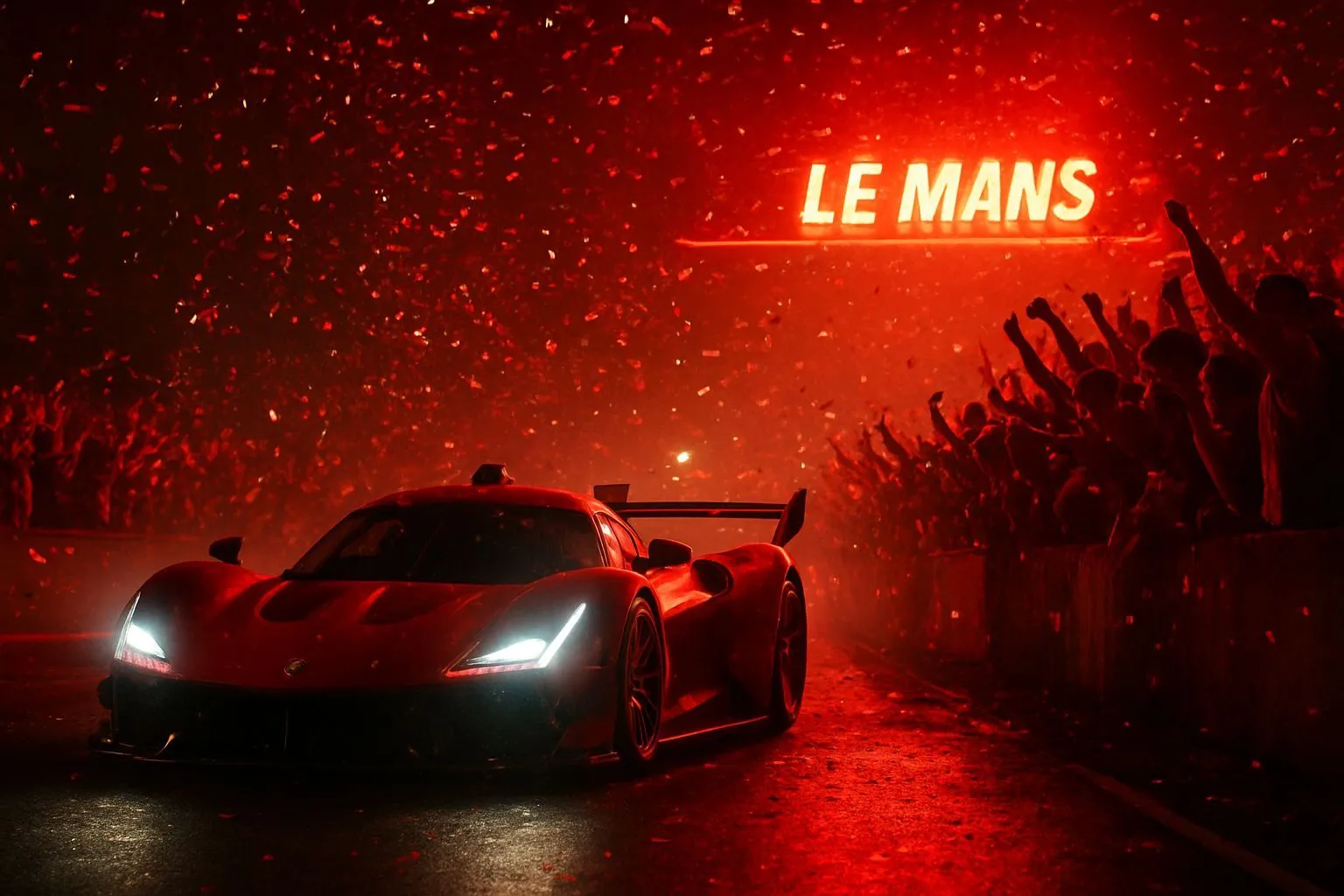
The roaring of engines, the smell of burnt rubber and the vertigo of speed are the primordial elements that have always fed the myth of Le Mans, a race that is not simply a competition, but an epic of resistance, innovation and pure adrenaline. Yet, even in such an intrigued stage of legend, there are moments that surpass the ordinary, undelently sculpting in the history of motorsport. On 12 June 2023 it was one of these days, when Ferrari, after an absence that lasted for fifty years, regained the highest step of the podium at the 24 Hours of Le Mans. It was not a victory, but a triumph that resounded with the power of an ancient prophecy finally accomplished, a return to the origins for a brand that ran its DNA. The atmosphere surrounding the Sarthe Circuit on that historical day was electric, loaded with expectations and a sense of inevitability. For decades, the iconic Cavallino Rampante had been absent from the top class of this motor marathon, leaving a void that no other stable, however dominant, had managed to fill fully. The victory of the Ferrari 499P number 51, guided with mastery and determination by the trio composed by Alessandro Pier Guidi, James Calado and Antonio Giovinazzi, was not only a demonstration of technical superiority or driving skills; it was the reaffirmation of an identity, a strong and clear message sent to the world: Ferrari returned, and its racing spirit is more alive than ever. This article aims to go beyond the simple chronicle of the event, entering into the depths of this historic victory, analyzing the context, challenges, innovations and the lasting impact that the return of Ferrari to Le Mans has had and will continue to have on the world motorsport scene, celebrating not only a success, but the rebirth of a legend.
The Epic Return of a Giant: Ferrari and the 24 Hours of Le Mans of 2023
The history of Ferrari and the 24 Hours of Le Mans is a glorious saga, full of unforgettable triumphs and a legendary rivalry, culminated in the 1960s with epic battles against Ford. Since 1949, the year of his first victory with 166 MM, until 1965, Maranello's Scuderia had accumulated nine absolute successes, forging much of his myth on this circuit. However, after the triumph of 250 LM in 1965, a strategic decision revolutionized the focus of Ferrari, orienting almost all resources and engineering efforts towards Formula 1, the Queen category of motorsport. This choice, while leading to countless successes in the Grand Prix, meant a progressive removal from the top endurance class, with the last official participation in the prototype category dating back to 1973. Fifty years: an eternity in the world of motor racing, a period of time that has seen entire generations of fans grow without ever seeing the Cavallino Rampante fight for the absolute victory at Le Mans. The absence of Ferrari left a void not only in the competition, but also in the collective imagination of racing car lovers, almost as if a fundamental piece of the puzzle was missing. The weight of this fifty-year absence was palpable, a long shadow lying on the brand’s recent history in Le Mans. The news of Ferrari’s official return to the Hypercar class for the 2023 World Endurance Championship (WEC) was welcomed with a wave of enthusiasm and disbelief. It was an announcement that not only promised to inflame rivalry with giants such as Toyota and Porsche, but that brought with it the promise to restore a cosmic order in the pantheon of racing. The task was difficult: not only to adapt to a complex and brutal discipline like endurance, but to do so against already established opponents and with a completely new project. But Ferrari has never been a brand that draws back in front of the challenges, and its DNA is filled with the will to overcome every limit, to prove that its racing spirit is immortal and unparalleled. 2023 was not only a year of return, but the year of redemption, the opportunity for Maranello to demonstrate to the world that his winning lineage at Le Mans was not at all a faded memory, but a flame still burning, ready to spread.
The Birth of the Modern Myth: Ferrari 499P and the Hypercar Class
The heart of Ferrari’s victorious return to Le Mans lies in its futuristic Hypercar, the 499P, a car that embodies the quintessence of Italian engineering and design, driven by the most advanced hybrid technology. Ferrari’s decision to return to the high-level endurance was not random, but strategically aimed at exploiting the new regulations of the Hypercar class (LMH and LMDh), introduced to attract a greater number of manufacturers and to make the competition more relevant also in terms of technological development for road cars. The 499P, presented at the end of 2022, is not a simple evolution, but a creation ex no., the result of years of research and development conducted with the specific objective of winning the 24 Hours of Le Mans and the Endurance World Championship. The name itself, 499P, is a tribute to history: the ‘499’ refers to the engine’s unitary capacity, while the ‘P’ stands for prototype, a reference to the glorious racing cars of the past. Under its aerodynamic and sophisticated body, there is a hybrid engine, consisting of a 3 litre biturb V6 (derived by the 296 GTB engine) mounted in a central-poster position, combined with an electric motor on the front axle, which can deliver up to 200 kW (272 hp). This hybrid system, in addition to providing additional power, allows the car to enjoy an integral traction under certain conditions, giving a significant advantage in terms of power management and traction. The carbon fiber monocoque frame has been developed to maximize stiffness and minimize weight, strictly respecting the limits imposed by the regulation. The aerodynamics, studied maniacally both at the computer and in the wind tunnel, is designed to generate an enormous deportance, essential for stability and speed in the curve, but also to minimize the resistance to advancement on the long straights of Le Mans. Every detail, from air vents to speakers, from wings to appendixes, has been optimized to ensure maximum performance and efficiency. This meticulous engineering approach, combined with the push of a forward-looking business strategy, placed the 499P not only as a vanguard racing car, but as the symbol of a new era for Ferrari in the endurance, an era where tradition merges with modernity to create a new chapter of sports successes.
Strategies and tactics: The Battle of the Sarthe Circuit
The 24 Hours of Le Mans of 2023 was a real battlefield, an exhausting marathon that tested not only the pure speed of the cars, but above all the mechanical resistance, the cohesion of the team and the strategic sagacity of every stable. The Sarthe Circuit, with its 13.6 kilometers long and the unique mix of fast strokes and more technical sections, is notoriously relentless, able to expose every slight weakness. For the Ferrari AF Corse, facing this race meant confronting Toyota’s caliber opponents, defending champion and strong of an unbeatable that lasted for years, and with other giants like Porsche, Cadillac and Peugeot, all determined to leave the mark in the prestigious Hypercar class. Since qualifying, Ferrari has demonstrated its intentions, winning a surprising first row with both 499Ps, an unequivocal signal of its regained competitiveness. But qualifying is only the beginning. The real race began under a plumbean sky, and weather conditions played a crucial role, with intermittent rain breaks that transformed the asphalt from dry to wet and vice versa, putting hard evidence the choices of tires and the sensitivity of the pilots. The strategy has become the key of time: deciding the right time for tire change, the amount of fuel to board, the management of the double turns of the pilots and the optimization of the pit stop have been chosen that have shaped the course of the race. The Ferrari team showed a lucidity and surgical precision in every decision. Despite some tensions, such as punctures or contacts with other cars, the crew of the 499P number 51 maintained constant pressure on the Toyota number 8, which was considered the favourite. The ability to recover soil after every unexpected, the impressive speed in the fast stretches and the stability in the curve allowed Ferrari to remain always in the top positions. The advantage was built round after round, shift after shift, without yielding a millimeter of land. The battle was incandescent until the last, with exchanges of position and moments when the tension was palpable. The bold strategy, the perfect performance of pit stops and the exceptional performance of drivers created the perfect substrate for a triumph that seemed almost predestined, demonstrating that victory at Le Mans is not only a question of speed, but a perfect symphony of engineering, strategy and agonistic spirit.
The Starring: Heroes of a Historical Victory
Behind each big race car there is a crew of exceptional drivers, and the Ferrari 499P number 51 has been no exception. Alessandro Pier Guidi, James Calado and Antonio Giovinazzi were the three heroes who shared the burden and honour to bring the Cavallino Rampante back to the highest step of the Le Mans podium. Each of them has brought the team a unique mix of experience, speed and resilience, creating a perfect synergy essential to face the 24 hours of race. Alessandro Pier Guidi, veteran of the races of duration and already winner of numerous titles with Ferrari in the GT classes, has brought his extensive experience and a thorough knowledge of the Sarthe Circuit. Its ability to manage pressure, maintain a constant pace and make rapid decisions in changing conditions proved fundamental, especially in critical moments of night and rain. Its precise and meticulous guide ensured that the car always remained in optimal conditions, minimizing the risks. James Calado, also a long-term driver in the endurance with Ferrari and teammate of Pier Guidi in many of their GT victories, showed an extraordinary consistency and speed. His ability to keep pace on the ride competitive even with worn tires or in difficult conditions allowed the team to gain valuable ground. His calmness and professionalism were a pillar for the entire team, helping to maintain high morale and concentration. Finally, Antonio Giovinazzi, former Formula 1 driver, brought with him a freshness and determination that gave extra boost to the crew. Its pure speed, resulting from the experience in the highest category of motorsport, has been evident since the first laps. Despite being on his debut in the Hypercar class in Le Mans, Giovinazzi quickly adapted, demonstrating an amazing maturity and mastery of the car. Its ability to pull out the maximum from 499P in each stint played a crucial role in the pursuit of victory. The synergy between these three drivers was exemplary. They were able to support each other, communicate effectively with the box and face any unexpected with a winning mindset. Their performance was not only a demonstration of individual talent, but a testimony of teamwork and total dedication to the common goal. In the margin of this historic victory, it is appropriate to make a statement regarding other drivers who participated in the 24 Hours of Le Mans 2023. In the original text provided, we mention a ‘Topic: Jimmie Johnson Ferrari wins the 24 Hours of Le Mans’. It is important to clarify that Jimmie Johnson, a NASCAR legend, has actually participated in Le Mans 2023, but with the Chevrolet Camaro ZL1 of the Hendrick Motorsports team, as part of the ‘Garage 56’ project, an unclassified experimental entry. He was not behind the wheel of the Ferrari 499P winner of the Hypercar class. This detail is crucial to correctly attribute the merit of the victory to the team and drivers of Ferrari AF Corse. The real heroes of the Cavallino Rampante in that memorable day were Pier Guidi, Calado and Giovinazzi, who with their ability wrote a new chapter in the legend of Maranello.
Behind the scenes: Engineering and Infallible Preparation
The triumph of Ferrari in Le Mans was not the result of a simple stroke of luck, but the culmination of a titanic enterprise that involved hundreds of engineers, technicians and specialists, combined with a program of development and rigorous testing lasted years. The creation of the Ferrari 499P was a millimetre precision operation, where each component, each line, each aerodynamic solution was designed, tested and refined with the unique goal of exceling in the most exhausting of automotive races. Maranello's engineering team had to face immense challenges, starting from a blank sheet to develop a completely new car according to Hypercar class regulations, which balance creative freedom with severe restrictions to ensure equal performance (Balance of Performance – BoP). This required not only oneexpertise mechanics and electronics of the highest level, but also a deep understanding of the dynamics of endurance, where reliability is as crucial as speed. Ferrari has invested considerable resources in advanced computer simulations, using computational fluid dynamics (CFD) to optimize aerodynamics and finite element analysis (FEM) to perfect frame structure and suspensions. These tools have allowed us to identify and solve potential problems before a single component is physically produced. Subsequently, the test phase on track was relentless, with the 499P grinding thousands of kilometers on various circuits, in different climatic conditions, to verify the reliability of each system, the duration of the components and the response of the car to the different setups. Each test session was an opportunity to collect valuable data, which were analyzed and used to make continuous improvements. The management of the hybrid system, in particular, represented one of the most complex challenges. Optimize braking energy recovery and its release to maximize power and efficiency, respecting the limits imposed by the regulation, required an extremely sophisticated calibration work. Moreover, logistics behind an endurance team is itself an engineering company. From the preparation of spare parts to the organization of pit stops, from the telemetry in real time to the communication between drivers and engineers, every aspect has been meticulously planned and tried. The success in Le Mans is, in this sense, the celebration not only of an exceptional car and talented drivers, but of the infallible preparation, of the strategic vision and the tireless commitment of an entire team, whose dedication has transformed an ambitious project into a glorious reality. This shows how Ferrari has never lost its ability to innovate and excel, even after a long period of absence, confirming that its engineering spirit is intrinsic and inexhaustible.
Motorsport Impact: Revitalization of Endurance
The Ferrari victory at the 24 Hours of Le Mans 2023 has had an impact far beyond the single sports result, acting as a true catalyst for the revitalization of the Endurance World Championship (WEC) and the entire world of racing. For years, the endurance had suffered from a certain stagnation, with a limited number of builders in the main class and a predictability in the results that had partly turned off the enthusiasm of the public and professionals. The introduction of the Hypercar Regulation (LMH and LMDh) has been designed to reverse this trend, offering an opportunity for new car manufacturers to come into play with more costs than previous prototype classes, but with the possibility to show cutting-edge technologies, especially hybrid ones, which have a direct relevance for the development of road cars. The entry of Ferrari, a brand with an unparalleled aura and global call, has unequivocally validated the goodness of this new formula. His triumph not only interrupted the multiannual domain of Toyota, but also demonstrated that competition is open, that new challenges are possible and that the emotion of the battle between automotive giants is back. This has generated a huge media resonance, attracting the attention of a wider audience, which perhaps did not follow the WEC assiduously, but which was captured by the epic story of Ferrari’s return. The domino effect is already visible: the interest of other manufacturers to join the Hypercar class has increased exponentially. Brands like BMW, Lamborghini, Alpine, Cadillac and Porsche, in addition to Peugeot and Glickenhaus already present, are deploying or announced the intention to deploy their cars. This influx of talents and resources is turning the WEC into one of the most competitive and fascinating categories of motorsport, promising even more spectacular and uncertain future seasons, with grids of departure rich of prototypes of the highest level. The competition is the salt of sport, and Ferrari has rekindled this flame, ensuring that the next editions of Le Mans and the WEC are battles between some of the most prestigious names of world motor racing. In addition, Hypercar hybrid technology pushes innovation in a sustainability perspective, showing how extreme performance can coexist with energy efficiency, a crucial message in the current era. The return to the success of an icon like Ferrari is not only a sporty fact, but a cultural phenomenon that reaffirms the value of tradition in the context of innovation, pushing the whole sector towards a brighter and more engaging future for fans around the world. His victory redefined expectations, demonstrating that endurance is anything but a marginal discipline, but rather an essential test bench for the future of the automotive and a stage of exciting rivalry.
The Value of the Mark: Ferrari between Mito, Passion and Technology
Ferrari is not only a car manufacturer; it is a global icon, a symbol of Italian excellence, luxury, speed and passion. His identity is inherently linked to racing, since the vision of his founder, Enzo Ferrari, for which the production of road cars was functional to finance sports. The victory at the 24 Hours of Le Mans, after fifty years of absence from the highest category, is therefore not a simple sports success; it is a powerful reassertion of brand identity, a universal message that strengthens every pillar on which the myth of the Rampante Horse is founded. At the level of marketing and prestige, the impact of a triumph in Le Mans is incalculable. Le Mans is considered one of the three most important races in the world, along with the Monaco Formula 1 Grand Prix and the 500 Miglia of Indianapolis, and winning it gives a legend that no other advertising campaign could ever match. For Ferrari, it means adding another golden chapter to a story already rich in successes, reconnecting to a glorious past that many believed confined to history books. This renews the interest in the brand for a new generation of fans and collectors, but also for the current and future customers of the road cars of Maranello, who see in the success on the track a direct confirmation of the engineering superiority and the intrinsic performance of every car that brings the Cavallino Rampante. The victory also demonstrates Ferrari's ability to innovate and compete at the highest technological levels. The 499P, with its cutting-edge hybrid powertrain, is a tangible symbol of Maranello’s commitment to new technologies and sustainability, while keeping intact the extreme performance that is the brand’s trademark. This not only attracts engineering talents, but reassures investors and the market on the ability of the company to adapt to automotive changes without compromising its sporting essence. Passion is the secret ingredient that permeates every aspect of Ferrari, from its workers to engineers, from drivers to fans. The victory at Le Mans triggered a wave of enthusiasm and pride throughout the world, rekindling the flame of passion for millions of fans. It is a triumph that goes beyond the mere result, touching the emotional ropes of anyone who loves cars and racing. The link between the brand, its history, its cars and its people is indissoluble, and successes like that of Le Mans serve to cement this relationship further, making Ferrari not only a company, but a real cultural phenomenon. In summary, the triumph at the 24 Hours of Le Mans 2023 is not only an extra trophy in the Maranello basin, but a powerful tool for strengthening the value of the brand, a strategic investment that will continue to fruit in terms of prestige, reputation, innovation and, above all, in that inextinguishable passion that always makes Ferrari unique in the world.
Lezioni learned e Prospettive Future: The New Age of Le Mans
La storica vittoria della Ferrari a Le Mans non è stata solo la celebrazione di un momento epico, ma ha anche offerto preziose lezioni e ha aperto nuove prospettive per il futuro dell’azienda nel motorsport endurance. Il ritorno dopo cinquant’anni di assenza è stato un test severissimo, e la Ferrari ha dimostrato non solo di essere all’altezza della sfida, ma di poterla dominare. Una delle lezioni più importanti apprese è stata l’importanza dell’affidabilità in un contesto di gara così brutale. Sebbene la velocità pura sia cruciale, è la capacità di una vettura di resistere a 24 ore di sollecitazioni estreme, senza cedimenti meccanici o elettronici, a fare la differenza. Il team di Maranello ha saputo costruire una Hypercar, la 499P, che si è dimostrata robusta e resiliente, un risultato straordinario per un progetto completamente nuovo. Questo successo ha consolidato la fiducia nelle capacità ingegneristiche interne di Ferrari e ha dimostrato l’efficacia del loro processo di sviluppo e test. Inoltre, la vittoria ha messo in evidenza l’abilità del team di adattarsi rapidamente a un ambiente competitivo molto diverso dalla Formula 1. La gestione della gara, le strategie sui pit stop, la gestione del traffico e la capacità di prendere decisioni sotto pressione sono state impeccabili, mostrando una profonda comprensione delle specificità dell’endurance. Questo apprendimento sul campo sarà fondamentale per le stagioni future, permettendo al team di affinare ulteriormente le proprie strategie e di ottimizzare le prestazioni. Guardando al futuro, le prospettive per la Ferrari nel Campionato del Mondo Endurance sono estremamente promettenti. La vittoria a Le Mans non è stata un punto di arrivo, ma un nuovo punto di partenza. Maranello è ora posizionata come una delle contendenti principali per il titolo mondiale, e ci si aspetta che continui a investire nel programma Hypercar per mantenere la sua leadership. La competizione nella classe Hypercar è destinata a intensificarsi ulteriormente con l’arrivo di nuovi costruttori e il miglioramento delle vetture esistenti. Questo significa che la Ferrari dovrà continuare a innovare, sia in termini di tecnologia della vettura che di strategie di gara, per rimanere al vertice. Il lavoro sulla 499P non si fermerà: ci saranno continui sviluppi aerodinamici, aggiornamenti al sistema ibrido e ottimizzazioni del software per massimizzare ogni aspetto delle prestazioni. L’impegno per la sostenibilità e le nuove tecnologie continuerà a guidare gran parte dello sviluppo, con un focus crescente sull’efficienza del carburante e sulla minimizzazione dell’impatto ambientale, in linea con le direzioni future del motorsport e dell’industria automobilistica. La nuova era di Le Mans e del WEC, con la Ferrari di nuovo protagonista, promette di essere una delle più entusiasmanti e tecnologicamente avanzate nella storia delle corse, con battaglie epiche che attendono gli appassionati in ogni circuito del mondo.
Beyond the Race: The Duration inheritance of a Cinquantennal triumph
La vittoria della Ferrari alla 24 Ore di Le Mans del 2023 trascende il mero significato sportivo, trasformandosi in un evento che ha generato un’eredità duratura, capace di influenzare il marchio, il motorsport e l’immaginario collettivo per anni a venire. Non si tratta semplicemente di un trofeo aggiunto alla bacheca di Maranello, ma di un potente simbolo che ha ristabilito un legame profondo tra la Ferrari e la sua storia gloriosa, fungendo da ponte tra il passato e un futuro ricco di ambizioni. Questo trionfo cinquantennale ha dimostrato che la filosofia di Enzo Ferrari, secondo cui l’innovazione e la ricerca della perfezione in pista si traducono in eccellenza stradale, è ancora più che mai valida. La 499P è un laboratorio viaggiante di tecnologie ibride e aerodinamiche che, a lungo termine, potranno trovare applicazione nelle vetture stradali, spingendo avanti i limiti dell’ingegneria automobilistica. L’impatto culturale di questa vittoria è altrettanto significativo. Ha riacceso la passione in milioni di tifosi in tutto il mondo, riaffermando l’immagine della Ferrari non solo come costruttore di auto di lusso, ma come una forza inarrestabile nel mondo delle corse, un simbolo di determinazione e di successo contro ogni previsione. Questo genera un senso di orgoglio e appartenenza che va ben oltre il pubblico tradizionalmente legato al motorsport, catturando l’attenzione di un pubblico più ampio e diversificato. L’eredità di questo successo si manifesta anche nel rinnovato interesse per il Campionato del Mondo Endurance, ora arricchito dalla presenza di marchi iconici e da una competizione feroce. La Ferrari ha contribuito a elevare il profilo del WEC, trasformandolo in un palcoscenico imprescindibile per i costruttori che desiderano dimostrare la propria leadership tecnologica e sportiva. Questo stimolerà ulteriori investimenti, innovazione e, in ultima analisi, gare ancora più spettacolari e coinvolgenti per gli appassionati. In conclusione, la vittoria della Ferrari a Le Mans è più di una semplice gara vinta; è la riaffermazione di un’identità, un tributo alla perseveranza e all’eccellenza, e un faro per il futuro. Ha dimostrato che, anche dopo cinquant’anni di assenza, il Cavallino Rampante non ha perso la sua magia, la sua velocità e il suo spirito combattivo. È la storia di un ritorno glorioso, un monito che la leggenda non muore mai, ma si reinventa, trovando sempre nuove strade per ispirare e stupire. La 499P, con i suoi piloti e tutto il team dietro di essa, ha scritto un capitolo indimenticabile, garantendo che il nome Ferrari sarà per sempre associato non solo a un passato glorioso, ma anche a un presente e un futuro di trionfi a Le Mans e oltre. Questa vittoria sarà ricordata come un simbolo di come la tenacia, l’innovazione e una passione inestinguibile possano portare a risultati straordinari, cementando il posto della Ferrari nel pantheon delle più grandi imprese sportive automobilistiche di tutti i tempi.


