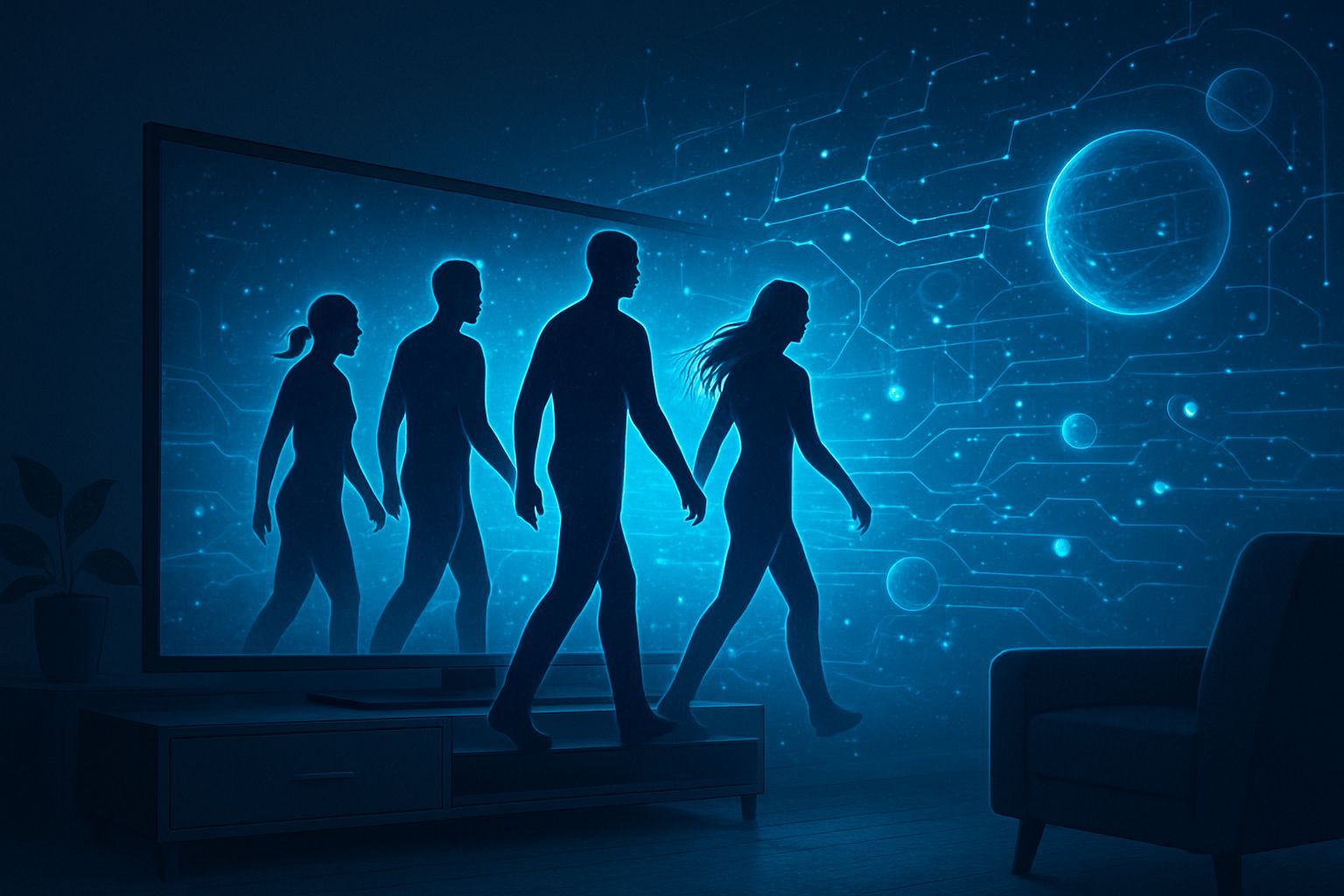
The image of viewers looking at traditional television, sitting on the sofa of the living room at predetermined times, now belongs to an almost archaeological era of media use. What was once the norm, a collective ritual marked by broadcasters’ palimpsests, progressively dissolved in a sea of flexibility and individual choice, an epochal change led by the advent and the overwhelming rise of streaming services. What was once a niche for a few technology enthusiasts, has become a daily and ineludible reality for millions of people around the world, with the United Kingdom which, as pointed out by recent data, represents a flashing example of this mass migration. The possibility of accessing countless content, from Hollywood blockbusters to award-winning TV series, from in-depth documentaries to children’s cartoons, with a simple touch or click, has redefined not only the way we consume entertainment, but has also shaped new habits and expectations. The phrase “Streaming TV while you lay in bed? You're not alone” perfectly captures the essence of this transformation: television is no longer confined to a specific place or a fixed time, but adapts to our lifestyle, following us where and when we want, even in the most intimate comfort of our bed. This shift from a linear and passive transmission model to an on-demand, customized and interactive, triggered a real revolution that touches every aspect of the media sector, from production to distribution, from monetization to final user experience. To fully understand the scope of this phenomenon, it is essential to explore the forces that have fed it, the challenges it has created and the directions it is taking, drawing a medial landscape in constant and rapid evolution.
The Unstoppable Ascese of Streaming: A New Televisive Paradigm
The age of streaming was not born from nothing, but is the culmination of decades of technological advances and changes in consumer expectations. Historically, television has evolved from the analogue transmission via ether, characterized by a limited number of channels and an absolute dependence on the palimpsest, the introduction of the cable and the satellite, which have multiplied the options but maintained the rigidity of the programming. The real turning point came with the advent of high-speed internet and the digitization of content, which opened the way to a completely new model: the on-demand one. Companies like Netflix, initially a DVD rental service via mail, have intuited the potential of this technology, strategically virando towards the distribution of content via streaming. This move was not only a simple technological transition, but a real paradigm shift, offering users unprecedented freedom to choose from what, when and where look. The ability to access vast movie bookcases and TV series with a fixed monthly subscription has eliminated the need for single purchase or rental, making entertainment more affordable and affordable. This model has thrived thanks to several key factors: the growing spread of broadband, which has made streaming a smooth reality even for high definition content; the proliferation of connected devices, from smartphones to tablets, from smart TVs to game consoles, which have made the screen virtually omnipresent; and the insatiable thirst of consumers for original and diversified content. Netflix, with its bold incursion in the production of original high quality content, starting from titles like House of Cards, has shown that a streaming service could compete, and even exceed, the productions of traditional television networks, establishing a new standard for industry and catalyzing an acceleration in the migration of millions of viewers from linear channels to on-demand services. This marked the beginning of a radical transformation that redefined the very concept of ‘television’, transforming it from a physical device to a multifaceted digital service.
Beyond the Screen: The Evolution of Medial Consumption Abitudini
The transformation induced by streaming has not only limited itself to the technological or economic aspect, but has profoundly influenced the habits and behavior of spectators, giving rise to cultural phenomena previously unthinkable. The image of the viewer watching TV from his bed, a gesture of comfort and intimacy mentioned in the original article, is emblematic of this new flexibility. It is no longer a matter of adapting to the palinsest, but it is the content that adapts to our lives, integrating at every free moment of the day, whether it a short trip by metro or a relaxing evening at home. This has fed the culture of binge-watching, the compulsive vision of multiple episodes of a series in rapid succession, a practice that gained popularity thanks to the availability of entire seasons at the time of launch. The binge-watching, if on the one hand it offers an immersive and uninterrupted narrative experience, on the other it raises interesting questions about its psychological and social effects: it can lead to greater involvement with history and characters, but also to potential effects on the attention and sleep-wake rhythms. The impact also extends to family and social dynamics: while traditional TV often served as a hub for family reunion, streaming consumption became more personalized and individualized, with each family member who potentially looks at different content on distinct devices. This does not mean the end of collective consumption, but its transformation into viewing sessions curated according to the specific tastes of the group or the individual. Moreover, the transition from the passive model of the linear TV to the active and curated one of the streaming has given users an unprecedented control, transforming them from simple recipients to real curators of their own entertainment. The platforms, in turn, responded to this customization thirst with increasingly sophisticated algorithms, which analyze vision preferences to suggest relevant content, creating a virtuous circle of discovery and involvement, but also laying the foundations for an experience sometimes too homogeneous and less prone to serendipity.
The War of Streaming: Competitive panorama and Fragmentation of the Market
The overflowing success of Netflix has not gone unnoticed, triggering a real “war of streaming” that has seen the entry of media and technological colossi, eager to grab a slice of this rapidly expanding market. Companies like Disney, with the launch of Disney+, Amazon Prime Video, Apple TV+, HBO Max (now Max), Paramount+ and Peacock, have invested billions in the production of original content and in the acquisition of rights, transforming the landscape from an almost monopoly to a crowded battlefield. This intensification of the competition has led to a fragmentation of the market, with consumers facing a wide range of services, each with its own exclusive catalogue and its price model. If on the one hand this abundance offers an unprecedented variety, on the other it has generated a certain “subscription fatigue” (subscription), with users struggling to manage numerous subscriptions and to draw between different catalogs. To differentiate, streaming providers adopt different strategies: some focus on the vastness of the catalogue (such as Amazon Prime Video, which combines films, TV series, music and other Prime services), others on the exclusivity of iconic brands (Disney+ with its Marvel universe, Star Wars and Pixar), others on film and narrative quality (such as HBO, traditionally renowned for its high-level productions). The battle is also played on the price front, with the introduction of cheaper subscription levels supported by advertising (AVOD – Advertising Video on Demand) to attract a wider audience, or packages that combine more services. The need to acquire and maintain subscribers has pushed platforms to expand their global reach, adapting content and marketing strategies to local markets, but the real challenge remains to offer a perceived value sufficient to justify monthly spending and to loyalty users in an environment where the cancellation (churn) is always around the corner. This fierce competition, while benefiting consumers in terms of choice and quality, also raises questions about the long-term sustainability of so many actors in a potentially saturated market.
Original content and Cinematographic quality: The New Imperative
In the war for the attention of spectators, the content became the real king, and the massive investment in original high quality productions is the new imperative for streaming services. This has given way to what many critics and professionals have defined the “golden age of television”, a period in which serial narrative has reached levels of complexity, ambition and technical production once reserved exclusively to the large screen. Streaming platforms are no longer limited to distributing movies and TV series of other studios; they have become themselves major of production, with budgets that rival, and sometimes exceed, those of traditional film studies. This race to production meant a huge opportunity for creators, directors, actors and crews, attracting top-notch talents that once gravitated almost exclusively around Hollywood. The result is an explosion of diverse content, embracing a wide range of genres – from historical drama to epic fantasy, from irreverent comedy to psychological thrillers – and which often dare to explore more complex and niches of specific audiences, which the generalist television networks, bound by the logic of the share of listening, they were struggling to do. Internationalization of production is another fundamental aspect: serious as Squid (South Korea) or La Casa de Papel (Spain) have shown that non-English content can conquer a global audience, lowering language and cultural barriers and enriching the offer with different narrative perspectives. This not only democratized the use of stories from every corner of the world, but also pushed platforms to invest in local productions to attract specific regional markets, creating a global ecosystem but at the same time deeply rooted. The success of a single original title can have a huge impact on the growth of subscribers, transforming a work of art into a powerful tool for marketing and loyalty, making creative innovation and productive excellence fundamental pillars of the strategy of each streaming service.
The Economic and Social Impact: From Production to Consumption
The streaming revolution has generated a profound and multidimensional economic and social impact, which radiates far beyond simple entertainment. On the economic front, the streaming industry has become a significant growth engine, creating thousands of jobs in sectors ranging from film and television production (writers, directors, actors, technicians, artists of special effects) to technology (software engineers, data experts, network infrastructure specialists) and marketing. The enormous expense for original content and licenses injected billions into the global economy, supporting creative industries worldwide. The main monetization model remains the subscription (SVOD – Subscription Video On Demand), but we are witnessing a growing diversification, with the expansion of services supported by advertising (AVOD) that offer a more economical entry point, and the persistent use of the transactional model (TVOD – Transactional Video On Demand) for the purchase or rental of individual titles. This flexibility in business models allows platforms to reach different audiences and adapt to economic conditions. The impact on traditional broadcasters was significant: the escape of viewers to streaming eroded the advertising revenue of the linear TV and forced broadcasters to invest heavily in their streaming platforms or tighten agreements with industry giants to remain competitive. From the social point of view, if on the one hand the streaming has democratized access to quality content, on the other has highlighted and sometimes sharpened the digital divide, that is the gap between those who have access to a reliable and fast internet connection and who not, leaving behind segments of the population. Moreover, the ability of platforms to influence tastes and cultural trends is immense, being able to launch and make viral stories that reflect or shape public debate. The constant need to produce new content also raises questions about the environmental sustainability of the great productions and the ethics of work in an increasingly demanding sector. In summary, streaming redefined value chains, income flows and power dynamics in the media industry, with long-term consequences that continue to unfold.
Customization and Algoritmi: The Invisible Curator of Our Tastes
At the heart of the personalized streaming experience reside algorithms, real invisible curators who constantly analyze our vision behaviors to suggest content considered of our interest. These complex systems, based on machine learning and artificial intelligence, go far beyond the simple categorization of gender. They take into account a myriad of factors: what titles we have looked at, for how long, at what time, which we have added to our list, which we have evaluated positively or negatively, and even our interactions with content (pause, rewind, jump). By crossing this data with the profiles of millions of other users with similar tastes, algorithms build a predictive model that aims to maximize our viewing time and our satisfaction. The main advantage of this customization is obvious: it allows us to discover new series or movies that otherwise we would never have met, expanding our entertainment horizons and reducing the time spent looking for something to watch. The experience becomes tailor-made, almost sartorial, for each individual user within a family nucleus. However, this omnipresent algorithmic guide is not deprived of potential disadvantages. The most mentioned risk is that of the “filter bottle” (filter) or “echo chamber” (echo chamber), where the algorithm, in an attempt to keep us within what we already know and love, ends up excluding divergent or surprising content, limiting serendipity and discovery outside our default patterns. This could lead to a taste homologation or, worse, to a reduction of exposure to new ideas and perspectives. In addition, important ethical issues arise regarding data privacy and algorithm transparency: to what extent are our choices influenced or manipulated? How are our vision data used? The discussion on the role of AI in content care is intended to intensify, especially with the evolution of models of IA generative which could one day not only recommend, but also contribute to creating customized content, pushing customization to so far unimaginable levels.
The Challenge of Connectivity and Infrastructure: The Digital Subsoil
The entire streaming architecture is based on an invisible but crucial foundation: global network infrastructure and high-speed internet connectivity. Without a robust and capillary network, the promise of on-demand streaming would remain dead letter. The growing demand for high-definition content (HD), Ultra HD (4K) and even 8K, combined with the adoption of advanced technologies such as the HDR (High Dynamic Range) and spatial audio, imposes bandwidth requirements and more stringent connection stability. A single 4K stream can consume tens of megabits per second, and with millions of users who look at the world at the same time, the load on servers and internet backs is immense. This has led internet service providers (ISPs) and governments to invest massively in upgrading infrastructures, with the spread of optical fiber and the development of 5G that represent fundamental steps to ensure the fluidity and quality of streaming experience. However, significant geographical disparities persist: while urban and densely populated areas generally enjoy high-quality broadband access, many rural and less developed areas still suffer from slow or non-existent connections, creating a real “digital divide” in access to modern entertainment. This raises issues of equity and social inclusion. Streaming platforms, for their part, must constantly optimize their video compression algorithms and their content distribution networks (CDN – Content Delivery Network) to minimize latency and maximize efficiency, ensuring that content reaches users with the highest possible quality, regardless of their geographical location. The resilience of the network, the management of traffic during peaks of use (for example, during the launch of a very anticipated series) and cybersecurity are all continuous challenges that require constant investments and innovation, highlighting how the entertainment experience is inherently linked to the technological foundations that support it, a real digital subsoil indispensable for the blooming of this new media ecosystem.
The Future of Streaming: Convergence, Metaverso and New Frontiers
The journey of streaming is far from being finished; on the contrary, it is in a phase of rapid evolution that promises to further redefine the boundaries of entertainment. One of the most marked trends is convergence, i.e. the fusion of different forms of media and technologies. Live events, in particular sport, are one of the next great frontiers for streaming, with platforms that compete to acquire broadcasting rights and offer interactive and personalized experiences that go beyond the simple passive vision. Integration with the world of gaming is another growing sector: the storytelling interactive, where the viewer can influence the plot, is already emerging as a new form of narrative, and the possibility of combining game elements with linear content opens fascinating scenarios. The concept of metaverso, a persistent and interconnected virtual world, suggests a future in which the vision of content could become an even more immersive and social experience, with avatar gathering in virtual environments to watch a movie together or participate in digital events. You will probably also see a consolidation of services, with the creation of “super-apps” or subscription packages that group multiple platforms, to counter fragmentation and membership fatigue. At the same time, the line between premium content produced by large studios and user-generated content (UGC) on platforms such as YouTube and Twitch will become increasingly subtle. Independent creators are already building personal media empires, and their influence could further challenge the traditional model. Augmented reality (AR) and virtual reality (VR) promise to bring entertainment to an unprecedented level of involvement, turning the living room into a portal to fantastic worlds. The future of streaming will be dynamic, with a growing emphasis on interactivity, immersion and extreme customization, shaping a media landscape where the boundaries between entertainment, information and social interaction will become increasingly labile, making every experience of unique and participatory vision.
Regulation, Censorship and Freedom of Expression in the Global Context
The global expansion of streaming services, while leading to greater accessibility of content, has raised complex issues related to regulation, censorship and freedom of expression, challenging national regulations designed for traditional and localized media. Working in hundreds of countries, the platforms have to navigate a labyrinth of extremely different laws and cultural sensibilities. A film or series considered acceptable in one nation may be considered offensive, inappropriate or even illegal in another. This requires streaming providers the difficult choice between adapting their catalogues to each single market, potentially limiting the global availability of certain securities, or risking fines, blocks or disputes. The question of censorship is manifested in various ways, from the cutting of specific scenes to conform to local moral or religious standards, to the complete removal of works that touch taboo or politically sensitive topics. This creates a debate on the responsibility of platforms as guardians of freedom of expression against the need to respect sovereignty and local laws. Another critical aspect is piracy and copyright protection in the digital age. The ease with which content can be copied and redistributed illegally represents a constant threat to rights holders and economic sustainability of industry. Platforms invest enormous resources in the fight against piracy, but the global and decentralized nature of the internet makes the challenge difficult. In addition, many governments are introducing regulations to promote the production of local content, imposing investment shares or catalog requirements for streaming services operating on their territory, with the aim of supporting the national audiovisual industry and preserving cultural identity. The responsibility of the platforms for the dissemination of misinformation or harmful content is another area of increasing concern, pushing legislators to explore new regulatory models to ensure that these technological giants operate ethically and responsibly, balancing freedom and security in an increasingly interconnected and complex global context.
Conclusions: A Medial Landscape in Costante Remodeling
The transformation of television consumption, from a passive activity and bound to an active, personalized and ubiquitous experience, is one of the most significant cultural and technological revolutions of our time. Starting from the intuition that spectators wanted to watch “Streaming TV while you lay in bed“, the industry responded with incessant innovation, redefining not only the way we interact with entertainment, but also the economic, social and infrastructural dynamics that support it. The rise of streaming services, led by pioneers like Netflix, has catalysed an unprecedented expansion in content offering, pushing narrative and productive quality to new leadership and democratizing access to stories from every corner of the world. This evolution has however triggered a fierce competition, which has fragmented the market but has also generated an abundance of choices for the consumer, albeit with the risk of “subscription fatigue”. The impact of this revolution is palpable in every aspect of society: it stimulated economic growth and technological innovation, but it also poses crucial questions on data privacy, on the role of algorithms in shaping our tastes, on digital divide and on the need to balance freedom of expression with local regulations and the responsibility of platforms. The future of streaming is an unexplored and fascinating territory, characterized by continuous convergence with other forms of media, the exploration of metaverts and immersive experiences, and the constant challenge of a global infrastructure that must evolve to support a rapidly growing demand. While the medial landscape continues to remodel at dizzying speed, one thing is certain: the ability to tell stories and the human thirst to connect through them will remain at the center of this incessant evolution, promising a future of entertainment ever richer, interactive and, above all, tailored for every single viewer.


