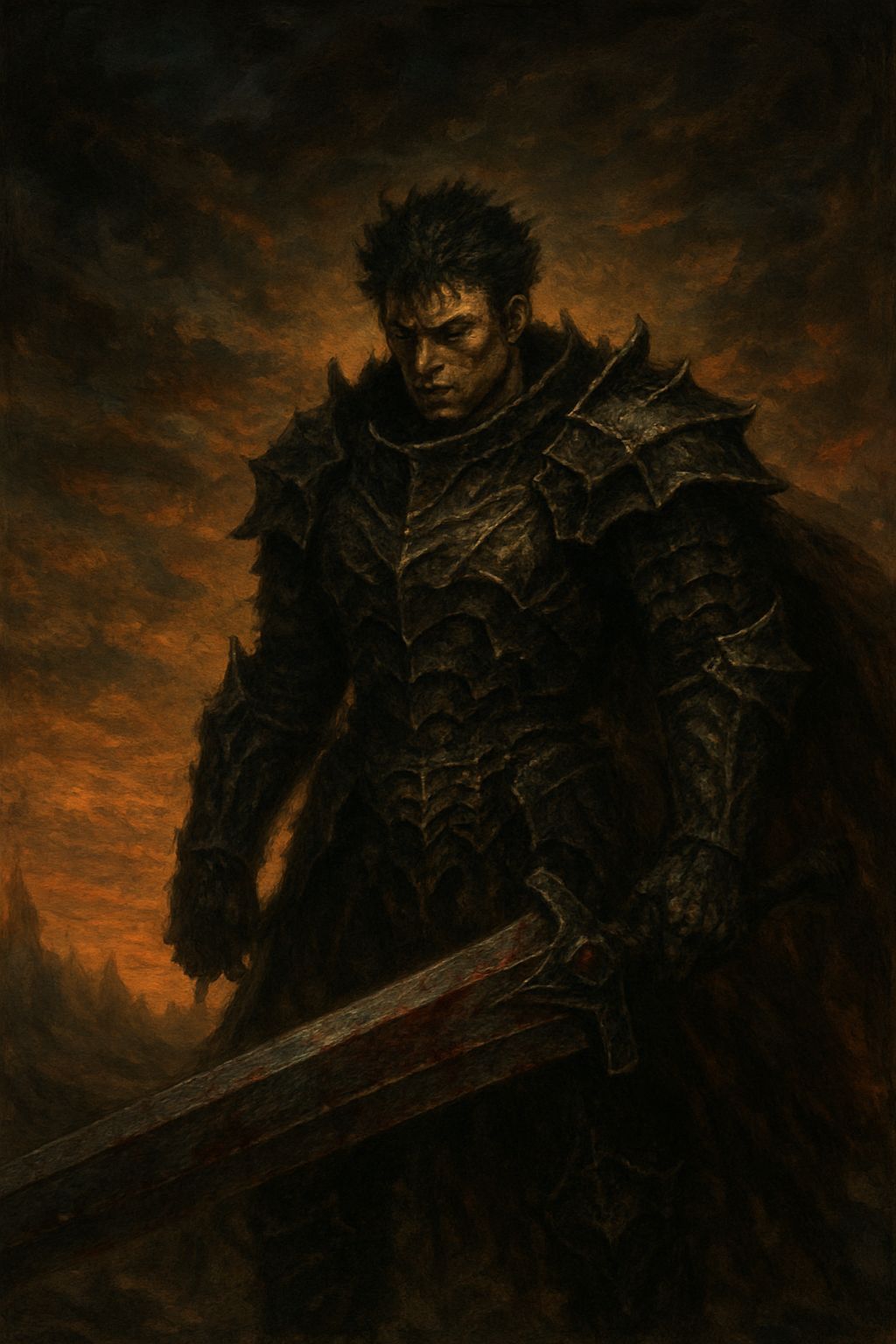
Berserk, the epic dark fantasy created by the genius Kentaro Miura, is not only a manga; it is a pillar of the collective imagination, a work that has redefined the genre and influenced countless artists, writers and developers of video games. Its raw narrative, deep and complex characters, incredibly detailed art and the ability to explore the darkest depths of the human soul, but also the unwavering strength of hope and friendship, make it an unforgettable experience. However, for new viewers or for those who want to enter this universe, the panorama of its animated transpositions can appear fragmented and even a little confused. Several adaptations, made in different eras and styles, tell segments of Guts' vast history, the black warrior, and its endless struggle against cruel destiny and supernatural forces. From the historical TV series of 1997, venerated for its fidelity to the original tone and the disturbing atmosphere, to the most recent film trilogy de The Golden Age and the 2016-2017 series, until recently Memorial Edition, each incarnation offers a different perspective and, sometimes, a swinging quality that has divided the public. This article aims to make clarity, not only by pointing out where and how to look at every animated adaptation of Berserk, but also providing a comprehensive guide to the most coherent vision order, analyzing the distinctive features of each production and, above all, deepening the cultural context and indelible heritage that Kentaro Miura left us. Our goal is to allow you to fully appreciate this extraordinary saga, navigating through its different forms and discovering why Berserk is much more than a simple soul or manga: it is a cathartic experience, a journey into abyss and resilience, a work that, even today, after decades of its first publication, continues to resonate deeply in the minds and hearts of its readers and spectators. Prepare to take the Dragon Slayer and take a path without compromise in the world Berserk.
The Dark Heritage of Kentaro Miura: A Timeless Labour
Before immersing ourselves in the nuances of its animated transpositions, it is imperative to recognize that Berserk, in its original form of manga, is the pulsating heart of this epoeia. Kentaro Miura, with his artistic and narrative mastery, sculpted a work that transcends the boundaries of the Japanese cartoon, rising to a true monument of dark fantasy literature. Started in 1989, the manga Berserk is an intrigued narrative of brutality and beauty, horror and hope, which follows the events of Guts, a lonely warrior marked by a traumatic past and the constant threat of demonic entities. His journey is a search for revenge and, at the same time, a fierce struggle for survival and to protect what was dear to him. Miura was a maniacal artist in the care of details: every table of Berserk is a masterpiece of ink and shadows, with vast and desolate landscapes, grotesque and imposing creatures, and expressive characters that communicate complex emotions without need of words. His art was not limited to visual representation; it was functional to narrative, immersing the reader in a ruthless but incredibly vivid world. The themes addressed are universal and profound: destiny against free will, the nature of evil, corruption of power, the meaning of friendship and betrayal, the fragility of human psyche in the face of trauma and the inexorable force of resilience. Miura has never escaped from the representation of extreme violence and purer horror, but has done so with a precise purpose: to show the dishumanization that war and despair can bring, and at the same time to exalt the spark of humanity that persists even in the darkest abyss. The influence of Berserk extends well beyond the world of manga and anime, having inspired video games as Dark Souls, Bloodborne and Elden Ring, movies, books and other fantasy works that have taken up atmospheres and archetypes. The disappearance of Kentaro Miura in 2021 left an undeniable void, but his work continues thanks to the commitment of his assistants at Studio Gaga and his friend Kouji Mori, who assumed the burden of completing the story based on the directives and notes left by the master. This ensures that the inheritance of Berserk, with its narrative complexity and its thematic depth, will continue to be celebrated and discovered by new generations, confirming its timeless masterpiece status and providing the ineludible basis to understand any animated adaptation.
Decipher the Souls of Berserk: The First Series (1997) and its Range
When talking about animated adaptations Berserk, the 1997 TV series, produced by OLM (Oriental Light and Magic) and directed by Naohito Takahashi, is often considered the canonical version and most loved by old-time fans. Composed of 25 episodes, this series has the merit of introducing for the first time the disturbing and fascinating world of Miura to a global audience. While starting with a short taste of the narrative arc of the Black Warrior, most of the series focuses entirely onGolden Epoch (Golden Age Arc), recounting the rise and tragic fall of the Hawk Band and the complex relationship between Guts, Griffith and Casca. Its strength lies in the fidelity to the tone of the manga: animation, although dated to today’s standards, is mainly traditional, with an emphasis on the expressions of the characters and the oppressive and bloody atmosphere that permeates the original work. Directing manages to capture the psychological tension and brutality of events, without overburdening violence or despair. But what elevates the 1997 series to a higher level is undoubtedly its soundtrack, composed by the legendary Susumu Hirasawa. His tracks, in particular ‘Guts’, ‘Forces’ and ‘Tell Me Why’, they have become iconic, able to perfectly evoke the epic greatness and intrinsic melancholy of history. They contribute fundamentally to creating a unique atmosphere, helping to make many unforgettable moments. The series ends abruptly with the Eclipse, leaving spectators with a chilling finish and without an immediate animated continuation, an aspect that has fueled fan desire for decades. Although it does not cover the whole saga and omets some minor and subtrame characters (such as the initial Puck), the 1997 series is an excellent and highly recommended introduction for those who want to perceive the most authentic spirit of the manga. As for vision, in Italy you can recover this pearl through Amazon Prime Video. However, it is not included in the basic subscription, but requires subscription to Prime Video Channel “Anime Generation”. This additional channel has a cost of €4.99 per month, but offers a free trial period of 7 days, allowing you to immerse yourself in Golden Age without initial costs and understanding if the aesthetics and narrative of the series do to your case. First Video is paid (49.90 euro/year or 4.99 euro/month) and offers many other benefits, including fast shipping and other streaming services. To activate the vision, just try Berserk on Prime Video, locate the 1997 series and activate the Anime Generation channel, following the instructions for the trial period and any subscription. Remember that, as with each subscription service, you can turn off the channel at any time if you decide not to continue.
Berserk: The Golden Age – The Cinematographic Trilogy (2012-2013) and the Birth of a New Animate Era
Fifteen years after the 1997 series, Berserk is back on the big screen with a new interpretation ofGolden Epoch in the form of a film trilogy: Berserk – The Golden Age – The Egg of the Dominant King (2012), Berserk – The Golden Age – The Battle of Doldrey (2012) and Berserk – The Golden Age – The Advent (2013). Produced by Studio 4°C and directed by Toshiyuki Kubooka, this trilogy has been an ambitious attempt to reproduce the saga with modern animation techniques, combining traditional 2D animation with a massive use of computer graphics (CGI). The goal was clearly to offer a more cinematic and visually spectacular experience, reaching a wider audience that perhaps was not familiar with the manga or with the previous series. Visually, the trilogy presents moments of great impact and smooth action scenes, especially in large-scale battles, where the CGI has allowed to represent the vastness of the armies and the brutality of the clashes in a dynamic and engaging way. The artistic direction tried to remain faithful to the design of the characters and settings of Miura, although with a more glossy and less crude interpretation than the anime of ’97. However, the predominant use of CGI has provoked conflicting reactions. While some appreciated the modernization and fluidity of animations in certain sequences, others found the often rigid and unnatural CGI, in particular in character movements and facial expressions, which sometimes appeared less organic and loaded with pathos than traditional animation. The film format also imposed narrative compromises: to condense the whole Golden Epoch in three films of limited duration, numerous dialogues, scenes and secondary characters were inevitably cut, sacrificing part of psychological development and sub-tractors that enrich the manga and, to a greater extent, the 1997 series. This has led to a tighter pace but, for some, also to a less emotional depth and a less faceted understanding of the characters and their motivations. Despite these criticisms, the trilogy had the merit of rekindling the spotlight on Berserk and bring theGolden Epoch a new generation of fans with an updated aesthetic. When I write, the cinema trilogy de The Golden Age is not available for streaming on major platforms. The only way to look at it in Italian is through the purchase of Home Video editions, such as DVD or Blu-Ray boxes, easily available on the main online stores as Amazon or eBay UK. It is advisable to keep an eye on digital rental platforms and purchase as CHILI or search engines like JustWatch, where you can add titles to a “wishlist” to receive notifications when they become available in streaming or for digital purchase. This indicates that, despite the digital age, for some historical content or with complex licenses, physical support remains the most reliable option and, sometimes, the only one.
The Controvert Return: Berserk TV Series (2016-2017) and the Difficult Adaptation Challenge
After the film trilogy, the thirst for an animated continuation for Berserk was palpable, but the wait was translated into one of the most controversial productions in the history of anime adaptations. TV series Berserk produced between 2016 and 2017, with a total of 27 episodes divided into two seasons, they resumed the narrative immediately after the events of the Eclipse, covering the arc of the Black Warrior (though not linear and fragmented), theArch of the Condanna (Conviction Arc) and part of theArco del Millennio Falcone (Falcon of the Millennium Empire Arc). The expectation was very high, but the technical realization failed much of the fanbase. The most critical element was the almost exclusive use of the low-budget (CGI) graphics computer, often rigid, little detailed and with animations that were struggling to capture the fluidity and expressiveness of the Miura tables. The result was a visual aspect that, in many moments, appeared amateur or unfinished, with characters moving in a robotic way and a general feeling of plasticity. The artistic direction and photography were also critical, with a palette of often flat colors and a management of the frames that could not enhance the drama of the scenes. The infamous sound effect 'CLANG', used for every impact of the Dragon Slayer, has become a symbol of questionable production choices, contributing to an audio experience that many found repetitive and uninspired. Despite the obvious technical gaps, the series had the merit of continuing the narration of manga in points never touched by the previous adaptations, introducing beloved characters like Puck, Isidro, Farnese and Serpico, and deepening the path of Guts after the Eclipse, his fight against the Apostles and his search for revenge. There were rare moments when the series managed to capture fragments of the magnitude of Berserk, in particular in quieter sequences or in some well adapted dialogues, but these episodes have often been blurred by technical difficulties. It is an adaptation that deeply divided the audience, leaving a bitter taste to many long-time fans who hoped for a transposition to the height of the original material. However, for those who want an animated continuation of events after the Eclipse, these two seasons remain, for now, the only option. For viewing TV series Berserk of 2016-2017 and the Memorial Edition, the reference streaming service is Crunchyroll. Crunchyroll is a leading platform in the world of souls. To access it is necessary to sign up for a subscription, with options starting from 4.99 euros per month (Fan Plan) which includes a free trial period of 14 days for new users. It is important to note that the series are available in the original Japanese or English language, with subtitles in Italian, a choice that could not please those who prefer dubbing. Registration is simple: just connect to the Crunchyroll website, search Berserk, select the desired season and start the free trial by entering the required data and a payment method. Here too, the cancellation is easily manageable through your account.
Berserk: Memorial Edition (2022) – A Bridge Between Past and Future
In response to the desire of many fans of an adaptation ofGolden Epoch that it was more in line with expectations and that could integrate some of the moments cut by the original film trilogy, in 2022 was released Berserk: Memorial Edition. This new TV series, consisting of 13 episodes, is not a completely new production, but rather a reworking and expansion of the 2012-2013 animation film trilogy. The idea behind the Memorial Edition was to offer a more complete and cohesive version ofGolden Epoch, using the same animations of the trilogy but reintegrating significant scenes that had previously been cut for cinematic malnutrition needs. These additional fragments, which include dialogues, interactions between characters and crucial moments for the development of the plot and characterization, contribute to a greater narrative depth. In addition Memorial Edition has benefited from a new audio mix and, in some cases, an improvement in visual quality, trying to mitigate some of the criticisms addressed to the original CGI of the films. The insertion of new sequences and the subdivision in television episodes allowed a more relaxed pace, closer to that of a traditional TV series, allowing spectators to better absorb the narrative and appreciate the nuances of the characters. This adaptation was welcomed with greater favor than the 2016-2017 series, as it showed a commitment to trying to improve an existing product and responding, at least in part, to fans' wishes. Although it cannot match the loyalty and atmosphere of the 1997 series for purists Memorial Edition stands as the best animated option for those who want a complete vision ofGolden Epoch with a more modern aesthetic and a more smooth and detailed narrative than the individual films. Ideal bridge for newcomers who prefer a contemporary animation and want to explore the most famous and crucial part of the saga Berserk in a more digestible format. Its existence also underlines the continuous commitment to honor Miura’s work and to try to find the right balance between the artistic needs and the expectations of the public. Also for Berserk: Memorial Edition, the reference platform for streaming is Crunchyroll. Users with a Premium subscription can access and enjoy this revisited version of theGolden Epoch with subtitles in Italian. Crunchyroll’s approach to making these updated versions available demonstrates its centrality as a hub for anime enthusiasts, offering consolidated access to different iterations of iconic works. So, if you are already enrolled in Crunchyroll for the 2016-2017 series, you will already have access to this improved version of the Golden Age.
The Definitive Guide to the Berserk Vision Order: A Path Between Manga, Anime and Film
Navigate through the various adaptations of Berserk it can be a difficult task, but establishing a coherent vision order is essential to better appreciate the depth and evolution of the plot. There is no universally recognized “perfect order”, since each choice involves compromises, but we can outline different strategies based on your preferences and your level of familiarity with the work. The core of each recommendation remains, however, the manga of Kentaro Miura, which is and will always be the definitive and most complete source. Although the natural starting point isGolden Epoch, its animated transpositions offer different entrance doors. One of the most common and appreciated strategies by long-time fans is: 1. Berserk (Series TV 1997): Start with the original TV series. Despite its 25 episodes only cover theGolden Epoch, its traditional animation style, the oppressive atmosphere and the iconic soundtrack of Susumu Hirasawa offer the most faithful experience to the manga tone. This series also includes some initial moments of the Black Warrior arch as a flashback, giving an idea of the future Guts. End with the Eclipse, leaving a powerful cliffhanger. It is available on Prime Video via the Channel “Anime Generation”. 2. Berserk: Memorial Edition (TV series 2022): After the series of ’97, you might want to deepen or review theGolden Epoch with a more modern animation and a slightly larger narrative. The Memorial Edition reworks the 2012-2013 films in 13 episodes, reintegrating cut scenes and improving audio. It offers a more complete and visually updated version of the most famous arch, although with the CGI style that may not please everyone. It is available on Crunchyroll. Alternatively, you can choose one of the two options forGolden Epoch, not necessarily both, depending on whether you prefer classical or modern aesthetics. The original films of 2012-2013, as mentioned, are difficult to find in streaming. 3. Berserk (TV series 2016-2017): After seeing theGolden Epoch in one of its animated incarnations, you can proceed with the 2016-2017 series, available on Crunchyroll. These seasons resume history directly after the Eclipse, covering theArch of the Condanna and part of theArco del Millennio Falcone. It is important to prepare for the animation style completely in CGI that has generated many discussions, but it is the only animated adaptation that continues the narrative beyondGolden Epoch. Essential Council: Integrate with the Manga. Regardless of the chosen order of vision for souls, the strongest and most definitive recommendation is of read the manga of Kentaro Miura. No animated adaptation managed to capture the completeness, depth and majesty of the original work. The manga covers all the events, includes characters and subtractors cut, and allows you to appreciate the incredible art of Miura without compromising adaptations. Many fans recommend reading the manga before any soul, or at least using it to fill the narrative gaps between one series and the other. The manga of Berserk is the ultimate and indispensable experience for every real enthusiast. Starting with reading, you will have a complete picture and it will be easier to appreciate the qualities and defects of every animated adaptation as an extension or interpretation of the original work. The suggested order aims to offer the smoothest and most consistent narrative possible for those approaching the world of Berserk through animation, but with the awareness that the complete path is only found between the pages of master Miura.
Themes Deep and Cultural Impact: Why Berserk Continues to Respect in Our Souls
Beyond the brutality of his battle scenes and the horror of demonic creatures, Berserk is a deeply thematic work that continues to reflect in our souls for its ability to explore the most complex facets of human experience. The heart of Berserk beats around a few, powerful, narrative and philosophical pillars. The first and perhaps most obvious is the conflict between destiny and free will. Guts is a man who fights against a pre-ordered and cruel destiny, symbolized by the sacrificial brand and the constant threat of the Apostles. His is a constant struggle to forge his own path, refusing to be a pawn in a divine or demonic game. This quest for self-determination, although often futile and painful, is what makes it such a powerful and relationable character. Another central theme is trauma and resilience. Each character in Berserk is marked by a past of unimaginable pain. Guts, Casca, Rickert, Isidro, Farnese, all bring deep scars, both physical and psychological. The work explores how trauma can shape an individual, leading to despair, madness or, on the contrary, to an indomitable force of mind. The resilience of Guts, who, while driven by the desire for revenge, also seeks to protect his new companions, is a beacon of hope in a world without mercy. Theambition and corruption of power are beautifully embodied in the figure of Griffith. His staggering ascent and subsequent sacrifice to realize a great dream raise deep ethical issues: how much are you willing to lose, or sacrifice, to achieve your goals? His transformation into Femto represents the apex of corruption and the loss of humanity in the name of an egoistic and absurd ambition, a sharp comment on the very nature of power. Thefriendship and betrayal are equally central, defining the emotional core ofGolden Epoch. The link between Guts, Griffith and Casca is the engine of history, and its traumatic dissolution is the catalyst for all subsequent events. The dynamics of these relationships are explored with a rare complexity, showing how love, admiration and loyalty can turn into hatred, resentment and betrayal with devastating consequences. Finally, Berserk is a work on brutality of war and the search for humanity. The world of Miura is a place of constant conflict, where life has little value and violence is on the agenda. Yet, in the midst of all this horror, the characters seek moments of peace, of human connection, of purpose. Guts' journey becomes less and less a mere revenge and more and more a search for a place in the world and a reason to live. The cultural impact of Berserk is monumental. He cemented the genre of dark fantasy in manga and anime, opening the way to more mature and complex works. As mentioned, its influence is evident in videoludic masterpieces such as the series Souls (Demon’s Souls, Dark Souls, Bloodborne, Elden Ring) FromSoftware, which draw heavily on aesthetics, atmospheres and archetypes Berserk, from heavy armor to gigantic swords, from horrible creatures to decaying kingdoms. He has influenced Western fantasy writers and artists of all kinds, demonstrating that even the darkest stories can contain a deep emotional and philosophical resonance. Berserkultimately, he continues to speak to us because he explores the shadow areas of human experience with a sincerity that is striking, offering an epoeia that is both a celebration of the strength of the human spirit and a warning against its fragility, making it an immortal and infinitely relevant work.
In conclusion, to enter the world of Berserk it is a journey that requires patience and discernment, but which rewards enormously with one of the most powerful and influential narratives ever created. We explored the different paths leading to this epic dark fantasy, from the first, acclaimed, animated iterations to the most recent and controversial, trying to shed light on their predictions and defects, and guiding you through a path of vision that we hope will help you. We highlighted how the 1997 TV series, available on Prime Video through the channel Anime Generation, remains a reference point for the atmosphere and fidelity to the original tone, while covering only theGolden Epoch. We analyzed the 2012-2013 film trilogy, an ambitious attempt to modernize theGolden Epoch with CGI, available only in Home Video, and its improved version, the Berserk: Memorial Edition of 2022, which reworks movies in a more complete TV series on Crunchyroll. We did not miss the controversial 2016-2017 series, also on Crunchyroll, which, despite the criticism of animation, represent the only direct animated continuation of post-Eclipse events. However, the strongest and most indispensable recommendation, as we have pointed out several times, is to consider the manga of Kentaro Miura as the ultimate and unsurpassed experience. Any animated adaptation, however faithful or ambitious, cannot match the depth, complexity and meticulous art of the original work. Use souls as a complement, as a visual and auditory access door, but allow the manga of Miura to guide you through the complete narrative, without compromise, and to make you fully appreciate the greatness of this story. Whether you are neophytes or veterans, the saga of Guts, Griffith and Casca offers a deep reflection on human nature, destiny and resilience, leaving an indelible mark in the imagination of anyone who dares to immerse himself in his pages or his frames. His legacy, continued with devotion after the master’s disappearance, ensures that the “Black Warrior” will continue to hold his Dragon Slayer and make way through darkness for generations to come. That your journey into the world Berserk rich in discoveries and intense emotions. Good reading and good vision!


