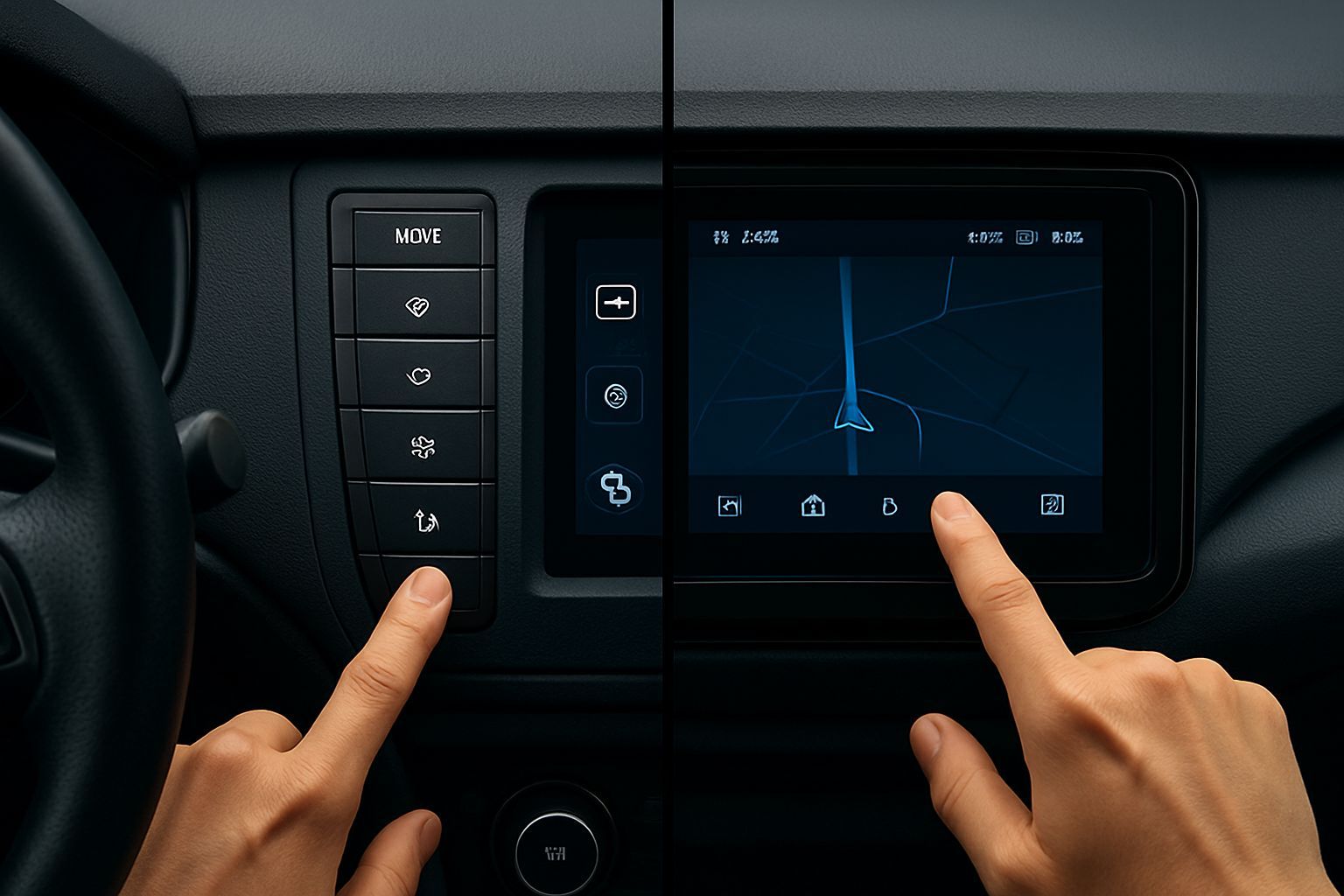
In the age of ubiquitous digitalization, the cabin of our cars has become a sanctuary of tactile controls and immediate to a futuristic cockpit, dominated by glossy screens and complex user interfaces. This evolution, if on the one hand it promises a refined aesthetic and unprecedented flexibility, on the other it raises deep questions about ergonomics, safety and, ultimately, about the relationship between man and machine. The question is no longer just an aesthetic preference, but a fundamental discussion on human factors: how humans interact with systems, which are cognitive and perceptive limits, and how the interface design directly affects their ability to operate safely. The decision of the U.S. Navy to reject touchscreens in favor of physical controls for critical systems, citing the reports of the National Transportation Safety Board (NTSB) on excessively complex systems, acts as a significant alarm bell. If an organization that manages some of the most sophisticated and dangerous machinery in the world recognizes the inherent dangers of excessive dependence on touchscreens, should we, as a society, carefully reflect on the application of such design philosophies in the vehicles we drive every day? The automotive industry is at a crossroads, where the impulse to innovation must be balanced with the deep understanding of human needs and capabilities, especially when the stake is life itself. This article aims to explore this dichotomy thoroughly, analyzing the rise and potential decline of touchscreens, the crucial role of advanced research in driving simulators, and outlining a path towards conveying interfaces that are not only avant-garde, but above all safe and intuitive, ensuring that technology serves the driver, and not the contrary, in a constantly evolving world towards autonomous and connected driving. We will explore cognitive challenges, security implications and possible solutions for a future where human-machine interaction is increasingly harmonious and effective.
L'Ascesa dei Touchscreen: Aesthetic Against Ergonomics
The massive integration of touchscreens in modern cockpits was not a random phenomenon, but the result of a confluence of aesthetic, economic and marketing factors that led manufacturers to a minimalist and futuristic aesthetic. The idea of a clean dashboard, almost free of physical buttons, immediately attracted consumers looking for a ‘premium’ and ‘technological’ experience, reflecting the omnipresence of smartphones and tablets in everyday life. Touchscreens offer unparalleled design flexibility: a single screen can host a myriad of functions – navigation, infotainment, air conditioning, vehicle settings – which would otherwise require dozens of buttons and knobs. This has allowed manufacturers to reduce production costs, simplify assembly processes and update functionality through software, offering the possibility of dynamic customization and new after-sales features. The promise was of a adaptable interface, always updated and intuitive, almost a large smartphone integrated in the car. However, this innovation rush has often neglected the fundamental principles ofcognitive ergonomics and road safety. The lack of tactile feedback is perhaps the most critical defect: with a physical button, you can feel the ‘click’ or resistance, knowing that you have activated a function without diverting your gaze from the road. With a touchscreen, you need to look at the screen to locate the virtual ‘pulsante’, make sure to press it correctly and visually verify the activation. This seemingly trivial process significantly increases the time when the driver's eyes are far from the road, even for a few seconds, which at highway speed translate into hundreds of meters 'blind' paths. Scientific studies have shown that the average time needed to complete a simple task (such as changing radio station or adjusting temperature) can triple or quadruple with a touchscreen compared to physical control. This increase in cognitive load and of the visual distraction is in direct conflict with the primary objective of the guide: to keep the attention on the road environment. Designers, in an effort to make interfaces more intuitive, have often created nested menus and abstract icons that require greater learning and attention, transforming simple tasks into frustrating digital dexterity exercises. The charm of minimalist aesthetics has thus clashed with the reality of the human need for rapid, reliable and, above all, safe interactions while driving a moving vehicle.
Security verdict: From NTSB Reports to Daily Experience
The safety implications related to excessive touchscreen dependence in the vehicular interfaces have not been confined to the realm of ergonomic theory, but have emerged overwhelmingly through incident reports, academic studies and the daily experience of millions of drivers. The call to the decision of the United States Navy to favor physical controls for critical systems is not an isolated case, but reflects a growing awareness by regulatory and security bodies. In particular, the National Transportation Safety Board (NTSB) in the United States expressed significant concerns, attributing in different road accidents to distractions caused by complex and touchscreen-based infotainment systems. These reports are not limited to indicating distraction as a general factor, but deepen how distractionarchitecture itself the interface can induce the driver to deviate attention from the road for dangerously long periods. The main problem is the time of ‘off-road eyes’ (Eyes-Off-Road Time, EORT). Only one second distraction at 100 km/h means to travel almost 28 meters without full awareness of the surrounding environment. Many touchscreens require complex gestures, navigation through multiple menus and a touch accuracy that is difficult to maintain on a disconnected road or during a maneuver. The tactile feedback, present in physical buttons, allows the driver to operate ‘muscle memory’, keeping his eyes on the road. Without it, each interaction becomes a micro-test of visual and motor dexterity. A flashing example is the regulation of air conditioning or audio volume, tasks that should be performed almost subconsciously. On many modern vehicles, these actions require you to tap an icon on the screen, sometimes even to navigate a submenu, then scroll or tap repeatedly. This fragmentation of attention results in an increase in cognitive load, where the driver's brain is forced to divide the resources between the primary task of driving and the secondary task of interacting with the infotainment system. The result is a lower ability to perceive dangers, react to unexpected or process crucial information on traffic. The decision of the Navy, operating in high-stress environments where every millisecond and every error can have catastrophic consequences, emphasizes the importance of interfaces that allow rapid, reliable and unambiguous interaction. If fighter pilots or ship commanders require tactile and immediate controls to operate critical systems, it is legitimate to ask why common drivers are required to face similar or even higher digital complexity, driving a car on busy roads. This debate is therefore not a question of technological retrogardism, but a need for intrinsic safety based on established principles of human-machine interaction in dynamic and potentially dangerous environments.
Science Behind the Interface: The Role of Advanced Simulators
To understand and mitigate the risks of complex user interfaces, industry and research increasingly rely on sophisticated tools: advanced driving simulators. These are not simple video games, but complex mobile laboratories, such as National Advanced Driving Simulator (NADS) in Iowa, which costs 80 million dollars and represents a cutting-edge research infrastructure. The NADS and similar structures are designed to replicate with an extraordinary fidelity the driving experience in a wide range of scenarios, from urban highways to country roads, in different weather and traffic conditions. They use hydraulic motion platforms that simulate acceleration, braking, curves and even road vibrations, real vehicle cabins and 360-degree projection systems that completely envelop the driver in a hyperrealistic virtual environment. Within these controlled environments, researchers can conduct rigorous studies on human behavior, impossible to replicate safely on the road. They can accurately measure parameters such as driver reaction times, visual attention througheye tracking (ocular tracing), cognitive workload through biometric sensors and specific questionnaires, and the effectiveness of different user interface design. For example, an experiment can directly compare the safety and efficiency of a touchscreen-based infotainment system compared to one with physical controls for the same function, in critical traffic conditions or during emergency maneuvers. Simulators also allow to test drivers’ reactions to rare or extreme risk scenarios, such as the sudden emergence of an obstacle, the transition between human and autonomous driving, or the management of critical alerts from ADAS systems. This ability to manipulate variables, control the environment and collect objective data is essential to identify weak points in interface design and develop safer and more intuitive solutions before they are implemented in real vehicles. The data collected in these simulators are very valuable to inform the design guidelines for manufacturers, to guide safety regulations and to provide a scientific basis for discussions on human factors. Their role is irreplaceable in shaping the future of vehicle interfaces, ensuring that technological innovation does not compromise security, but rather the elevi, through a deep understanding of how man interacts with the digital world within the cabin.
The Return of Physical Controls: A Recognition Signal?
After years of unbridled running towards the integration of increasingly larger screens and user interfaces entirely based on touchscreen, we now see a signal, albeit cautious, of recognition of limits of this approach. Some automotive manufacturers, who in the past had fully embraced the philosophy of ‘all screen’, are shyly reintroducing physical controls for the most critical and frequently used functions. This is not a complete trend reverse, but rather a search for a optimal balance between digital and analog. The idea is to preserve the modern aesthetics offered by large screens for less critical infotainment functions or information that does not require constant interaction, while reintroducing knobs and buttons for what really matters while driving. Functions such as volume control, temperature adjustment, windshield defrosting or driving mode selection, which require rapid interaction without visual distraction, are returning to be managed by tactile controls. Some manufacturers are exploring hybrid solutions, such as rotary controllers that flank the touchscreen, allowing you to navigate the menu without touching the screen, or buttons with aptic feedback that simulate the physical sensation of a click. The reason for this rethinking is twofold: on the one hand, the increasing scientific evidence and security reports (such as the NTSB) that emphasize the risks of distraction; on the other, the direct and often frustrated feedback of users. Consumers, after the initial enthusiasm for novelty, began to experience on their skin the uncomfortableness and the danger of having to divert their eyes from the road to carry out simple actions. The concept of ‘muscle memory’ is fundamental here: an experienced driver knows instinctively where physical controls are found for the most common functions, enabling them to operate with a minimum look or even without looking. This is not possible with a touchscreen, where the location of a virtual ‘pulsante’ can change, or where the flat surface does not offer any tactile reference. The return, even partial, of physical controls is a signal that industry is beginning to listen to both the science of human factors and the voice of its customers, recognizing that technological innovation must always be at the service of usability and, above all, safety. It is not a question of rejecting progress, but of integrating it wisely, ensuring that technology can be more secure and less stressful, rather than compromising it.
Ergonomies Cognitive and Charge of Mental Work Guide
THEcognitive ergonomics is a branch of ergonomics that focuses on mental processes, such as perception, memory, reasoning and motor response, in relation to the interactions between the human being and other elements of a system. In the context of the guide, the application of its principles is crucial to understanding how interface design affects the mental work load of the driver. The mental workload, or cognitive load, refers to the amount of mental effort required to perform a task. The guide is intrinsically an activity that imposes a high cognitive load: it requires the driver to monitor the surrounding environment, make quick decisions, manage the vehicle and anticipate the actions of other road users. When the need to interact with complex infotainment systems is added to this, the cognitive load increases dizzyingly, risking overcoming human brain processing capabilities. A poorly designed interface, like a touchscreen that requires multiple steps for a simple function, obliges the driver to deviate valuable mental resources from the primary task of driving. This can manifest itself as a cognitive ‘tunnel vision’, where the driver is overly focused on the touchscreen, ignoring important signals in the surrounding road environment, or as a reduction of ‘ Situational awareness’, the ability to understand what is happening around the vehicle. The increase in cognitive load not only compromises safety, but can also lead to stress, frustration and fatigue of the driver, especially during long trips. In an age where vehicles are equipped with advanced driving assistance systems (ADAS) and semi-autonomy functionality, cognitive load management becomes even more critical. These systems, while offering great benefits in terms of safety and comfort, introduce new interactive challenges. The driver must understand when the system is active, what its limits are, and especially when and how it must intervene. An unclear transition between automated and manual driving, or an interface that does not effectively communicate the status of the system, can generate confusion (‘mode confusion’) and critical delays in the driver’s response, with potentially disastrous consequences. Cognitive ergonomics teaches us that design must anticipate and support human mental processes, minimizing unnecessary effort and ensuring that the most important information is always accessible and comprehensible with the minimum expense of attention. Ignoring these principles in the design of the cabin means not only compromising user experience, but also introducing a significant risk in the complex and potentially dangerous dynamics of road guidance, at a historical moment in which technological complexity increases exponentially.
The Future of the Man-Machine Interface in Autonomous Vehicles
The advent and progressive diffusion of autonomous vehicles represent a radical turning point for the design of the human-machine interface (HMI) and raise fundamental questions on the role of physical controls in a future where the machine should, in theory, drive alone. Although the idea of a fully controlled cabin may seem futuristic, reality is much more nurtured and complex. Even in vehicles with the highest levels of automation (level 4 and 5), where human intervention is minimal or null, the need for a clear and intuitive interface persists, if not even intensifies. For lower automation levels (level 2 and 3), which still require active driver supervision and ability to regain control at any time, HMI becomes critical for safe transition between autonomous and manual driving. Here are new challenges: how the vehicle effectively communicates its operating status to the driver (are you driving me?), which are the most appropriate alerts to request human intervention, and how the driver can regain control quickly and safely in emergency situations. In these scenarios, well-placed physical controls and clear tactile feedback could play an irreplaceable role to ensure immediate and decisive action. In addition to traditional buttons and knobs, the future of HMI in autonomous vehicles will also explore new ways of interaction. The voice control, for example, promises an interaction ‘without hands and eyes’, but must overcome significant challenges in terms of recognition accuracy, understanding of natural language and ability to manage complex commands in noisy environments. The geological control, although intuitive in some applications, it can lead to excessive movements and fatigue. The augmented reality (AR) projected on the windscreen (Head-Up Displays, HUD) could provide vital information without diverting the look from the road, integrating navigation data or warnings directly into the driver's field of view. Even biometric sensors, which monitors the driver’s attention and health, may inform HMI, adapting interaction according to the level of fatigue or stress. The key will be to design systems that are not only technologically advanced, but also deeply rooted in understanding human factors, driver psychology and confidence dynamics between man and machine. The ultimate goal is to create an ecosystem of interfaces that allows a smooth and intuitive transition between different levels of automation, always keeping the human at the centre of decision-making, even when it is not actively driving. Research on advanced simulators will continue to be essential to test and validate these new interfaces before their large-scale implementation, ensuring that the future of mobility is autonomous, but above all safe and fully in harmony with human capabilities.
Beyond the Automotive Sector: Lesson for All Technical Sectors
The lessons learned and the challenges faced in the automotive industry with regard to user interface design and human factors are not an isolated case, but they represent a universal paradigm applicable to a wide range of technological sectors. The debate between physical and touchscreen controls, the importance of tactile feedback, cognitive load management and the need to prioritize aesthetic safety, resonate in every area where human-machine interaction is crucial. Let’s think aboutaviation: modern aircraft pilot cabins, while integrating advanced digital screens, maintain an abundance of switches, knobs and physical buttons for critical functions. The reason is the same that drives the U.S. Navy to prefer tactile controls: in high pressure or emergency situations, the ability to act quickly, without having to look for an icon on a screen or navigate in a menu, is vital. The ergonomics of cockpit is the result of decades of research on human factors, where each detail is designed to minimize errors and optimize performance under stress. Similarly, in industrial control systems or medical devices, where a human error can have disastrous consequences, the interface design favours clarity, immediate feedback and ease of use. Magnetic resonance machines, complex production machinery or intensive therapy monitors, while incorporating screens, often have physical controls for the most important functions, precisely to reduce the probability of errors due to distraction or ambiguity of the interface. Even in the field of consumer electronics, the phenomenon of ‘digital distraction’ is omnipresent. Although a small mistake on the smartphone usually has no deadly consequences, user experience can be greatly improved with a design that respects the principles of human factors. The tendency to ‘smart’ each object, integrating touch screens and functionality in household appliances, thermostats and other household devices, often leads to a more complex and less intuitive interaction than simple analog controls. The main lesson is that the technology is not inherently good or bad; its value is determined by as is designed and implemented in relation to human capabilities and limits. Innovation should always be guided by a deep understanding of users and user contexts. It is not enough to create something new; it is essential that it is also effective, efficient and, above all, safe. The principles of human factors offer a robust framework to evaluate new technologies, ensuring that progress does not happen at the expense of basic functionality and safety, promoting a responsible design that balances innovation, aesthetics and the fundamental usability for the human being in all technological sectors.
Design for Human: Principles Responsible Innovation Guide
The increasing complexity of technological interfaces, particularly in the automotive sector, requires a deep reflection on the guiding principles that should guide innovation. It is not a question of rejecting progress, but of embracing an approach innovation responsible that puts the human being at the center of the design process. Scientific data, safety reports and everyday experience converge to indicate some key guidelines for the design of human-machine interfaces of the future. The first principle is the safety priority: each design decision must be assessed on the basis of its impact on the driver’s ability to keep the attention on the road and react promptly to dangerous situations. This means minimizing the time of ‘off-road eyes’ and cognitive load. The second principle isbalance between physical and digital interfaces: it is not a question of ‘or one or another’, but of identifying the functions that benefit most from immediate tactile controls (e.g. air conditioning, volume, essential for safety) and those that can be effectively managed through screens (e.g. complex navigation, less urgent entertainment options). The choice should be based on the criticality and frequency of use of the function. The third principle is the clarity of feedback: the user must always know whether a command has been received and what action has arisen, whether through visual, auditory or tactile feedback. The lack of clear feedback is one of the main sources of frustration and distraction. The fourth principle is the design for ‘muscle memory’: For recurring functions, controls must be placed in a coherent and intuitive manner, allowing the driver to operate without having to look. The fifth principle is theextensive use of user testing and advanced simulations: Before a new interface reaches the market, it must be subjected to rigorous testing in controlled environments, such as driving simulators, to assess its effectiveness and safety in a wide range of scenarios and with different profiles of users. This also includes testing of different age groups and levels of familiarity with technology, to ensure inclusive accessibility. Finally, the design must be iterative and adaptive: the technological landscape and user expectations are constantly changing. Interfaces should be designed to be up-to-date and improved based on new data and feedback. In conclusion, responsible innovation is not limited to introducing new technologies, but to integrating them so that they improve human experience rather than complicate or compromise it. For designers, engineers and legislators, this means embracing a culture of design focused on man, recognizing that the real technological advance is what makes life safer, easier and more enjoyable for everyone. The challenge is to create interfaces that are not only technologically brilliant, but reflect a deep empathy for human capabilities and limitations, thus leading technology to a more harmonious and safe future for mobility and beyond.


