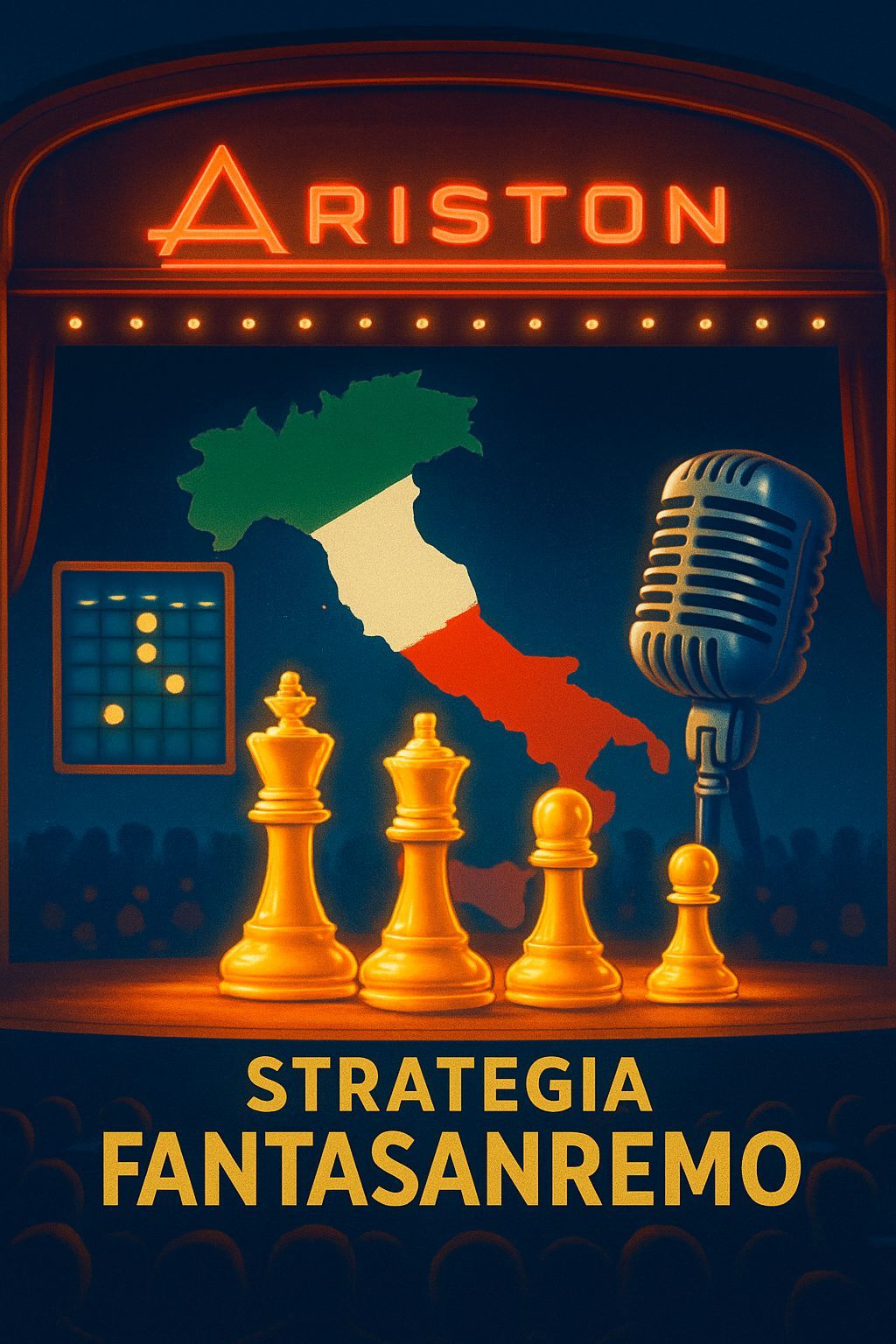
The Sanremo Festival, for over seventy years, is the lighthouse of Italian music, an event that every year paralyzes the country in front of TV screens, transforming Liguria into an epicentre of sounds, emotions and debates. But in recent years, alongside the sacredness of the stage of the Arston and the wait for the winning song, a new protagonist emerged, a digital phenomenon that has been able to rekindle the enthusiasm and interactivity of the audience, especially the younger one: the FantaSanremo. Born almost by joke, as a fun pastime among friends, this musical fantasy game quickly climbed the peaks of popularity, turning into an inseparable component of the Sanremese experience for millions of Italians. It is no longer just a matter of musical tastes or typhoseries for an artist; it has become a real parallel competition, a plot of fortune, strategy and deep knowledge of the dynamic festivals and its characters. Its ability to engage, stimulate discussions and create a vibrant community has redefined the way we live the Festival, making it more dynamic, unpredictable and, above all, participatory. This article aims to go beyond the simple explanation of the rules, as often happens in the introductory guides, to explore in depth the roots of this success, the complex strategies behind the creation of a winning team, the importance of leagues as a social aggregator and the cultural impact that FantaSanremo has exercised and continues to exercise on our perception of one of the most iconic events of the Italian panorama. We will analyze its bonus and malus mechanism, the true heart of the game, but also the technological aspect, the impact on marketing and the future prospects of a game that is much more than a simple pastime: it is a real social phenomenon. Through a detailed and thorough analysis, we will try to unveil the secrets that have transformed the FantaSanremo from a niche of fans to a real collective rite, able to make every performance, every outfit, every word of a singer in the race, a potential point or malus decisive for the final victory. The journey into the world of FantaSanremo is a journey into the heart of Italy that is amused, that compares and that, once again, finds in the Festival of Sanremo an unexpected but extremely effective meeting point and aggregation.
The Evolution of the Ghost: From Niche Game to National Phenomenon
The FantaSanremo, in its evolutionary path, represents a striking example of how an idea born spontaneously can become, within a few years, a cultural phenomenon of mass, redefining the interaction with a traditional event like the Festival of Sanremo. Its origins are often recognized in 2020, when a group of friends in the province of Marche, almost by joke, began to compile lists of singers and assign points based on bizarre or predictable events during the evenings of the Festival. The intuition was brilliant: to apply the logic of Fantacalcio, another pillar of Italian entertainment based on the football championship, to a completely different context but equally full of passion and discussion. Initially, the game was managed manually, with Excel sheets and WhatsApp groups, an authentic community exercise and shared passion. But the virality of the concept was almost immediate. Social networks, especially Twitter and Instagram, became the perfect resonance case, amplifying enthusiasm and allowing the game to overcome the boundaries of the circle of original friends. The arrival of an official platform and a dedicated app marked the true turning point, professionalizing the game and making it accessible to anyone, with clear rules, an automatic score system and a simplified league management. This passage from a “low” initiative to a structured organization opened the doors to millions of new players, including public characters, influencers and the same artists in the race, who began to interact with the dynamics of FantaSanremo, sometimes riding the wave for promotional purposes or simply for the sake of participating. His ascent has shown a deep understanding of the public's desire to not only be passive viewer, but a leading actor, although at a distance. FantaSanremo injected a dose of unpredictability and fun in an event that, although loved, risked to become overly formal or predictable. The possibility to influence, even only metaphorically, the performance of its “season” through the performances of singers, has created a more intimate and personal connection with the Festival. He has transformed every gaffe, every flat gesture, every change of dress into a potential bonus or malus, making every moment of the direct television a potential turning point for his team. This evolution was not only technological or organizational, but it represented a real paradigm change in the way of living and interpreting the Sanremo Festival, projecting it towards a more interactive and socially connected dimension, a model that other events could and should emulate in order to keep alive the interest of the new generations.
Advanced Strategies to Create the Perfect Team: Beyond the Simple Baudi
Creating a winning team at FantaSanremo is an art that goes far beyond the simple selection of seven names from the list. It requires insight, knowledge of the dynamic festivals and a strategy weighted in the allocation of the 100 Baudi available. The fantaquotation of each artist is not random: it reflects the chances of success at the Festival, notoriety and, crucial, the predisposition to “ bonus” behaviors. An effective strategy must balance these elements, avoiding falling into the most common traps. The first, and perhaps more widespread, is the so-called “strategy of the big”, which consists in investing much of the budget on singers with the highest fantaquotations, generally considered the favourites for the final victory. This approach has the advantage of ensuring artists with a high potential for placing, which guarantees consistent bonuses, but involves the risk of rapidly exhausting Baudi, leaving little margin to cover the rest of the team with artists capable of generating “performance” bonuses. An alternative is “trategy of the hunter bonus”, which favours artists known for their extrosity, charisma or tendency to scenic behaviors that make extra points, regardless of their ranking. These singers, often with average or low rates, can turn out to be real gold mines if they can ring a series of fun and unexpected bonuses. We think of an artist who goes down the stairs stumbles but with grace, or who wears a particularly daring outfit, or who dedicates a special greeting to the public. These moves are not always predictable, but a careful observation of their festival past or their social habits can provide valuable clues. There is also “strategy of the dark horse”, which involves a deeper analysis of less-quoted artists, perhaps emerging or their debut, which could surprise both in terms of musical performance and scenic behavior, offering a high return on investment in Baudi. Often, these artists have a low purchase price, allowing to build a more balanced and diversified team. The key is to find a smart mix: to have one or two “big” to ensure placing points, flanked by “bonus hunter” and “dark horses” that can maximize the points deriving from the actions on the stage. The choice of captain is equally strategic: it is not only the strongest singer, but what is believed to maximise the specific bonuses (double points from the top five for each evening and the bonuses/malus of the final ranking). This choice can be tactical and change of evening in the evening, requiring constant monitoring of the performance of singers. For example, if an artist has a particularly important evening or a highlight is expected, appointing him captain for that specific evening can be a winning move. Moreover, the importance of staying up to date on pre-Festival “rumors” and the news that emerge during the Sanremese week cannot be underestimated. Artist statements, pressroom tests, social media interactions: everything can be a clue to anticipate bonuses or malus. The ability to adapt and read the context are essential qualities for a fancier who aims to win, transforming the team selection into a real risk management and forecasting game. Flexibility in changing training (titles/reserves) and the captain until just before the live is another fundamental strategic lever, which allows to react to latest news or program changes, making the game dynamic and always evolving.
Fanta's Winning Heart: Bonus, Malus and Hidden Game Rules
At the center of the Gear of FantaSanremo there is an extraordinaryly ingenious bonus system and malus, able to transform every moment of the Festival into a potential point generator. This mechanism, which evolves and renews every year, is the real soul of the game, what makes it unpredictable, fun and, above all, participatory. It is not just about rewarding the musical talent, but of enhancing the whole show, encouraging behaviors that increase entertainment and virality. The bonuses, often characterized by a touch of humor, go from the classic “be the first to sing” (+20 points), which rewards the opening of the curtain, to the more extravagant “wear sunglasses during the exhibition” (+5 points), a small tribute to the pop aesthetic that squeezes the fashionable eye. There are bonuses related to the interaction with the public or with the guests, such as “to be presented by a guest” (+10 points) or “to make the orchestra sing” (+25 points), which encourage spontaneity and involvement. Some bonuses reward gestures of great scenic or communicative impact, such as “dedicate victory to a relative” (+15 points) or “make a live scaramanti gesture” (+10 points). Particularly significant are the “legated to the final victory” bonuses, with the winner of the Festival that brings well +100 points to the team, as well as those for the critical prizes or the press room, which emphasize the importance of artistic quality recognized by professionals. But the game would not be so compelling without the malus, the penalties that make the competition a delicate balance between risk and reward. A simple “inciampo or fall from the staircase” can cost -10 points, while a “erroneous presentation” of the title of the song or the name of the artist entails a penalty of -5 points. In more serious cases, such as “fixes from the public” (-20 points) or, in the extreme scenario of a “disqualification from the Festival”, which involves a heavy -100 points, the malus can literally turn the fate of a league. This duality creates a constant tension and keeps players glued to the screen, analyzing every detail of the performance. The distinction between holders and reserves adds a further strategic level. While the owners accumulate all bonuses and malus, reserves earn or lose points only in relation to bonuses and extra malus, often more rare or related to particular situations. This rule encourages to place singers in titular training with greater probability of generating points through direct interaction with the stage and the audience, while keeping on the bench those who could still contribute with less common bonuses. Fundamental, and a real suspense engine, are the “bonus and malus secrets”, unveiled daily just before the start of the live. These temporary “jolly”, valid only for the current evening, can radically alter strategies and rankings, rewarding the readiness and ability to adapt players. For example, a secret bonus could be “the singer wearing an eccentric headdress” or “who does a selfie with an orchestra member”, pushing fans to carefully monitor every little detail of the broadcast. This dynamic system of rules, constantly evolving, is what guarantees the freshness of the game year after year. The production of the FantaSanremo is able to calibrate the bonuses and malus to stimulate the creativity of artists and keep the attention high, transforming the Festival not only in a musical race, but in a vast stage of performance that goes beyond the pure singing performance, a field of play where every gesture counts and every frame hides a potential score.
Leagues: Community, Competition and the Social Appearance of FantaSanremo
The leagues represent the epicenter of FantaSanremo’s social experience, the place where individual competition merges with group dynamics, transforming the game from a mere solo exercise into a shared celebration. If the World Championship is the general classification that aggregates all participants, the leagues are the narrow “salotti”, the personal arenas where friends, colleagues and family compete in a battle at the last Baudo and the last bonus. This is where the FantaSanremo fully expresses its aggregative potential, strengthening links and creating new traditions. The act of creating a league is simple but full of meaning: you choose a often ironic name and you define its nature – public, private or secret. Private or secret alloys, in particular, become real autonomous ecosystems. The owner (the creator) and any admins are not only technical managers, but central figures that animate the group, accept new memberships, mediate any “counters” on the bonuses, and, what is not negligible, can establish internal prizes. Unlike the World Championship, where there are no cash prizes, private leagues often place small symbolic rewards: a dinner, a playful bet, or simply the right to brag until the next edition. This adds a layer of motivation and fun, transforming the outcome of the game into something tangible within your social circle. Participation in a league, or creation of its own, stimulates a constant and lively discussion. Messaging groups explore comments during the evenings of the Festival: they analyze the performances, they joke about unexpected malus, they rejoiced for an unexpected bonus. This real-time interaction is fundamental, it creates a sense of belonging and amplifies the emotion of the Festival. It is not uncommon to see friends gather to follow the evenings together, with the phones in hand, ready to compare the scores and to comment on every move of the artists. The leagues also offer a fertile ground for the creation of shared strategies or, on the contrary, of accused rivalry. There are those who try to influence the choices of others, those who boast of their own predictions, and those who, with self-irony, complain about bad luck. This playful but competitive aspect is a very powerful social catalyst, able to animate even the most formal relationships, such as those between work colleagues, providing a light and fun conversation topic that breaks the routine. The “Premium Leagues”, organized by the sponsors, add a further dimension, offering the possibility to win real prizes and, in fact, democratize access to competitions related to the event. This shows how the model of the leagues is not only a play mechanism, but a powerful tool for marketing and engagement, able to extend the scope of the Festival well beyond its television transmission, creating micro-communities animated by one, great passion: the FantaSanremo and Italian music. Their ability to generate discussion, interaction and a healthy spirit of competition is the tangible proof of FantaSanremo's role as a social phenomenon.
Beyond the Game: FantaWe'll be the Marketing and Influencer Economy Tool
The impact of FantaSanremo extends far beyond the simple fun of the participants, configuring itself as a powerful marketing tool and a significant actor in the economy of influential marketing. Its ability to generate engagement and discussion captured the attention of brands and companies, who quickly understood the potential of this platform to reach a vast and highly involved audience. The sponsors, in fact, do not just enter their logo, but often create “Premium alloys” or even introduce personalized bonuses and malus related to their products or services. Imagine a bonus as “Artist who nominates a brand X during the performance” or “Cantante who wears a garment of clothing of a given brand”. These actions, while maintaining the playful and spontaneous tone of the game, become real promotional levers, integrated organically in the experience of the Festival, perceived by the public as part of the fun rather than as traditional advertising breaks. This immersive marketing model is extremely effective, as it exploits the passion and attention of fans, transforming the game into a vehicle for brand awareness and positive association. The artists themselves learned to play with the dynamics of the Ghost. It is no longer uncommon to see them adopt specific behaviors on stage, make boat gestures or wear unusual accessories, clearly inspired by the bonuses and malus of the game. This conscious interaction between artist and FantaSanremo creates a virtuous circle: singers generate points for fans, who in turn amplify the discussion on social media, increasing the visibility of the artist and the Festival. This symbiosis has made the FantaSanremo a natural media amplifier for the Sanremo Festival, attracting a younger and digitally native audience that otherwise could feel less involved by a perceived event as more traditional. The game has helped to age the image of the Festival, making it more current and dynamic. In the influential economy era, FantaSanremo also offers a platform for influencers and content creators. Many public characters, not only musical, share their teams, their strategies and their reactions to the Festival’s evenings on social media, creating additional content that further stimulate interaction. These famous “fantallenatories” become magnets for audiences, extending the scope of the game and the Festival to new segments of the audience. The direct Instagram and Stories dedicated to training analysis or commentary on scores have become a fixed appointment for many fans. Finally, the FantaSanremo has demonstrated how gamification can be successfully applied to mass entertainment events, transforming spectators into active participants and creating a level of involvement that traditional media forms can hardly match. This model opens new frontiers for the entertainment industry, suggesting future paths to make cultural events more interactive, socially relevant and, not least, commercially attractive for a wide range of partners.
The FantaSanremo App and Multichannel Interaction: A Diving Experience
In the context of such a phenomenon, technology plays a preponderant role, and the official application of FantaSanremo represents the pivot around which the entire gaming experience for millions of users rotates. The availability of the app on Android and iOS platforms, including alternative stores, testifies to the commitment to capillary accessibility, ensuring that every potential player can participate regardless of their mobile device. The app is not a simple transposition of the web version, but an optimized platform for mobile interaction, designed to accompany the user at every stage of the Festival. From the first access, after a simple and intuitive registration process (which also supports access through Google accounts, Apple ID or Facebook, reducing initial friction), the user is immersed in a clear and functional interface. The ability to create a team or join a league is immediately accessible, making the game start quickly and smoothly. The true force of the app, however, emerges during the evenings of the Festival. Push notifications, to which the user consents to the first start, become crucial tools to maintain engagement. Imagine the tension of the live: a singer is on stage, he is about to perform, and a “secret bond” is unveiled at the last minute. The timely notifications of the app allow players to react in real time, perhaps by changing the captain or training if the rules allow it, adding a “last-minute” strategy that amplifies adrenaline. In the same way, notifications about updating scores, available from the morning after the bets, allow players to constantly monitor their position and their opponents in leagues, feeding discussion and rivalry. The “Notifiche” section within the app, accessible through the bell icon, becomes a central hub for all important communications: requests for participation in private leagues, updates on rankings, news on singers. This ensures that no player loses crucial information. The user interface is designed for maximum usability: navigation between the different sections (squadra, leghe, trofei, regulation) is fluid and intuitive, with well visible buttons and a clean design. Training management, with the possibility of dragging singers between owners and reserves, is an example of how the app simplifies operations that could be complex. The “Trofei” section, introduced to encourage exploration and participation, is also well integrated, transforming the achievement of specific targets in digital badges, which add a further layer of gamification and recognition. The multichannel experience offered by FantaSanremo, which supports the web version to the mobile app, is an exemplary model of how technology can enrich a traditional event. It is not limited to replicating the content, but transforms it, makes it more interactive, more immediate and more deeply integrated in the daily life of users, who can access the game wherever they are, maintaining a constant link with the Festival and its league. This fluidity and attention to the details of the user experience are key factors of FantaSanremo’s success, demonstrating that a solid and well-thought technological infrastructure is indispensable to sustain and grow a mass phenomenon.
The Future of the Ghost: Innovation, Challenges and Perspectives
The explosive success of the FantaSanremo in recent years naturally raises questions about its future prospects: how will it maintain its attractiveness, what innovations will be introduced and what challenges will it face to consolidate its position of cultural phenomenon? The evolution of the game is inherently linked to adaptation and the ability to surprise, while maintaining its ludicrous and inclusive essence. One of the future directions could be the introduction of even more dynamic and interactive game modes. You could imagine a system of “in-game bets” with virtual Baudi on specific events during the evening, perhaps linked to forecasts on the scaletta or the outfit of the conductor. Or, the integration of “daily challenges” with extra bonuses for specific tasks, stimulating a more constant and varied participation. The possibility of creating instant “mini-legae” for a single evening or for specific categories of artists could further expand the game options. Another area of potential development is the deepest integration with the television broadcast itself. Imagine the possibility to vote in real time (always with virtual Baudi) for a bonus or malus proposed by the production of FantaSanremo, or to view live the rankings of the most important leagues directly in over impression on the television. This would create an even more immersive experience, fading the boundaries between the game and the real spectacle. From a technological point of view, the challenges are not lacking. Management of such a high volume of users, especially during the peaks of the evenings of the Festival, requires a robust and scalable infrastructure. Optimisation of the app to ensure speed and responsiveness, implementation of artificial intelligence features to suggest teams or strategies, or use of blockchain to ensure score transparency could be future horizons. In addition, data security and the prevention of possible fraud attempts will remain absolute priorities. The greatest challenge for the FantaSanremo will however be to maintain its originality and its innovative spirit without falling apart. The game is loved just for its lightness, its autoironia and the ability to transform a traditional event into something new and fresh. Too many complications or excessive marketing could compromise this balance. It will be essential to balance the introduction of new features with the maintenance of simplicity and accessibility that have decreed its success. The perspectives are wide: the FantaSanremo model could be exported to other cultural or sporting events, adapting the gamification mechanism to different contexts. Imagine a “FantaEurovision” or “FantaCinema” for film festivals. Its ability to generate engagement and create communities is universal. Ultimately, the FantaSanremo is not only a game, but a successful social experiment that has shown how digital interaction can envigorate consolidated events, creating new forms of participation and collective fun. His future trajectory will depend on his ability to remain relevant, innovative and, above all, faithful to the goliardic and inclusive spirit that made him so loved by the Italian public.
Conclusion: FantaSanremo come Fenomeno Culturale e Sociale
At the end of this in-depth analysis, it is evident that the FantaSanremo is much more than a simple pastime linked to the Italian Song Festival. It is an authentic cultural and social phenomenon that has been able to redefine the way in which millions of Italians interact with one of the most rooted events in the national tradition. Starting as a goliardic idea among friends, he has evolved and structured, keeping intact that spirit of spontaneity and fun that has decreed its success. We explored its origins and its rapid rise, which bear witness to a thirst for more active participation and a richer and more multifaceted experience of media events. Its ingenious bonus and malus structure, constantly evolving, not only rewards the musical talent, but also celebrates the estro, the scenic performance and, sometimes, the unpredictability, transforming every single moment of the Festival into a potential turning point. This system has in fact mimicned entertainment, transforming viewers into strategically committed “flackers”, able to anticipate and react to the dynamics of the stage of the Arizona. We then analyzed the advanced strategies for the creation of the perfect team, demonstrating how the choice of singers and captain is an art that requires insight, knowledge of dynamics and a good dose of risk management, going far beyond the simple selection. The leagues, on the other hand, emerged as the pulsating heart of the social aspect of the game, spaces in which the competition intertwines with the creation of communities, strengthening existing links and creating new ones, nourishing friendly debates and rivalries that enrich the collective experience of the Festival. FantaSanremo was also an effective marketing tool, able to attract sponsors and involve the same artists in an interaction game that amplifies visibility and engagement, demonstrating the potential of gamification in the influencer economy. Finally, the official app showed how technology was fundamental to make the experience accessible, immediate and immersive, ensuring real-time updates and a smooth interaction that elevates the game far beyond the boundaries of your PC. The future prospects, while presenting challenges related to innovation and the maintenance of originality, suggest a path of continuous growth and potential expansion towards new cultural horizons. Ultimately, the FantaSanremo is not only a game, but a catalyst of emotions, a content generator and a social interaction amplifier that has been able to instill new life to an Italian institution. Its uniqueness lies in the ability to combine passion for music with the lightness of the game, creating a bridge between tradition and digital innovation. It is a brilliant example of how to reinvent the involvement of the public, making every Festival of Sanremo an experience not only to watch, but to play, to live intensely, joining Italy under the sign of shared entertainment.


