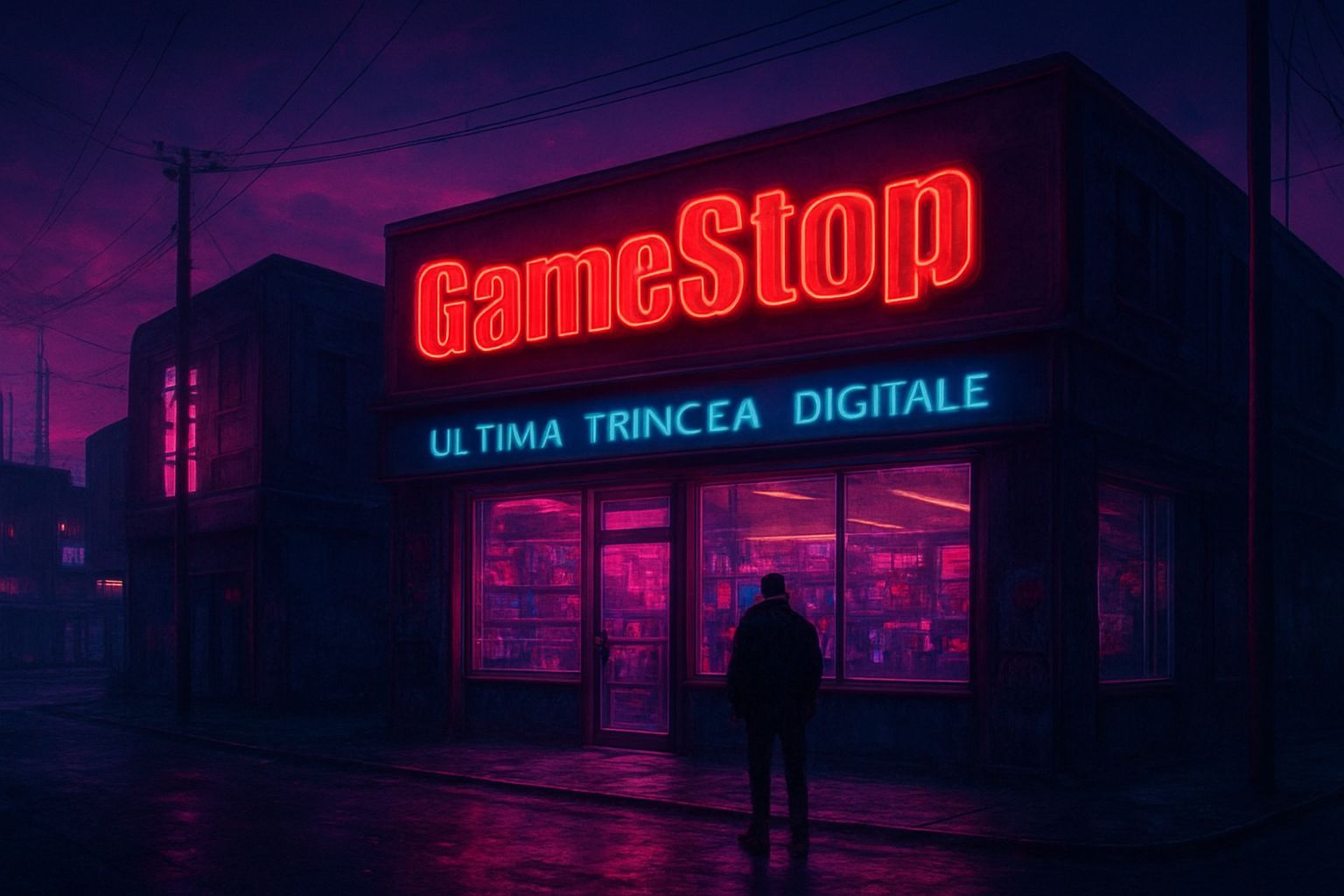
In September 2015, in a rapidly evolving gaming landscape, GameStop, the retail giant of video games, embarked on a move that then appeared to many as a desperate attempt to stem the unstoppable tide of digital distribution. The decision to replace digital download codes with physical disks within the console bundles offered in its over 5,000 stores worldwide was not a simple logistical adjustment, but a strategic declaration deeply rooted in its business model. At that time, while console producers and game publishers pushed more and more towards the convenience of digital, GameStop clinged to its permute program, a real and proper still of salvation which represented a third of its turnover and 45 percent of its gross profits. That program, which allowed players to sell their used games and GameStop to resell them with a considerable markup, was the lifeblood of the company, but was completely obsolete in the era of digital downloads, where physical property simply did not exist. The maneuver, although presented as an answer to the alleged consumer preferences for the record resale value, was quickly unmasked by the executives themselves as a tactic to preserve a threatened business model, a clear signal of how an entire industry was struggling to adapt to a epochal technological change. Today, at a distance of years, we can reflect on that decision and trace the trajectory that has led the video game market to turn into a reality mainly, if not almost exclusively, digital, leaving behind a wake of challenges for the traditional retailers and complex questions on the property, preservation and future of the medium.
The Dilemma del Fisico vs. Digitale: A Historical Perspective and GameStop Prophecy
GameStop's decision of 2015 to promote physical supports in console bundles was not an isolated event, but rather theapex of an increasing tension he's been living in video games for years. Since the beginning of the 21st century, with the advent of faster internet connections and platforms such as Steam for PC, the concept of digital download began to set foot, promising convenience, immediate access and elimination of production and physical distribution costs. For GameStop, however, this evolution represented an existential threat to its basic business model, which depended critically on the game market used. The permutation program not only generated significantly higher profit margins than the sale of new games, but also encouraged customers to return to physical stores, creating a circular ecosystem of purchase and resale. A physical game, once purchased, could be exchanged or resold, maintaining a residual value that the digital could not offer. GameStop executives, such as Paul Raines and Tony Bartel, tried to justify the 2015 move by appealing to the "strong preference" of consumers for the physical disk, underlining the perception of intrinsic value in the possibility of swapping the game. This argument, although not entirely unfounded for a part of the clientele, masked the reality of a company that struggled to maintain relevance in a market that was rapidly turning towards alternative consumer models. The fact that publishers like EA were already generating most of their revenues from purely digital sources, showed an unstoppable trend. The reaction of GameStop, however understandable from the corporate point of view, was perceived by many analysts and observers as a futile attempt to reject the inevitable, a premonitor sign of how the future would marginalize the physical mediators in favor of direct connections between creators and consumers, redefining not only the logistics, but the entire gaming economy.
The Inexorable Ascesa of Digitale: Disco Console and Subscription Services
The years following 2015 have proved inequivocally the correctness of forecasts oninexorable rise of digital distribution, even exceeding the most optimistic expectations of its supporters and the pessimistic ones of its detractors. GameStop's move, instead of slowing down the transition, was quickly obscured by a series of developments that cemented the digital domain. One of the most significant impacts was the introduction of fully digital console by the main producers. Microsoft’s Xbox Series S and Sony’s PlayStation 5 Digital Edition have completely eliminated the disk drive, offering a gaming experience exclusively based on download, often at a lower price than their disk drive counterparts. This choice has normalized the digital purchase for millions of new users, especially among younger generations who have never had a strong affection for physical support. In parallel, the explosion of video game subscription services further revolutionized the panorama. Xbox Game Pass, PlayStation Plus Premium, EA Play and other similar “Netflix video games” models offer a vast catalogue of titles accessible with a monthly fee, moving the focus from the concept of “property” to “access”. This has drastically lowered the entry barrier to a huge library of games, encouraging consumers to experience more titles without the commitment of single purchase, and made the physical disk even less relevant. The interdependence between increasingly fast internet connections, the wide storage capacity of consoles and the convenience of digital marketplaces has created an almost self-sufficient ecosystem. The COVID-19 pandemic, with the forced closure of physical stores, then acted as a catalyst, further accelerating the adoption of digital on a global scale and confirming that the 2015 GameStop attempt was, in fact, an argine against a tide too powerful to be contained, demonstrating the inevitability of an epochal transformation that redefined the habits of consumption and the architecture of the video game market.
GameStop in Post-Digital: Between Existential Crisis and Ephemeral Rebirth
GameStop's attempt to anchor to the physical market in 2015 proved, as expected by many, a temporary palliative that could not prevent the next and deep structural crisis that hit the company. The following years saw a steady decrease in sales of physical games, a trend that progressively eroded the pillars on which GameStop was founded. The closures of shops have become a sad reality all over the world, the dismissals have followed and the company struggled to find a new identity in the rapidly evolving digital landscape. However, GameStop history was not linear, and 2021 marked a surprising and unexpected chapter: the company has become the hub of a phenomenon known as “mememe stock”. Small investors, coordinated through online platforms like Reddit, organized a massive purchase of GameStop shares, triggering a “short squeeze” against the big hedge funds that bet on its failure. This event has pushed the value of actions to astronomical levels, generating a wave of optimism and unprecedented media attention. Although the “mememe stock mania” provided GameStop a significant capital injection and renewed visibility, it did not solve its underlying challenges. The company has tried to take advantage of this moment of grace to undertake a transformation process, focusing on initiatives such as the NFT trade, the expansion in the PC gaming hardware market, the sale of collector’s products and a greater focus on e-commerce to compete with the industry’s giants. Despite the efforts and the arrival of new leaders, the transition was slow and impelled by obstacles. Revenues continue to be dominated by sales of hardware and accessories, while the segment of physical and used games, once the company’s pulsating heart, remains in decline. GameStop's story has become an emblematic case study on the resilience (or its lack) of a traditional business model in the face of a technological revolution, highlighting that even an unexpected media and financial revival cannot replace the need for a deep and sustainable strategic innovation to survive in the digital age.
The Digital Property Question: A New Consumer Rights Frontier
The debate on consumer preference for the physical disk, mentioned in 2015, concealed a much deeper and more complex issue that has become central in the digital age: that of property. When you buy a physical game, you become owners of a tangible object that can be lent, exchanged, reselled or preserved indefinitely. This gives consumers a sense of autonomy and control over their purchase which is radically different in the digital world. The purchase of a digital game, in fact, is almost never a real “property” in the traditional sense of the term, but a license of use. The consumer acquires the right to access and play that title, but the software remains the property of the publisher or developer. This distinction has enormous implications for consumer rights and cultural preservation. If a publisher decides to close the servers of an online game, or if a digital platform is released, the games purchased digitally could become inaccessible, even if legally purchased. Examples such as removing games from digital marketplaces due to expired licenses or closing online stores (such as the Nintendo 3DS or Wii U) have shown how fragile this form of “ownership”. There is no use market for digital games, which eliminates a value source for the consumer and the possibility to recover part of the initial cost. This has generated a heated ethical and legal debate: should consumers have the same resale rights and loan for digital content as for physical ones? Could the legislation on “right to repair” for hardware find a parallel in “right to preservation” for software? The issue of digital property is an unexplored frontier that calls into question consolidated concepts and calls for new regulatory solutions to ensure that technological advancement does not take place at the expense of the rights and freedom of consumers to manage their cultural assets in the digital environment in which they increasingly reside.
The Market of Used Games and its Decline: Who Perde and Who Vince?
The decline of the used game market, of which GameStop wasundisputed king, it represents one of the most direct and significant consequences of the transition to digital, redefining the economic dynamics of the entire industry. In the previous model, the games used were a fundamental resource for GameStop, which could buy them at low price from consumers (often in the form of credit for buying new titles) and resell them with a exceptionally high profit margin. This mechanism benefited consumers with limited budgets, which could access games at a reduced cost, and of course GameStop itself. However, for publishers and developers, the use market was often seen as a economic damage. Each copy of a used and resold game meant a potential sale of a lost new copy, and consequently zero revenue for game creators. With digitization, this problem simply disappeared. Digital games cannot be “used” in the traditional sense of the term; once a license has been purchased, it cannot be re-held or transferred to other users. This reality has led to a huge advantage for publishers, which now get 100% of revenues from every digital sale, without the “loss” of the secondary market. It also opened its way to new monetization models, such as microtransactions, DLC (loadable content), battle passes and seasonal subscriptions, which have become pillars of post-launch gain strategies. These models, intrinsically digital, generate a constant flow of revenue far beyond the initial purchase of the basic game. If on the one hand this has ensured greater financial stability for developers and has allowed continuous investments in the development of live games and services, on the other has eliminated a source of savings for consumers and has emphasized the feeling of not “posing” the software really. The decline of the used market is therefore a striking example of how digitization has shifted economic power and the generation of revenues from the intermediary to the creator, with a deep impact on the pockets of all actors involved in the vast ecosystem of video games.
Beyond the Game: The Role of Experiences and Communities in the Future of Retail
While selling physical and used games evaporates, the question that plagued GameStop in 2015 – what role remains for the physical store in the future of gaming? – has become even more pressing and pervasive. The answer, if there is one, no longer resides in the basic transaction of a product, but in the offer of aexperience and in the construction of a community. Physical stores that intend to survive must be transformed from simple stores to aggregation and entertainment centres. This could mean the adoption of “experiential cocktails”, where customers don’t come just to buy, but to interact with products, participate in events and feel part of something. A store could host local eSports tournaments, serve as a hub for cooperative gaming sessions, offer test stations for the latest consoles and peripherals or even devote spaces to retrogaming, turning into a kind of interactive museum and game room. The focus moves on sale collection products and merchandise, a sector that still thrives in the physical world, where the passionate seeks action figures, shirts, comics and other objects related to their favorite franchises. The niche of limited edition physical games, often intended for collectors and condomists, could find in specialized shops its strength, offering rare and collectible items that the digital cannot replicate. In addition, the physical store can play a crucial role as a meeting point for the community, a place where players can exchange views, make new friends and feel less isolated in a hobby that often takes place on their own, behind a screen. This human and social aspect is something that the digital struggles to fully replicate, and represents a competitive advantage intrinsic for physical retail. Shops that cannot evolve in this direction, offering something more than the mere transaction, are destined to follow the fate of the physical game market, disappearing under the weight of the efficiency and convenience of digital. The future of retail in gaming, therefore, is not in the sale of discs, but in the creation of added value that goes beyond the product itself, focusing on emotion, interaction and belonging to a dynamic subculture.
Environmental impact and Sustainability: The Physics Weight Against Digital Lightness
A less discussed aspect in the debate between physical and digital distribution, but of increasing importance in the current global context, is that of environmental impacts and sustainability. The traditional model of physical distribution involves a significant ecological footprint at every stage of the product life cycle. The production of disks, plastic and packaging houses requires the extraction of raw materials, manufacturing processes that consume energy and generate emissions, and a vast logistics system for transport covering thousands of kilometers, from the manufacturer to the distributor, to the retailer and finally to the consumer. All these steps contribute to pollution, fossil fuel consumption and waste production, especially when products become obsolete or are discarded. On the other hand, the digital model, although it seems “lighter” and free of packaging, is not without its own environmental weight. Digital distribution is based on massive infrastructures: data centers, servers, data transmission networks that require huge amounts of energy to work and cool down. Every download, every update, every online game session contributes to the energy consumption of these infrastructures, which often depend largely on non-renewable energy sources. Hardware production, such as consoles and increasingly powerful PCs necessary to manage complex digital games, also has a remarkable environmental impact. The challenge of sustainability in gaming is therefore not a simple choice between “good” (digital) and “bad” (physical), but rather a recognition that both models present challenges. Industry is called to find more ecological solutions for both: optimize physical production processes to reduce waste and use recycled materials, and invest in renewable energy to power data centers and digital infrastructure. The growing awareness of climate change prompts publishers and developers to consider not only economic convenience, but also the environmental responsibility of their distribution choices. The future of sustainable gaming will require a holistic approach, which evaluates the entire life cycle of the product and is committed to minimizing the ecological footprint in all its forms, whether the game arrives on disk or through the network.
Conclusion: The Unstoppable Evolution and the Need for Adaptation
GameStop’s 2015 attempt to promote physical games in console bundles was ultimately aeloquent resistance illustration to change in an industry at the point of one epochal transformation. What then seemed a strategic move to preserve a profitable business model, was retrospectively confirmed as a last desperate battle against the unstoppable advance of digital. Over the years, the gaming landscape has unrecognizably changed: digital-only consoles are a consolidated reality, subscription services dominate consumption, and the very perception of the “ownership” of a game has been redefined. GameStop has faced and continues to face the immense challenges of a company whose fundamental model has been eroded by the forces of technology and the evolution of consumer habits. Its history, made of existential crises and ephemeral rebirths fueled by unexpected market dynamics, serves as a warning for any sector facing disruptive innovation. The used game market, once the button heart of GameStop, almost disappeared, moving power and profit margins directly into the hands of publishers and developers, who found new ways of monetization in the digital ecosystem. However, the debate is not purely dichotomic. While digital provides convenience and efficiency, it also raises complex questions about consumer rights, game preservation and the environmental impact of the infrastructures that support it. The future of physical retail, although drastically resized, could reside in its ability to reinvent itself as a center of experience and community, rather than as a simple point of sale. The evolution of physique to digital gaming is a story of adaptation: those who knew how to embrace change prospered, those who resisted struggled. The greatest lesson is that in a world in constant technological evolution, the only constant is the innovation and flexibility, because the tide of progress does not wait for anyone, and the ability to navigate it defines survival and success in the long term.


