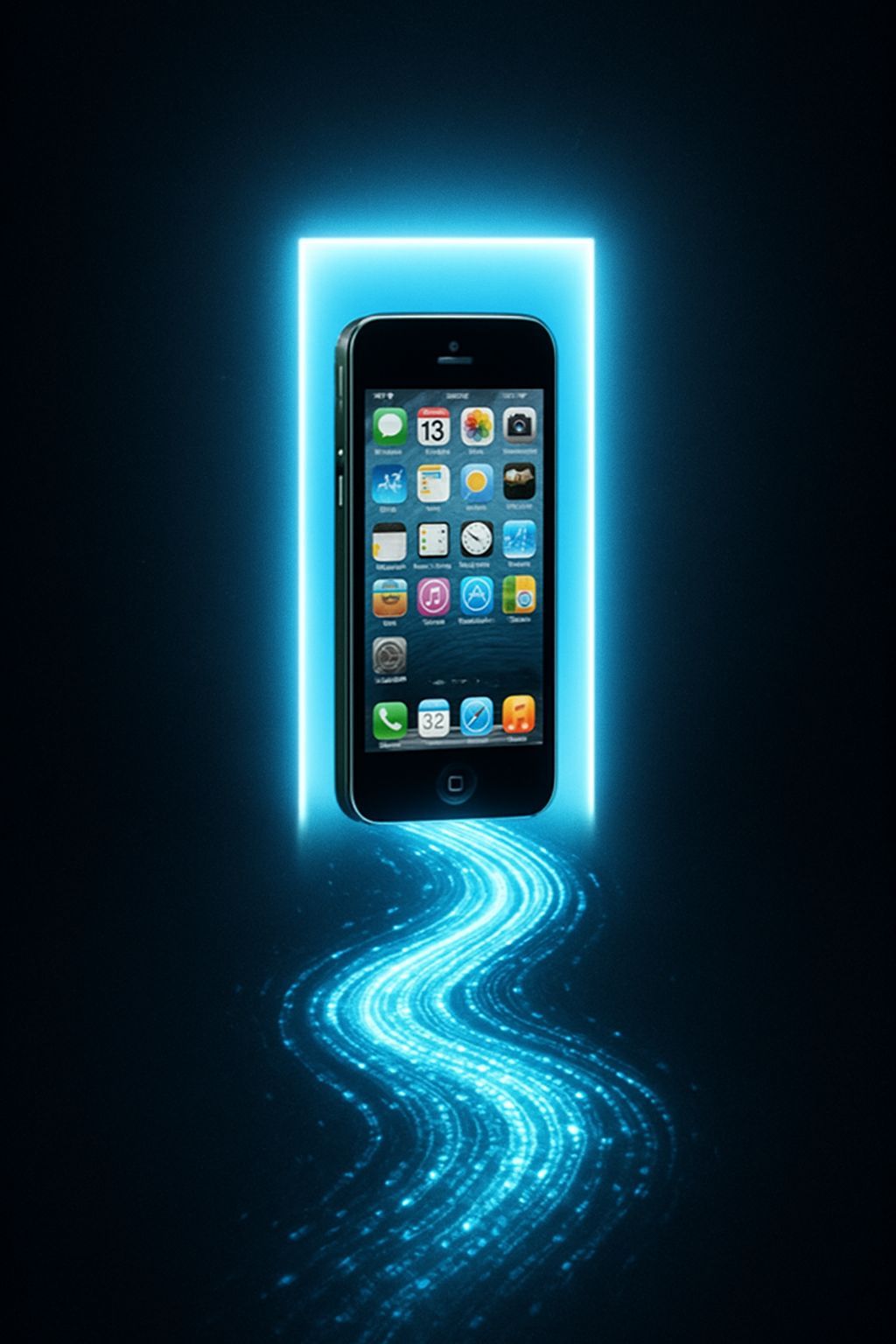
It was May 2012 and the technological universe was in turmoil, dominated by an almost palpable anticipation that floated around the next jewel of the Apple house. The voices, powered by leaks of news and industrial speculations, painted the picture of a new generation iPhone that would not be limited to a simple incremental update, but would introduce a substantial change and, for some, “revolutionary” in its most iconic design: the screen. The heart of this discussion was an alleged modification of the appearance of the display, from the consolidated 3:2 to a larger 16:9, accompanied by an increase of the diagonal dimensions from 3.5 to 4 inches and a new resolution of 640×1136 pixels. This was not a simple numerical adjustment; it was a critical crossroads for the entire mobile industry, especially for the iOS ecosystem. The transition to a higher and narrow display, while maintaining the width of the unaltered device, raised crucial questions not only for Apple’s hardware engineers, but especially for the vast community of developers who had built the foundations of the App Store. Would they have been forced to redesign their applications? How would they manage the transition maintaining compatibility with the millions of iPhones “old guard” still in circulation? The dilemma was not only technical, but strategic: Was Apple dictating a new direction, forcing adaptation, or was it simply responding to a market need already manifested? The original article by Ars Technica of May 2012 perfectly captured the uncertainty and excitement of that period, acting as a map to the sunlight for the anxieties and expectations. Today, with hindsight, we can analyze not only how those forecasts have been realized, but also the deep implications that that “resolving change” had on mobile design, app development and user experience in a decade of incessant innovation. This retrospective journey will allow us to better understand the legacy of a decision that, although at the time appeared as a simple technical adjustment, has actually redefined the standards and expectations for entire generations of devices.
The Age of Change: From 3:2 to 16:9 and Mobile Redefinition
The transition from the iconic 3:2 to a more modern 16:9 in the iPhone 5 display, although anticipated by months of indiscretion, represented a fundamental turning point not only for Apple but for the entire smartphone industry, marking the beginning of a new era in the design of the mobile user interface and multimedia experience. Apple’s choice to stretch the screen, keeping the width of the device exactly like that of previous models, was a calculated move and deeply in line with the company’s design philosophy, which favoured ergonomics and ease of use with one hand. The main argument for this decision was the optimization of the use of multimedia content: 16:9, in fact, was already the dominant standard for high-definition television, movies and most online videos, eliminating the annoying “black bands” on the sides or above and below the content, which were a constant on display 3:2. This aspect was not of little account in a time when streaming video and media consumption on portable devices were exploding in popularity, turning the smartphone from a communication tool to real personal entertainment center. The resolution of 640×1136 pixels, in addition to offering more vertical space for apps (an entire additional line of icons on the Home screen, a detail not negligible for Apple), maintained the excellent density of “Retina” pixels that had already conquered users with previous models, ensuring sharp texts and detailed images. However, the impact of this transition was far deeper than just video optimization. 16:9 quickly became the new benchmark for the industry, also pushing Android manufacturers, who until then had experienced a myriad of aspect ratios and resolutions, to converge towards a more uniform standard. This helped to simplify the life of developers, but at the same time created a “mini-cycle” of adaptation that would then prepare the ground for subsequent evolutions, such as “edge-to-edge” displays and those with notch. The choice not to enlarge the phone was a statement of intent by Apple, a statement that the overall size of the device, and the ability to reach them comfortably with the thumb, were sacred parameters for user experience, a principle that would be gradually abandoned in the following years with the increasing demand for ever larger screens. In retrospective, the iPhone 5 was not just a phone with a larger screen; it was the catalyst that accelerated the adoption of a new visual paradigm in the mobile world, redefining the expectations on how content should be displayed and interacted, and laying the foundations for the inexorable march towards increasingly expanded and immersive formats.
The iOS Developer Challenge: A Pixel Puzzle in Continuous Evolution
The passage of the iPhone 5 to display 16:9 was a complex and multi-faceted challenge for the vast community of iOS developers, a real pixel puzzle that required not only technical adaptation but also a deep reconsideration of app design strategies. Until then, the consistency of aspect ratio 3:2 allowed developers to work with a relatively predictable set of constraints, facilitating the creation of “pix perfectel” user interfaces that appeared identical on all devices. With the introduction of 16:9, reassuring uniformity was broken, generating legitimate concerns about backward compatibility and the amount of work needed to update existing apps. The main fear was that Apple would impose a mandatory update, or that unenhanced apps would appear with annoying black bands (“letterboxing”) on the new screen, compromising user experience and quality perception. Many developers were already accustomed to managing minor resolution variations, but the change of aspect ratio was a question of different scale, which influenced the layout of elements, font size and general interaction. Apple, aware of these challenges, had begun to introduce tools such as the Auto Layout in iOS 6 (launched in conjunction with the iPhone 5), a system of constraints based on the relationships between the elements of the interface, which would be crucial for creating flexible layouts and adaptable to different size and orientations of the screen. However, at the time of the iPhone 5, many developers still relied on the “springs and struts” (automatic resize masks), a less sophisticated approach requiring greater manual intervention to adapt elements to new geometries. This meant that, for less recent apps or those developed without predicting such a change, the transition was far from painless. The developers had to reconsider the entire visual hierarchy of their apps, ensuring that the buttons were not truncated, that the text did not run unexpectedly and that the interactive elements were still easily accessible. In addition, the question of continuing to support older devices 3:2 created an additional charge, forcing some to maintain separate codebases or implement complex logics to distinguish between different aspect ratios. This experience, though tiring, proved to be a catalyst for the adoption of more robust and “future-proof” development practices, pushing the community to master the Auto Layout and think in terms of responsive design. It was a precious lesson on the importance of designing for flexibility, a principle that would become even more critical with the introduction of iPad, Apple Watch and the proliferation of iPhone with increasingly diversified screen sizes, preparing developers to a panorama where the “pixel perfect” no longer meant “fixed size” but “perfect adaptation”.
Beyond the Pixels: The Impact on User Experience and Ergonomic Perfection
Beyond the technical complexity for developers, the switch to display 16:9 of the iPhone 5 had an immediate and tangible impact on user experience, an impact that, for most consumers, was largely positive, redefining expectations on what a phone could and should offer in terms of displaying content. The most obvious and immediately appreciated aspect was the optimized use of multimedia content. With the iPhone 5, 16:9 videos were played in full screen without the unsightly black bands, offering a more immersive and immersive film experience, a factor not negligible at a time when YouTube, Netflix and other streaming platforms were becoming an integral part of everyday life. The games also benefited enormously from this additional space, allowing developers to create larger and more detailed worlds, with an extended field of view that improved immersion and playability. The extra surface of the screen also translated into a greater amount of information displayed vertically, without the need to continuously scroll. This meant multiple lines of text in emails, more posts visible in social media feeds, more search results on Safari and, like Apple itself emphasized, an entire additional line of icons on the Home screen, increasing the perceived information density of the device. This “longing” of the display, without altering its width, was an ergonomically crafted move. Keeping the width unchanged from the 3.5-inch models, Apple retained the ability to use the phone comfortably with one hand, a feature that Steve Jobs himself had always considered essential. The user could still reach much of the screen with the thumb, a crucial consideration for everyday usability. This contrasted clearly with some Android phones of the time that, in an attempt to offer larger screens, they sacrificed ergonomics, often being too wide and uncomfortable to handle. However, not all aspects were immediately perfect. The applications not yet updated appeared with the already mentioned black bands, creating an uneven visual experience that could be annoying and make the phone look “incomplete”. This prompted Apple to strongly encourage developers to upgrade, often with the implied threat of reduced visibility or negative reviews for unenhanced apps. In the long term, however, the 16:9 of the iPhone 5 has asserted itself as a point of reference, helping to shape the expectations of users on larger and immersive screens, and to consolidate the vision of a phone that is yes a device for productivity, but also a powerful window on the world of entertainment, all maintaining a promise of usability that, for the time, was avant-garde.
The Evolution of Mobile Design: Previous for the Future of Displays
The introduction of the 16:9 display on the iPhone 5 in 2012 was not an isolated event, but rather a catalyst that started a cascade of changes in mobile design, establishing a precedent that would profoundly influence the evolution of smartphone screens for the coming years. Apple’s decision to deviate from the 3:2, a constant from the first iPhone, marked the beginning of an inexorable trend towards ever higher and “longer” displays, a trend that would lead to appearance relationships like 18:9, 19:9 and even 21:9 in some later models. The iPhone 5, with its length increase and width maintenance, showed that it was possible to offer a greater viewing surface without overly compromising the ergonomics of the grip with one hand, a balance that would be increasingly difficult to maintain as the diagonals of the screens continued to grow. This move prompted the entire industry to reconsider its standards. Android manufacturers, who until then offered a variety of aspect ratios, began to converge towards 16:9 and then to overcome it quickly, in an attempt to overcome Apple in terms of display size and immersive. This led to a race to innovation in which the edges of the screen were gradually reduced, culminating in the era of “edge-to-edge” displays and, subsequently, “notch” and “punch-holes”, all solutions designed to maximize the screen-body ratio and offer an even more expanded visual experience. The iPhone 5, in this sense, was the first step of Apple in this direction, demonstrating that the audience was ready and eager for larger screens and with different formats. Its influence can be traced not only in later iPhone models, which continued to increase the size and aspect ratios, but also in the general approach to mobile design. The “Retina Display”, already introduced with the iPhone 4, combined with the new ratio 16:9, established a new standard of visual quality and immersion for portable entertainment. This was crucial for the rise of high fidelity mobile games and for the proliferation of video streaming services, which found in the new format an ideal space to express themselves. The iPhone 5 lesson is clear: innovation in display design is not only a matter of numbers, but how these numbers translate into an improved user experience and a catalyst for the evolution of the entire product category. It has shown that the display design is a key battlefield for innovation, pushing the limits of what is technologically possible and what users expect, laying the foundations for the future of flexible, folding displays and advanced display technologies that we are seeing emerge today.
The 2012 Technological Context: A World in Transition Towards New Mobile Power
2012 was not only the year of the iPhone 5 and its “resolutionary” display, but it represented a period of effervescence and profound transition for the entire technological landscape, a context that provided the ideal background for Apple’s bold move. At that time, the smartphone market was booming and fierce competition. Android, with its open architecture and its wide range of manufacturers (Samsung, HTC, Motorola, LG), was gaining market shares at an impressive pace, offering a plethora of devices with different screen sizes, resolutions and prices. This fragmentation, although it offered users a greater choice, also represented a challenge for developers, who had to test their apps on a myriad of hardware configurations. Apple, with its closed and controlled ecosystem, had the advantage of greater uniformity, but risked to appear stagnant in the eyes of some, asking for larger screens and new features. The introduction of the 4 inch 16:9 was Apple’s response to this competitive pressure, an attempt to offer a wider display without abandoning its design principles. In addition to smartphones, 2012 also saw the growing affirmation of tablets, with Apple’s iPad dominating the market but faced the competition of Android models like the Nexus 7. This meant that developers had to start thinking more holistically about user experience on screens of different size and shape factor, preparing the ground for the era of “universal apps” that would work on iPhone and iPad. Cloud computing was becoming mainstream, with services like iCloud, Dropbox and Google Drive starting to change how people store and access their data. The iPhone 5, with its increased processing capacity and LTE connectivity (a significant innovation for Apple in the United States), was perfectly positioned to exploit these new infrastructures, making access to online content faster and smoother than ever. Social media was already a dominant force, but continued to evolve, with Instagram that had been acquired by Facebook in that year and Twitter that consolidated its position as a real-time news platform. The social apps benefited enormously from the additional space offered by the new display, allowing for greater display of content and easier navigation. In addition, 2012 was a period of rapid improvement of smartphone cameras, with mobile photography that was established as a form of art and a means of personal expression. A larger and better-quality display like the iPhone 5 further enhanced photos and videos captured, making the viewing experience more rewarding. In summary, the iPhone 5 was not launched in a vacuum, but in a dynamic and rapidly evolving technological ecosystem. Its innovation in the display was not only a response to Apple’s internal needs, but a strategic reaction to the wider market forces, placing the company for the next wave of mobile growth and innovation, and establishing new standards that would shape the future of smart devices.
From Theory to Practice: Apple Solutions and Developer Adaptation
The transition of the iPhone 5 display from 3:2 to 16:9, while initially generating fears among developers, was managed by Apple with a series of tools and strategies that, over time, allowed the iOS ecosystem to adapt and thrive, laying the foundations for a more flexible and responsive approach to user interface design. Apple did not leave developers completely at the mercy of change, but provided clear indications and introduced new technologies to facilitate transition. The most significant of these was the introduction of Auto Layout in iOS 6, released in conjunction with the iPhone 5. Before Auto Layout, the developers relied mainly on “authorsizing masks” (automatic resize masks), a rudimentary system that managed the resize of the elements only in relation to the edges of their superview, making the management of more dynamic and asymmetrical layouts complex. Auto Layout, on the contrary, allowed to define relationships based on constraints between the elements of the interface, such as “this button must be centered horizontally and have a fixed distance from the lower edge”, or “this element must be halfway the adjacent one”. This declarative approach allowed interfaces to be automatically adapted to different size and direction of the screen, drastically reducing the need for specific code for each resolution. While learning Auto Layout required a significant initial investment, it revealed a fundamental technology that would support the entire evolution of Apple devices, from iPads with different sizes to Apple Watch and, in the future, all devices with unconventional screens. In addition to Auto Layout, Apple encouraged developers to use the `UIScreen' APIs to get the exact size of the screen and consult the Human Interface Guidelines guidelines, which were updated to reflect the new best practices for design 16:9. For older apps that had not been updated, Apple implemented a “compatibility” mode that displayed the app with black bands, simulating a 3:2 display. If on the one hand this ensured that apps continued to work, on the other it created a visual incentive for developers to update their creations, since the unskilled apps appeared less modern and less “native” than those that fully exploited the new space. This “carrot and stick” strategy was effective in guiding the ecosystem towards the adoption of new standards. The transition of the iPhone 5 was not just a test bench for developers, but an opportunity for Apple to refine its development tools and educate the community to a more flexible approach to design. The lessons learned from this challenge, in particular the importance of Auto Layout and responsible design, have become key pillars of modern iOS development, allowing developers to address with greater confidence the continuous hardware evolutions, from notch displays to folding, ensuring that user experience remains consistent and high quality across the entire Apple product range.
The “Resolutionary” inheritance: Retina Display and Perenne Pixel Density Race
The term “resolutionary”, as used in the article of Ars Technica of 2012 in reference to the potential change of resolution of the iPhone 5, was not a random neologism, but recalled a philosophy that Apple had already impressed in its DNA with the introduction of Retina Display on the iPhone 4. This was not only a game of words, but a declaration of intent that underlined the company’s constant commitment to visual excellence, a commitment that extended beyond the mere change of aspect ratio. With the iPhone 5, the redefinition of the resolution at 640×1136 pixels, while maintaining the same pixel density of the predecessor (326 ppi), served to reiterate and strengthen the concept of Retina Display: such a density that the individual pixels were no longer distinguishable from the human eye at a typical viewing distance. This meant that even with a larger and more elongated display, the user continued to perceive images and texts with a sharpness and fluidity comparable to high quality printing, an experience that at the time was still a rarity in the mobile landscape. The legacy of the “Resolutionary” was not limited to the only increase in size or format change, but was inherently linked to Apple’s constant search for visual perfection. The concept of “points” (points) instead of “pixel” (pixels) in the iOS development framework was a manifestation of this philosophy. The developers worked with an abstract drive (the point) which was then mapped to multiple physical pixels on the Retina display. This allowed Apple to increase pixel density without requiring developers to completely redesign interfaces for each new resolution, ensuring smoother and more consistent scalability through several generations of devices. The iPhone 5, in this sense, was a flashing example of how Apple could balance hardware innovation with software retrocompatibility and ease of development. The move to maintain the width of the unaltered display, while increasing its height and resolution, allowed to double the rendering area without changing the horizontal reference points for the interface elements, simplifying the adaptation work in part. This attention to detail and the ability to innovate both hardware and software have allowed Apple to maintain a leadership position in display design, constantly pushing the limits of what is technologically possible and what users expect. The iPhone 5, with its “long” display and its “Retina” resolution, was not only a successful phone, but a crucial step in the perennial race to pixel density and visual quality that continues today, shaping not only the next iPhones but the entire display industry, from tablets to professional monitors, all influenced by the search for unprecedented clarity and immersion.
Steve Jobs’ Role in iPhone 5 Design: A Posthumous Vision
The rumors that circulated in May 2012, and that Ars Technica’s article resumed, suggested that Steve Jobs, who died in October 2011, had “worked closely” on the design of the next iPhone, presumably the iPhone 5. This speculation, although difficult to verify definitively, fits perfectly into the narrative of Apple’s design philosophy and the central role Jobs played in shaping every aspect of the company’s products. The decision to extend the 4 inch screen and adopt the 16:9 ratio, but maintaining the total width of the phone identical to that of the previous models, was a move that fully reflected the design principles Jobs had always advocated: simplicity, elegance, intuitive usability and a firm belief that the shape should follow the function, always at the service of the user experience. One of Jobs’ best-known mantras about iPhone design was its emphasis on the importance of use with one hand. He firmly believed that a phone should be handled comfortably with the thumb, and that overcoming a certain width would compromise this fundamental feature. The transition to 16:9 of the iPhone 5, therefore, can be interpreted as an attempt to maximize the display surface for the use of multimedia content and to show more information vertically, without sacrificing the ergonomics Jobs considered sacred. This choice of “vertical” design rather than “horizontal” was clearly detached from the trends of some Android competitors of the time, who were already experimenting with significantly larger and wide screens, often at the expense of comfort. The idea that Jobs had “supervised” this project, or at least approved the strategic direction before his death, gave the design of the iPhone 5 an aura of legitimacy and continuity with the original vision of Apple. It was not simply a change dictated by market trends, but a weighted evolution and in line with the fundamental values of the company. Although Jobs' direct involvement in the project “N41AP” or “N42AP” cannot be proven beyond any reasonable doubt, the influence of his philosophy permeated every corner of Apple, especially in key projects that were in construction during his last years. His legacy was a constant search for perfection, a maniacal attention to detail and the will to challenge conventions, all features we find in the choice “resolutionary” of the iPhone 5. In this sense, the iPhone 5 was not just a new product, but a bridge between the era of Steve Jobs and the future of Apple, a lasting testament to his vision and his deep understanding of what makes a product not only functional, but really “magical” for the user.
Future perspectives: Beyond 16:9 Towards New Horizons and Challenges Continue
The experience of the iPhone 5 with its passage to display 16:9, although it dates back more than a decade ago, still offers valuable lessons and insights on how the mobile industry faces innovations in displays, especially in an era characterized by unprecedented hardware experimentation. The 2012 transition, in fact, was only the first step of Apple towards deviation from the original aspect ratio, preparing the ground for the successive evolutions that would have seen the introduction of even more “long” displays (such as 19.5:9 of the iPhone X), the “edge-to-edge” displays, the notchs, the “punch-holes” and, more recently, the technologies under the display for cameras and sensors. Each of these innovations has redesigned, in different forms, the same challenges faced by developers and users with the iPhone 5: how to adapt content, how to ensure compatibility and how to maintain a consistent user experience. The key lessons learned then, such as the importance of Auto Layout and responsible design, have become even more crucial. Today’s developers no longer have to worry about just a couple of appearance reports, but about an almost endless range of sizes, shapes and screen configurations, including folding and rollable displays that are emerging. This requires an approach to design that is no longer “pixel perfect” in the literal sense of a fixed layout, but “design perfect” in the sense of an interface that adapts smoothly and intelligently to any container. In addition, the introduction of display with variable refresh rates (ProMotion on iPhone and iPad) and the growing demand for ever brighter screens and with a wider colour range, add additional layers of complexity and opportunities. These advances not only improve visual quality, but also affect the perception of fluidity and responsiveness of the interface, requiring developers to optimize their applications to fully exploit these capabilities. The search for the maximum “screen-to-body ratio” (screen-body ratio) has pushed the boundaries of industrial design, transforming phones into almost pure screens, an evolution that the iPhone 5 has contributed to inaugurate. This has opened new possibilities for immersion, but has also created new ergonomic and usability challenges, such as the difficulty of reaching the top elements of the screen with one hand. The 16:9 story of the iPhone 5 is a constant reminder that hardware innovation is a continuous process, and that every change, however seemingly minor, has repercussions on the whole ecosystem. The challenges of yesterday have been transformed into the foundations of today’s solutions, preparing the industry for a future in which the displays will become even more adaptable, interactive and, perhaps, even invisible, but always with the ultimate goal of offering an increasingly rich and seamless user experience. The “resolution” of technical and design challenges is, and will remain, an endless evolutionary process.


