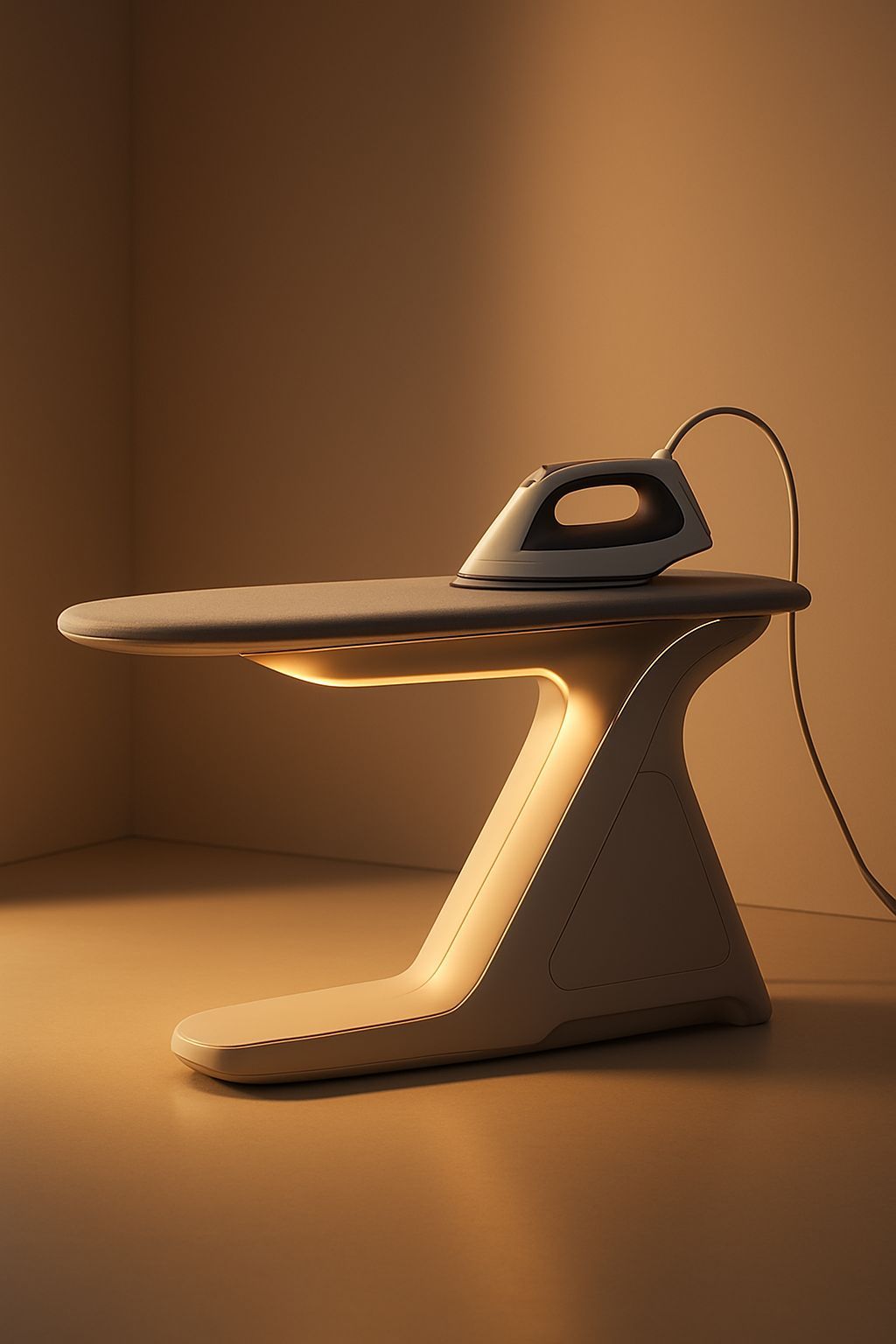
The act of ironing, often perceived as one of the most boring and tiring domestic impairments, can turn into a surprisingly efficient and even pleasant activity, provided they have the right tools. Although attention is often focused on the choice of the most performing iron – steam, boiler, vertical – an equally crucial element, and sometimes underestimated, is the ironing board. Far from being a simple support plan, a well-designed ironing board is the basis on which each effective ironing session is built. Imagine investing in a state-of-the-art iron, capable of generating powerful steam jets and sliding on the fabrics with a surprising lightness, and then using it on an unstable axis, with a ruined plan or an inadequate cloth. The result would be useless fatigue, stubborn folds and growing frustration. The truth is that the ironing board is the silent but fundamental partner of your iron, a true ally that can elevate the quality of your ironing, reduce its time and significantly improve your comfort. This is because a good axis must offer stability, an optimal surface for the diffusion of heat and moisture absorption, and ergonomics designed to prevent incorrect postures and fatigue. It must be robust but at the same time handy, easy to open and close, and to store without cluttering. With the evolution of materials and technologies, the market today offers a wide range of ironing boards, from simple and essential to those equipped with intelligent optionals and innovative design. Orienting in this offer may seem complex, but with the right information, choosing the perfect ironing board for your needs will become a clear and satisfying process. This complete guide has been designed to accompany you step by step in discovering all the features that make an ironing board an intelligent investment, analyzing in depth every aspect, from building materials to more advanced features, from space saving solutions to maintenance tips. Our goal is to provide you with all the tools to make a conscious decision, allowing you to transform ironing from a loom into a smoother, efficient and even rewarding experience. Forget the surface guides and get ready to explore the world of ironing boards with a new perspective, discovering how a seemingly simple accessory can make a huge difference in the care of your garments and the well-being of your home. Whether you are neophytes or ironing experts, parents with laundry batteries to face or singles attentive to details, here you will find the tips and information necessary to choose the model that will revolutionize your approach to this activity. We are ready to immerse ourselves in every technical, functional and aesthetic detail, to ensure you make the most suitable choice for your needs and your lifestyle. The perfect ironing is not a mirage, but the result of a winning combination between a good iron and, above all, an ironing board up to expectations.
no
The Perfect Anatomy: Essential components of a Higher Quality Ass
no
When talking about ironing board, its effectiveness and durability depend largely on the quality of materials and the robustness of its structure, often neglected elements in favor of more striking aspects. The ironing board is a complex system, consisting of different parts that must work in harmony to ensure optimal performance. The heart of each axis is undoubtedly its frame or supporting structure, which determines the stability and ability to bear the weight of the iron (especially those with integrated boiler), the pressure exerted during the ironing and occasional movements. The most common frame materials include thesteel solid wood (often beech, as in the models Foppapedretti and Mottiwood), and sometimes thealuminium for the lightest options. Steel, such as the one used in Gimi Jean or in Gimi Pollicino, offers excellent durability and resistance over time, and is often treated with epoxy paints to prevent corrosion. A tubular steel frame with generous diameters, such as the 35mm of the Colombo Turbo, ensures remarkable stability and minimizes the oscillations that could compromise the precision of ironing. Solid wood, on the other hand, gives not only a more traditional and warm aesthetic, but also an intrinsic solidity and wear resistance that make it a premium choice, as demonstrated by the Foppapedretti Assai and Mottiwood Premium models. Wood also has the advantage of being a natural and sustainable material, and its robustness is often accompanied by a greater weight, which further contributes to stability. Aluminium, although less common for frames complete with large axes, is appreciated for its lightness, making the axis easier to move and store. Regardless of the material, the frame design must include a safe lock mechanism that prevents accidental closures during use, a fundamental aspect for home security, as highlighted in the Vileda Total Reflect M.
no
In addition to the frame ironing plan is the other fundamental component. Its composition directly affects the efficiency of ironing. The floors can be made in different types: perforated or mesh metal is the most widespread, as it allows the steam to penetrate through the tissues and disperse down, avoiding the formation of condensation and excessive moistening of the garments. Examples such as the ASTIR 622 with its perforated and galvanized mesh top emphasize the importance of this feature. Plans in poplar or multilayer wood (as in the Foppapedretti Assai) offer a more rigid and stable surface, but they must be properly drilled to ensure the transpiration of steam. Some high-end models use surfaces in composite material or with patented technologies to improve the smoothness and reflection of heat. The heat and moisture resistance of these floors is crucial to prevent deformations or damage over time. I feet of the axis they also deserve attention: they must be robust, preferably with anti-slip rubber inserts (as in the ASTIR 622 and Mottiwood), to ensure a firm grip on any type of floor and prevent accidental movements during stretching, further increasing safety. The shape and size of the plan are then aspects to be considered according to the type of garments to be ironed. Larger planes (such as the 120×44 cm of the Colombo Turbo or the 143×39.5 cm of the Mottiwood Premium) are ideal for linen and tablecloths, while more compact or dedicated plans (Gimi Planet Stiramaniche, Leifheit Stiramaniche) are perfect for details or for those with little space. The overall stability, determined by the crossing of the legs and the quality of the blocking mechanisms, is the last, but not least, pillar on which the functionality of a quality ironing board rests. A solid and well-balanced structure reduces physical exertion and increases precision, transforming potentially stressful activity into a more smooth and rewarding task.
no
Beyond the Surface: The Critical Importance of the Stress Plan and Telo Copriasse
no
The ironing plan is not only a physical support for leaders, but an active component that directly affects the effectiveness and speed of the process. Its composition and, in particular, the choice of covered roof, they are details that can make the difference between a laborious ironing and a fluid and smooth and smooth. Most floors are perforated to allow vapour leakage, preventing the accumulation of moisture that could re-weather the tissues or cause condensation under the axis. This principle is essential to obtain dry and perfectly smooth garments. Some floors, such as wood, are treated to resist moisture and heat, maintaining their structural integrity over time. True innovation, however, is often manifested in the axis. Traditionally, the covers are made in 100% cotton, appreciated for its heat resistance, naturalness and good iron smoothness. A padding in spring (a thick and soft fabric, often made of cotton or polyester) under the cotton cloth, as it is found in many models Gimi (PinkGimi, Gimi Planet Stiramaniche) and ASTIR 622, is essential. This cushioning layer protects the underlying plane, provides a soft surface that prevents the formation of signs on the fabric due to the underlying network and improves the distribution of heat, allowing the iron to flow without friction.
no
Technological evolution has introduced covers with advanced features ranging beyond simple cotton and cotton. An excellent example is technology Total by Vileda, where the cover incorporates one allied layer. This innovation is designed to reflect both steam and heat towards the head, rather than disperse them down. The benefit is twofold: on the one hand, it significantly accelerates the ironing process, since the heat acts on both sides of the fabric almost at the same time; on the other, it completely prevents the formation of condensation under the axis, keeping the environment dry and protecting the tissues from excessive moisture. This results in a faster, more effective stretching with less energy consumption, as iron has to work less to achieve the desired result. Other axle covers can present special treatments, such as those anti-sticks or with nano-coating, which further improve iron smoothness and stain resistance. The maintenance of the seat cover is equally important for the longevity and efficiency of the stretching. It is advisable to choose removable and washable axis, so you can regularly clean them to remove starch, dirt or lime. When the cloth is worn, burnt or loses its padding, it is essential to replace it, since a damaged cover compromises the quality of ironing and can damage the garments or iron itself. Many manufacturers offer specific spare cloths for their models, ensuring perfect grip and functionality. Finally, the tension of the cloth on the floor is not negligible detail: a well-tight cloth, without creases or loosenings, guarantees a uniform working surface and prevents the formation of new unwanted folds on the garments. Some axle covers are equipped with adjustable elastic bands or cords to ensure a perfect grip, thus contributing to a seamless ironing experience and professional results. The careful choice of the cover, considering both the basic material and any integrated technologies, is therefore a crucial step to maximize the efficiency and pleasure of ironing.
no
Ergonomics and versatility: How the Right Axis Transforms Stress Experience
no
Ergonomics is a factor often underestimated in the choice of an ironing board, but it is crucial to prevent back pain, fatigue and to make activity less burdensome. A good ironing board should adapt to the user, not the contrary. The height adjustment is therefore one of the most important and widespread characteristics. Models like Foppapedretti Assai and Mottiwood Premium offer three adjustable positions, while the Colombo Turbo reaches up to six positions and the Gimi Jean allows a regulation up to 90 cm, and the Vileda Total Reflect M between 76 and 96 cm. This flexibility allows you to find the ideal posture for both standing and sitting, reducing stress on back and shoulders. The optimal height is the one that allows to hold the folded arm at about 90 degrees compared to the elbow, with the hand resting on the iron in a relaxed way. The adjustment mechanics must be smooth and secure, with a robust block that prevents accidental lowerings.
no
In addition to height stability general of the axis is fundamental. A board that breaks or swings not only makes ironing more difficult and less accurate, but can also be dangerous, especially with a hot iron. The legs must be robust and well spaced, forming a solid base. The non-slip feet, often rubber, are essential to ensure that the axis remains firm on any type of floor, as seen in the ASTIR 622 and Mottiwood. The axle weight also contributes to stability: heavier axes (such as the 12 kg of the ASTIR 622 or the 8.7 kg of the Assai Foppapedretti) tend to be more stable, although less easy to move. To overcome this last point, some larger axes or high weight are equipped with wheels integrated, which facilitate transport from one room to another or repositioning without having to lift the entire weight. This functionality is especially useful for those who have the habit of ironing in different areas of the house or must move the axis frequently.
no
The versatility of an ironing board is often extended by the presence of additional support points and integrated accessories. The base is an indispensable element for safety and comfort. It can be a simple, heat-resistant metal grille (such as the Gimi Jean or Mottiwood Premium), a removable support (Foppapedretti Assai), or a larger and robust platform, specific stainless steels with boiler ( Turbo stopper with ultra-resistant boiler port up to 10kg, ASTIR 622 with large folding door grill). The important thing is that it is stable, resistant to high temperatures and that allows to safely store the iron without risk of falls or burns of the cover. Another very useful accessory is the lower shelf or whitewashing grill. This additional space (present in Foppapedretti Assai, Mottiwood, ASTIR 622, Mottiwood Premium, Colombo Turbo) is perfect for supporting already stretched garments, ironing linen or even ironing products such as spray or starch. It helps maintain the ordered work area and at hand, improving the workflow. Finally, the iron, such as the Gimi Planet Stiramaniche or the Leifheit Stiramaniche 2.0, are specific accessories designed to iron sleeves of shirts, trousers and other small and difficult to manage on a large floor. They can be integrated into the axis (less common for standard axles) or purchased separately as table mini-axes. The ability to adjust the inclination or orientation of these accessories adds an additional level of comfort and precision. All these features, if well implemented, help transform the act of ironing from a burdensome task to a more manageable and less impactful activity on the body, significantly improving overall experience.
no
Technology at the Perfection Service: Advanced features for an Impeccable Stress
no
The innovation in the ironing board sector does not stop to the choice of materials or basic ergonomics; it extends to advanced features that can revolutionize the efficiency and quality of ironing, approaching the professional results. One of the most important considerations in the modern era is compatibility with irons with steam boiler. These irons, known for their potency and effectiveness of steam, are often heavier and voluminous than traditional irons. For this reason, many modern axes are designed with extra-large and ultra-resistant base, like the reinforced boiler door of the Colombo Turbo, capable of up to 10 kg, or the wide retractable grills of the ASTIR 622. These supports not only offer greater stability for heavy iron, but are also often equipped with heat-resistant silicone slots or mats to ensure safe heat dissipation and prevent damage.
no
Pushing further, some high-end ironing boards, often called “professional” or “active”, integrate systems suction and blowing. This is a real quality leap in the ironing experience. The suction system (or vacuum) creates a depression that fixes the tissue on the axis plane. This has many advantages: it prevents the garment from moving or sliding, making the ironing more precise; it aspires the excess steam through the fabric, instantly drying it and preventing the formation of condensation; and it helps to eliminate the most stubborn folds, since the fabric is ironed on a completely flat and stable surface. This is especially useful for delicate or difficult to handle fabrics, such as silk or linen. The blowing system (or blower), on the other hand, inflates the axis tart with an air flow. This creates a “air cushion” on which the garment can be ironed without direct contact, a precious function for delicate garments, prints or embroidery, which could be damaged by direct pressure of iron. It is also ideal to refresh already stretched garments or to give volume to fabrics such as wool or velvet, without flattening them. These active functions, although mainly present in more expensive models, are an investment for those who iron large quantities of laundry or have very specific care needs.
no
Another feature that greatly improves practicality is the presence of a integrated electrical socket on the axis itself. This eliminates the need for bulky and dangerous extensions, keeping the work area more neat and safe. Many of these sockets are equipped with a switch to turn on and off the iron directly from the axis, offering more immediate control. Some models also include a support for iron cable, which keeps it lifted and away from the fabric, avoiding that it hangs or twists during stretching, a small detail that makes a great difference in terms of fluidity and comfort.
no
Finally, even if less common in the home, some innovative ironing boards could integrate temperature sensors, digital displays or smart connectivity for ironing tips or to monitor usage. Although these are still market niches, they indicate the future direction of innovation, aiming to make the ironing experience increasingly assisted, efficient and even “intelligent”. The choice of an axis with these advanced features depends greatly on individual needs, frequency of use and budget, but it is undeniable that they represent the culmination of technology applied to a seemingly simple domestic accessory.
no
Space & Style: Space & Design Solutions for Every Home Care
no
In a time when living spaces tend to be more and more optimized and design plays a leading role in home furnishings, even the ironing board, a purely functional object, had to evolve to meet these new needs. The traditional folding axes have been flanked by a myriad of space saving and design-oriented solutions, capable of harmoniously integrating into each environment or disappearing completely from sight when not in use.
no
The most common type, the folding standard, she was perfected. Models like the Foppapedretti Assai and the ASTIR 622 are examples of axes that, while offering a wide ironing surface when open, close in extremely compact dimensions, standing alone and occupying a few centimeters wide (the closed Assai Foppapedretti measures only 14 cm wide). This makes them ideal for storage in a storage room, behind a door or in an unused corner of the laundry room, without requiring a fixed installation. The robustness of the locking mechanism and ease of opening are crucial aspects in these models, since a slender or unstable system would vanish the advantage of the compactness.
no
For those who live in really reduced spaces, the mini-axis table represent an excellent solution. The Gimi ASSE da Stiro Pollicino is a striking example: with dimensions of 73×32 cm, it can be used on any flat surface (table, counter) and, thanks to its folding hook, it can be hung inside a closet or behind a door, disappearing almost completely. These models are ideal for ironing small amounts of garments, for singles, students or as an additional axis for specific garments such as sleeves, a task in which the Leifheit Stiramaniche excels. Their portability also makes them perfect for travellers or those who need a temporary solution.
no
A step forward in space saving solutions are ironing boards or missing. These brilliant innovations provide a fixed wall installation, often within a cabinet or niche, from which the axis can be extracted and folded when necessary. Once placed, it disappears completely, leaving the environment free and neat. They are particularly appreciated in studio apartments, anguste laundries or service bathrooms. Some models also include drawers or compartments to store iron and accessories, transforming the entire unit into a complete but invisible ironing station.
no
For lovers of integration and minimalist design, there are also integrated ironing boards in furniture. These are often tailor-made solutions, where the axis is part of a drawer, a closet or an island of the kitchen or laundry. This option is the most discreet and blends perfectly with the decor, offering an immediate functionality when needed and disappearing completely when not in use. It requires greater planning during interior design, but the aesthetic and functional result is unparalleled.
no
Finally style and design of the ironing board have become important also for the most traditional models. The natural color of Foppapedretti Assai and Mottiwood beech wood gives an elegant and refined look, adapting to classic or modern contexts. The rugs, as noted in the Gimi Planet Stiramaniche with its assorted design, offer the possibility to customize the appearance of the axis, adding a touch of color or fantasy to the home environment. An ironing board is no longer just a tool, but it can become an element that contributes to the overall aesthetics of the house, especially when it is not completely hidden. The search for the perfect model must therefore balance the pure functionality with the ability to integrate harmoniously into the available space and reflect the user’s personal style.
no
The Value Beyond the Price: Durability, Sustainability and Maintenance of Iron Axis
no
Buying an ironing board should not only be a matter of initial price, but an investment in durability, long-term efficiency and, more and more often, in sustainability. A superior ironing board is designed to withstand the wear of time, moisture and intensive heat, turning into a reliable partner for years. The durability is inherently linked to the quality of materials and the care in the construction. A robust steel frame, solid wood treated (such as beech used by Foppapedretti and Mottiwood) or galvanized metal components (such as the ASTIR 622) are indicators of a product intended to last. Height and closing adjustment mechanisms must be solid and well assembled to withstand repeated opening and closing cycles without giving way. “Made in Italy” products, like many of the Gimi and ASTIR models, often provide greater attention to detail and high quality standards.
no
In addition to durability sustainability is becoming an increasingly relevant choice criterion. Prefer natural, recyclable materials or from sources managed responsibly, such as certified beech wood, can reduce environmental impact. Some manufacturers are beginning to use organic cotton for axle covers, such as Colombo Turbo, a small but significant step towards a more conscious consumption. The possibility to easily replace wearable components, such as the cover cloth and its padding, is another fundamental aspect of sustainability, since it extends the useful life of the entire axis, avoiding it to be thrown away prematurely because of a single damaged component. Investing in a durable ironing board also means reducing the frequency of purchases and, consequently, the production of waste.
no
The maintenance plays a crucial role in ensuring the longevity and optimal performance of your ironing board.
1. Cleaning of the cover: It is the most exposed part and tends to accumulate residues of starch, dirt, limestone and fabric fibers. If the cover is removable and washable (most is), follow the manufacturer's instructions for washing. Typically, gentle washing at low temperatures is enough. If it is not washable, you can clean it with a damp cloth and a delicate cleanser, making sure to dry it completely before reusing it.
2. Replacement of the cover: A burnt, burnt, stained cloth permanently or with flat padding loses its effectiveness. The surface will no longer be smooth, the steam will not spread properly and the iron may not flow well, risking to ruin the garments. Replace the axis cover and the underlying spring periodically is a minimal investment that preserves the quality of the ironing and protects the underlying plan.
3. Cleaning the floor: If the top below is perforated metal, it can accumulate dust and residues. Clean it with a damp cloth when the cover is removed. Make sure it is completely dry before putting the cover back to prevent rust.
4. Structure control: Periodically, check the stability of the legs and the functioning of the locking and adjustment mechanisms. Make sure all screws are tight and there are no loose or damaged parts. Lubricate joints if necessary with a dry lubricant to avoid cygolii or difficulty in opening/closing.
5. Correct storage: When not in use, place the axis in a dry place and protected by temperature and humidity changes, especially if it is a wooden model. Use the locking mechanisms to keep it secure.
no
Know when it is time to replace the whole ironing board is equally important. If the structure is unstable, the legs are damaged or are no longer securely blocked, if the plane is deformed or has irreparable breaks, or if the adjustment mechanisms no longer work safely, then it is time to consider a new purchase. A proven ironing board not only makes ironing ineffective but can also be a safety risk. Carefully assessing these aspects means making an informed choice that will bring benefits both for the long term for your portfolio and for the environment, ensuring an experience of ironing always at the top.
no
Guide to the Definitive Purchase: Find the Ideal Iron Axis for Every User Profile
no
After exploring the anatomy, technologies and design options of the ironing boards, it is time to distill all this information in a ultimate purchasing guide help you choose the perfect model for your specific needs. The “best ironing board” does not exist in absolute; there is only the one best suited to you. To make the right choice, it is essential to consider your user profile, your budget and available space.
no
User profiles and Choice Policy:
no
1. The Occasional Styrant or Who has Little Space:
- Existence: Draw a few garments at a time, save space, ease of storage.
- Criteria: Compact or table models.
- Features to Search: Lightness, easy and compact closing mechanism (such as the folding hook of the Pollicino Gimi), small size. A mini-axis like the Pollicino Gimi or an ironamanic like the Leifheit Stiramaniche are ideal. Traditional foldable axes that close in little space, such as the Assai Foppapedretti (14 cm wide closed) or the ASTIR 622, are also valid, provided they are not too heavy for occasional shift.
- Budget: Generally in the low or medium band.
no
2. Frequent Styrant or Middle Families:
- Existence: To stimulate moderate amounts of laundry regularly, comfort and efficiency.
- Criteria: Stability, floor width, ergonomics.
- Features to Search: Adjustable height on multiple positions (such as the Vileda Total Reflect M or the Colombo Turbo), generously sized stretching plan (120×38 cm or more), safe base, preferably with a lower shelf for the linen. Vileda's Total Reflect technology is a plus to accelerate ironing. The robustness is fundamental, therefore axes with steel frame or solid wood.
- Budget: Average band.
no
3. The Passionate Styrant or Numerous Families (or with Iron with Boiler):
- Existence: Draw large quantities of laundry, use an iron with boiler, achieve professional results, maximum efficiency and comfort.
- Criteria: Robust compatibility with boiler rings, advanced functionality, maximum stability and ergonomics.
- Features to Search: Extra-large and ultra-resistant poggiaferro (such as Colombo Turbo, up to 10kg), very wide stretching plane (such as the Mottiwood Premium with 143 cm long), solid wood or reinforced steel structure, robust adjustment mechanisms. Active axes with suction/suffling systems, although more expensive, can be a valid investment to maximize efficiency and quality. Wheels to facilitate movement.
- Budget: Medium-high or high band.
no
Additional considerations:
no
- Material: Prediligete axles with steel frames or solid wood for maximum durability. Drilled floors are always preferred for steam management.
- Copriasse: Make sure it is good quality (cotton with spring) and is easily replaceable. Technologies like “Total Reflect” offer added value.
- Security: Always check the presence of safety blocks for opening/closing and non-slip feet.
- Brand and Warranty: Consolidated brands such as Foppapedretti, Gimi, Vileda, Mottiwood, Arredamenti Italia (ASTIR), Colombo and Leifheit are quality assurance and often offer good customer service and spare parts availability.
no
Remember, buying an ironing board is a decision that will affect your routine for years. Do not rush and carefully evaluate every aspect, balancing functionality, durability, aesthetics and budget. A well-chosen ironing board is not only a tool, but a real investment in your comfort and care of your garments, transforming a daily task into a more enjoyable and rewarding experience. With this guide, you now have all the tools to make the smartest choice and enjoy an impeccable stretching every time.
no
Ultimately, the ironing board is much more than just an accessory: it is the pillar on which an effective and ergonomic ironing is based. We have seen how every detail, from the robustness of the solid beech or steel frame, to the reflective technology of the axis, to the width of the top and to the versatility of the height adjustments, contributes to defining the overall experience. Whether you are looking for a space saving solution such as Gimi Pollicino, stability and elegance of a Foppapedretti Assai, innovation of a Vileda Total Reflect M, or the power of a Colombo Turbo for your steam generator, the market offers options for every need and budget. Understanding the importance of a breathable plane, anti-slip feet and accessories such as the whitewashing shelf or the ironmanic, will allow you to transform a potentially boring activity into a more efficient and even rewarding task. Do not underestimate maintenance and sustainability, opting for durable products and replaceable components. Choosing the right ironing board means investing in your comfort, in the care of your garments and ultimately in the quality of your time. Armed with the detailed information provided in this guide, you are now ready to locate the perfect ally for your ironing sessions, raising your home routine to a new level of perfection and practicality.


