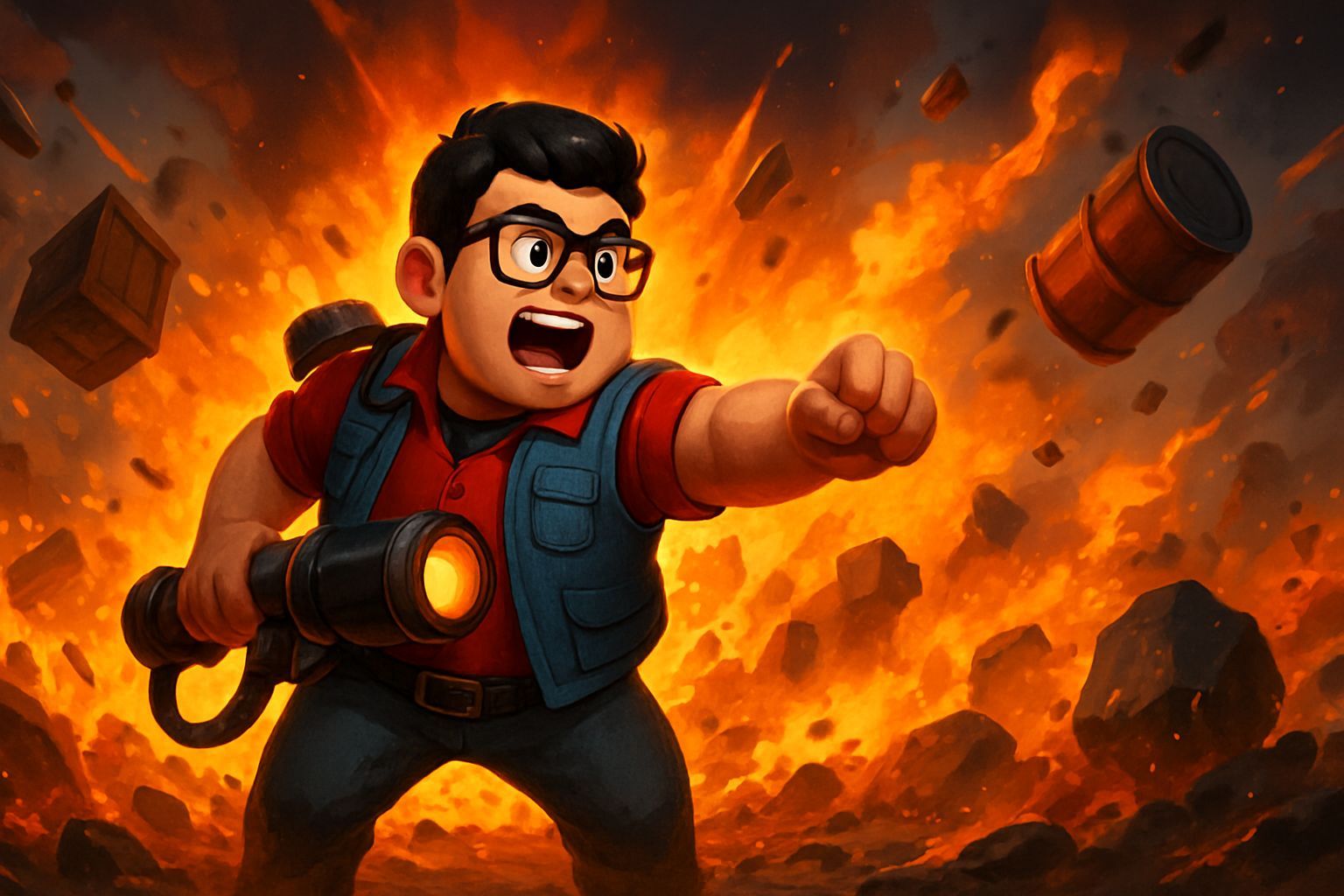
In the increasingly crowded panorama of open-world video games, Just Cause 4 has carved out a place of honor not only for its explosive theatricality and the indomite rebel spirit of its protagonist, Rico Rodriguez, but also for daring to push the boundaries of physical simulation and environmental reactivity as few other titles before him. The preview of the game, which catapulted us in the imaginary South American island of Solís, did not only confirm the ambitions of Avalanche Studios: to offer an experience sandbox unprecedented, where the chaos generated by the player merges with a wild and unpredictable nature, made alive by extreme climatic systems of a complexity and majesty so far rare. This approach is not limited to being a simple scenographic background, but becomes an integral element of gameplay, an opponent to face or an ally to exploit, transforming every mission and every moment of exploration into an opportunity for the most unbridled creativity. The Rico ramp, already iconic, is elevated to a tool of chaos engineering, able to interact with a world in constant change thanks to new changes that amplify the possibilities of destruction and environmental manipulation to the umpteenth power. Just Cause 4 is not just a follow, but a manifesto of the emerging game philosophy, where the rules of the world are bent to the fantasy of the player, and physics is not a limit but a canvas on which to paint eclarant gestures. However, like every ambitious experiment, Just Cause 4 is faced with the challenge of balancing this unconditional freedom with a coherent narrative progression and missions that fully enhance the arsenal of tools made available, avoiding the risk of falling into the trap of “more than ever” on a slightly larger scale.
The Sandbox Evolution: Beyond Ladder, Towards Dynamic Simulation
The Just Cause 4 approach to the concept of open-world marks a significant evolution compared to its predecessors and many other titles. While in the past the size of the map and density of activity were the main parameters to define a good sandbox, Avalanche Studios with Solís showed that true innovation lies in dynamics and responsiveness of the environment. It is no longer just a vast playground where to perform crazy gestures, but an interconnected ecosystem where the player's actions and the forces of nature influence each other in unpredictable ways. The island of Solís, divided into four distinct macro-areas – the snowy peaks nurtured by the storm, the dry desert with its sand storms, the lush and humid jungle, and the most civilized plains – does not offer simple backgrounds, but complete biomes, each with its own flora, fauna, settlements and, crucial, its extreme weather conditions. This variety is not purely aesthetic; each environment presents unique challenges and opportunities, pushing the player to vary their combat and movement strategies. For example, a sandstorm is not only a visual effect that reduces visibility, but a force that influences ballistics, flight and even enemy positioning, forcing Rico to adapt its approach. Similarly, the ascent currents generated by a tornado can be exploited for unprecedented altitude gains, transforming a mortal danger into a tactical opportunity. This level of interaction and simulation elevates Just Cause 4 beyond a simple action game, positioning it as a real emerging chaos simulator, where environmental conditions are never static and require constant adaptability. The focus on the physics of the wind, water and objects is not a hub, but the basis on which each interaction is built, making every moment of play unique and unrepeatable, a step forward towards an open-world that is not only great, but deeply alive and responsive.
The Tornado: Not Only Scene Effect, But Heart Gameplay Button
The tornado, fulcrum of natural disasters introduced in Just Cause 4, transcends the mere function of scenic effect to impose itself as a central and dynamic gameplay element, an opponent but also a potential ally. Its massive and unstoppable presence is not a mere destructive background, but a physical force shaped with a precision that influences every aspect of player interaction with the environment and enemies. Unlike snow or sand storms, already seen in other contexts, the tornado in Just Cause 4 is a tangible manifestation of the developers' bet on physics. It is not only objects that fly away, but a complex system of currents, winds and debris that can be analyzed, including and, in part, even exploited. Dealing with the tornado on foot or on a vehicle is often a suicide, but the genius of design is in allowing Rico to immerse itself inside, transforming danger into opportunities. Here, the mechanics of the ramp and the wingsuit take on a new dimension: the ascensional currents within the eye of the cyclone become a launching trampoline for daring aerial maneuvers, allowing attacks from above or impossible escapes. This “fly effect” is not a mere gimmick, but an advanced strategy that rewards audacity and understanding of environmental dynamics. The tornado thus becomes a unique “aircraft” tool, in which Rico can literally throw enemy vehicles, destroy bases, or disperse the forces of the Black Hand without firing a single shot, letting nature do the dirty work. Its programming is not limited to a default path, but interacts organically with the entire island, destroying bridges, buildings and vegetation in real time, constantly remodeling the battlefield. This capacity transform the landscape in a procedural and destructive manner, combined with the possibility to manipulate and interact with such an imposing natural force, position the tornado not only as a fearsome enemy, but as the largest and unpredictable “gadget” that the game provides, raising the concept of “emergency game” at levels never seen in an open-world.
The Rampino of Rico: From Traversal Tool to Ingenuity Platform
The ramp of Rico Rodriguez has always been the symbol of freedom of movement and destructive creativity in the Just Cause series, but in Just Cause 4 it is reinvented and strengthened, transforming itself as a simple traversal tool into a real chaos engineering platform. The introduction of three different types of integrated “gadgets” – the air lifter (auto-flating balloons), i retractor (high traction rectangles) and booster (mini-razzi propulsori) – is not a superficial addition, but the key to an unprecedented level of experimentation and physical interaction. Each of these upgrades can be customized through a detailed editor that allows you to change five physical variables, opening an infinity of combinations and applications. Do you want to levitate a tank in the sky with a bunch of balloons and then make it crash on the enemies with a boost of rockets? Do you want to attack an enemy to a vehicle and then ship both at crazy speeds with a powerful retractor? The possibilities are limited only by the player’s imagination. This freedom, however, brings with it a dual nature: on the one hand, it is an inexhaustible source of fun and “epic” moments for the most creative players and for those who love “to mess up” (especially in contexts of streaming or sharing); on the other, it raises questions about the actual integration of these mechanics in the main progression of the game. The original article highlights a potential risk: that the impact of these crazy combinations can go on the second floor, with many players who, after an initial phase of experimentation, could prefer a more traditional approach to shooters in the third person. This is not a fault of the mechanics itself, but a challenge of game design: how to constantly encourage the use of such powerful and creative tools, when is the solution “separate and destroy” often more immediate? The real strength of these gadgets lies in their ability to create a emerging gameplay, where the player does not follow a default path but builds his own solution, often in ways that the developers themselves had not predicted. Overcoming the feeling that they are “optional” and making them inherent in the resolution of the most complex missions will be the key to unlocking their full potential and consolidate Just Cause 4 as a truly revolutionary sandbox experience.
Power Physics: The Bet of Avalanche Studios between Realism and Pure Fun
The decision of Avalanche Studios of prefer physics compared to pure graphics represents a bold bet and a manifesto of their design philosophy for Just Cause 4. In an industry often obsessed with photorealism, choosing to devote massive resources to the simulation of complex climate systems, large-scale environmental destruction and the interaction between objects, vehicles and the Rico ramp, is a clear declaration of intent. It is not a question of sacrificing graphics, which however presents itself “good” for a preview code, but of recognizing that the depth of the interaction and the generation of emerging gameplay can offer an immersion and entertainment greater than a simple patinated aesthetic. The “vena tamarra” and the intrinsic exaggeration of the Just Cause series find in advanced physics their most fertile soil. We do not seek pedissequa realism, but rather an internal coherence that allows the player to understand and manipulate the laws of that altered world to create spectacular effects. A tornado that lifts entire buildings, vehicles that are launched for kilometers, explosions that propagate in chain: all this is possible thanks to a robust and optimized physical engine for the open-world scale. This technical choice is not exempt from challenges, as demonstrated by the “bizzarri pop-up poligonali” or the “rigidity of Rico in swimming” mentioned in the preview. Simulating such a complex and dynamic world, with hundreds of objects that interact in real time, requires enormous computing power and careful optimization. However, these “agreements still to be taken” are often part of the process of developing such an ambitious title. The investment in physics is what allows Just Cause 4 to stand out, transforming the game from a mere shooter to a unique “gatherer of stories”, where each player can tell their destructive epic. Avalanche’s bet is not only about immediate fun, but on the longevity and ability of the game to stimulate creativity and sharing “WTF movements”, elements that in an era dominated by streaming and social media have become crucial for the success of a title.
Seria Narration in a Chaos World: A Delicate Balance
The narrative premise of Just Cause 4, with Rico Rodriguez investigating the mysterious death of his father and going to the island of Solís, the operational base of the fearsome Black Hand, introduces a “a little more serious” tone than the tradition of the series. This attempt give greater emotional and motivational depth to the protagonist and his actions represents an intrinsic challenge for a game that makes chaos and exaggeration his trademark. The dilemma is ancient in open-world games: how to balance a linear plot, often rich in pathos and well-defined characters, with the almost unlimited freedom the player has to explore, deviate and generate their own emerging fun? Often, the immersion in the narrative is interrupted by the player’s tendency to “make casino” for the taste of doing so, creating a dichotomy between the urgency of the main mission and the natural trend of the sandbox. In Just Cause 4, this voltage is palpable: Rico is on Solís for a personal and serious matter, but the world around him is a constant invitation to the Ludic destruction and physical experimentation. The risk is that the seriousness of the plot is lost in the straw of explosions and in the madness of gadgets, or vice versa, that the desire to follow the narrative limits creative experimentation. However, Avalanche Studios seems to have tried to interweave these two aspects: the presence of the Black Hand as an omnipresent opponent and the need to “delete the criminal organization once and for all” offer a narrative justification for the escalation of chaos. The conquest of the territories and organization of the Caos Army, the group of rebels trained by Rico, can be seen as the manifestation of narrative progress through the sandbox mechanics. The delicate balance lies in making the main missions not only consistent with the plot, but also capable of push the player to use the entire creative arsenal of Rico, so that the “fare casino” is not a deviation, but an effective and recognized means to advance in history. If the game can make the player feel that every act of destruction and every crazy experiment contribute, even indirectly, to the resolution of the paternal mystery and the defeat of the Black Hand, then he will have found the square of the circle between narrative seriousness and pure sandbox fun.
The Innovation Cycle in the Sequel: Avoid the “More of the Same”
One of the most recurring concerns in the world of video games, and that the preview of Just Cause 4 has raised, is the risk that a sequel may fall into the trap of the “more of the same” on a slightly larger scale. This phenomenon afflicts many series of success that, in an attempt to capitalize a winning formula, end up offering marginal innovations that do not fully justify a new chapter. For Just Cause 4, this challenge is particularly acute given the inherently repetitive nature of some sandbox mechanics. Avalanche Studios has clearly attempted to counter this risk by introducing highly dynamic extreme climate systems and an upgraded ramp with unprecedented customization options. However, the question remains: are these innovations sufficient to maintain the fresh experience throughout the duration of the game, or will their novelty be exhausted after an initial phase of experimentation? The key to a successful sequel is not just adding new features, but integrate them deep and meaningfully in the main gameplay cycle, making them indispensable and not simple optional. The Caos Army system and the conquest of the territories, for example, are mechanics that have a strong potential to offer a more tactical and strategic progression, but as underlined in the article, “it is not exactly fresh mechanics” and its long-term impact depends on how well it marries with the rest of the experience. An effective innovation in a sequel must not only expand, but also reinterpret the foundations of the game. Just Cause 4 does it with environmental physics, transforming the environment itself into a game tool and an opponent. But the real challenge lies in designing missions that cannot be solved with the traditional approach, pushing the player to master the new mechanics of the ramp and exploit the extreme weather conditions. If the missions limit themselves to prefixed paths or simple “go there and shoot”, then innovations will risk remaining unused. The success of Just Cause 4 in overcoming the dilemma of the “more of the same” will depend on its ability to building an experience where exaggeration and creativity are not only for optional content, but they are the heart of each goal, constantly encouraging the player to think out of the schemes and to explore all the crazy possibilities the game offers.
Experience from Sandbox to Extremity: The Power of the Emergency Game
Just Cause 4 elevates the concept of sandbox game to another power, offering an experience that goes beyond the simple exploration of an open world to fully embrace the potential of emerging gameplay. The real focus of this evolution is not only the vastness of Solís or the variety of biomes, but the ability of the game to provide the player with environmental tools and dynamics that allow to create their own stories and solutions, often in ways that the developers themselves could not predict. The highly customizable ramp, with its air lifters, retractor and boosters, becomes a construction kit for chaos, a real “commercial gameplay factory”. It is not a matter of following a default path, but of inventing strategies on the moment: levitating an enemy with balloons and then launching it against another with a retractor, or turning a peaceful agricultural vehicle into a ground-air missile with a cluster of boosters. These interactions are not scripted, but arise from the combination of the physical rules of the world and the ingenuity of the player, generating unique and often hilarious moments. The introduction of dynamic storms, especially tornadoes, further amplifies this potential. The tornado is not a fixed obstacle, but a reactive entity that can be “filled with your own will” if understood. Take advantage of its ascensional currents for tactical advantage, or use it to shave a enemy base to the ground, transforms the landscape into a changing field of play that requires adaptability and creativity. This emphasis on emerging game has significant implications for replayability and for the community of players. Each session can be radically different, and the most spectacular moments become ideal material for sharing on social media, YouTube videos and Twitch streaming, where players compete to invent the most absurd and creative way to achieve a goal. Just Cause 4 does not only offer a game, but a “cassetta of tools” for fun, a workshop where the laws of physics become a tool for fantasy, placing the player at the center of narration and the generation of a chaos that is always spectacular, often unpredictable, and always intrinsically his.
Technical optimisation and Compromise Art: Production Challenges
The technical ambition of Just Cause 4, with its vast dynamic open-world, advanced physical simulation and complex climate systems, inevitably meets the intrinsic challenges of modern video game production. The preview of the game has evidenced some technical imperfections, such as the “discreet stiffness of Rico in swimming”, “the very yield of the little fluid water”, “bizzarri pop-up poligonali” and “qualche incastro of the character himself in the environment”. These observations, although common in the preview codes that by their nature do not represent the final product, serve to remind us the art of compromise and the complexity of optimization in such projects. Developing a game engine capable of managing large-scale destructibility, a physics of objects and vehicles so detailed, and at the same time animating a living world with different biomes and extreme weather conditions, requires a huge amount of resources and a constant balance between performance and visual quality. The priority given to physics, while being a conceptual force, also implies a significant computational load, which can lead to having to sacrifice the finishing of other details, such as water animation or swimming fluidity. Polygonal pop-ups and environmental recesses are typical “bug” that emerge when pushing the limits of the graphic and physical engine in such a vast and interconnected environment. The “revision” phase after the preview is crucial to “adjust” these aspects, not only to improve aesthetics, but also to ensure a smooth and frustrated gaming experience. This process of final optimization is often long and meticulous, and aims to eliminate imperfections without compromising the soul of the game, which in Just Cause is undoubtedly exaggeration and controlled chaos. The technical observations of the preview are therefore not an alarm bell, but a reminder of the continuous challenges that developers face to deliver increasingly complex and interactive virtual worlds, and how the final version of a game is the result of thousands of small and big technical and artistic decisions, all aimed at achieving a balance between ambition and reality.
The Future of the “Caos Controllato”: Learn Industry from Just Cause 4
Just Cause 4, with its emphasis on extreme physical simulation and dynamic climate systems, offers valuable lessons to the entire video game industry, outlining possible directions for the future of “controlled caos” and open-world interactivity. Its approach shows that innovation does not necessarily have to reside only in photorealistic graphics or in the size of the map, but can and must be found in depth of environmental interaction and creative freedom granted to the player. The industry can learn from Just Cause 4 the importance of investing in robust physical engines that allow large-scale destructability and detailed manipulation of objects. This not only generates immediate fun, but also nourishes emerging gameplay and the creation of content by the community, increasingly vital factors in the current media scene. The ability to transform a static to dynamic environment, with weather events that are an integral part of gameplay rather than simple visual effects, opens new frontiers for mission design and strategic interaction. Instead of limiting the player with predetermined paths, the future open-world could emulate Just Cause 4 in providing increasingly sophisticated “tool boxes”, encouraging players to find unique and unpredictable solutions to problems. In addition, the success or not of Just Cause 4 in balancing its “serious” narrative with the innate tendency to the chaos of its gameplay systems will provide a crucial case of study for other developers seeking to instill emotional depth in contexts with high freedom. It will be a test to understand whether purely playful fun can effectively coexist with a more mature plot without diminishing each other. Just Cause 4 is not just a game, but a daring experiment. Its innovations in the field of physics and design sandbox may not be perfect at launch, but its long-term impact could reside in the demonstration that players want worlds that are not only beautiful to see, but also infinitely interactive and shaped by their imagination, pushing industry to consider new definitions of immersion and fun.
Ultimately, Just Cause 4 is a crucial chapter in the Rico Rodriguez saga and, more generally, in the evolution of the open-world genre. Despite the inevitable imperfections of a code preview and the challenges inherent in the balance between freedom and structure, the game of Avalanche Studios stands out for its bold vision. He dared to push physical simulation and environmental dynamics to unprecedented levels, transforming Solís Island into a real reactive ecosystem and natural disasters into gameplay tools. The ramp of Rico, now an unparalleled ingenuity platform, embodies the philosophy of a game that invites wild experimentation, promising an experience in which the player is the real architect of chaos. Although the final success will depend on the cohesive integration of all these ambitious mechanics in progression and missions, Just Cause 4 has already demonstrated the potential of a future where virtual worlds are not only vast, but intrinsically interactive, emerging and constantly surprising. His legacy will not only be to have offered another round of explosive carousel, but to have drawn a course for industry, demonstrating that true innovation lies in the ability to transform physics into an art and chaos into an expression of pure ludic creativity.


