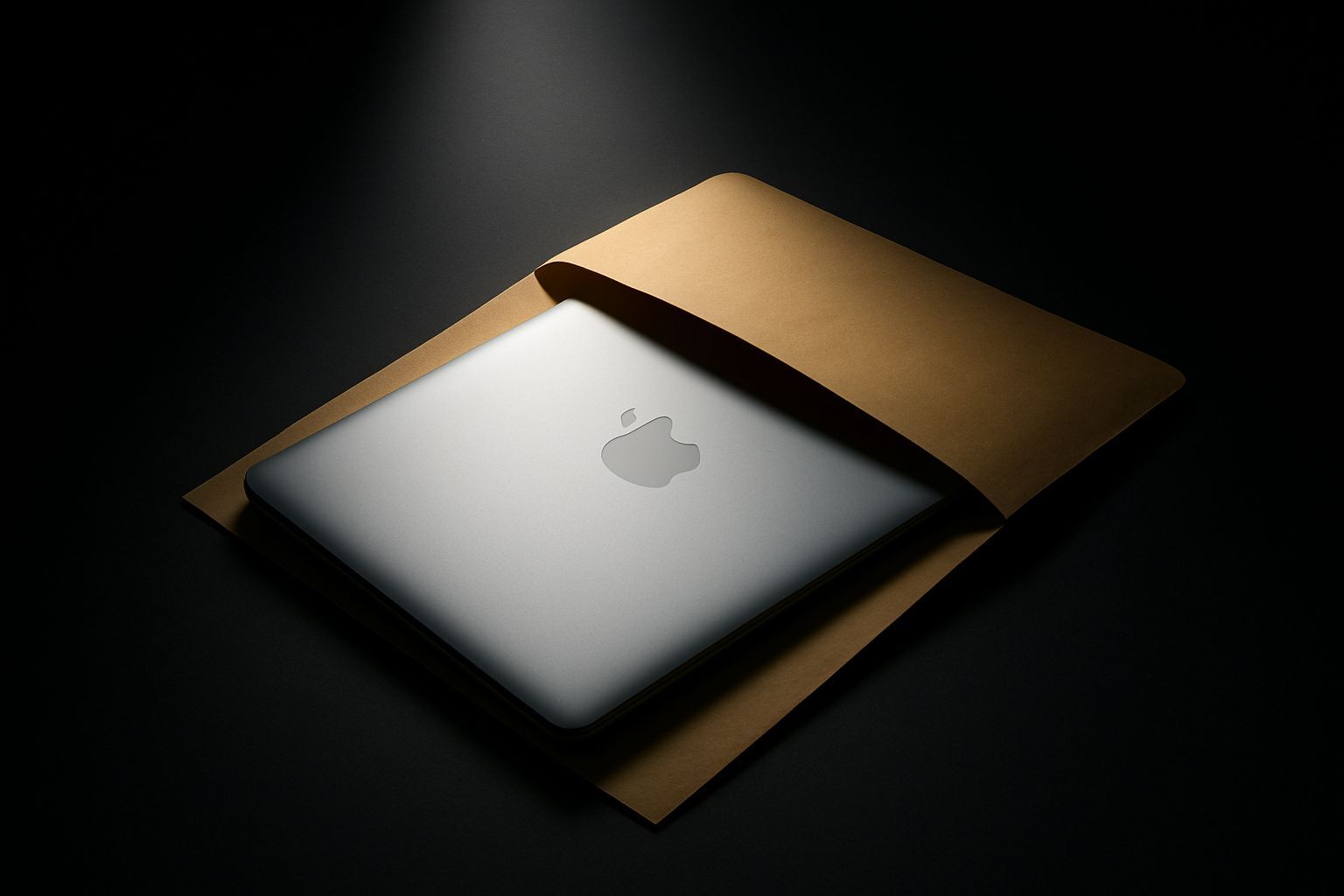
On January 15, 2008, the technology world stopped to attend Steve Jobs’ annual keynote at the Macworld Expo. The wait was palpable, the fervent speculations. But no one was really prepared for the announcement that he would start a new era in laptop design: the introduction of MacBook Air. Jobs, with his unmistakable stage mastery, extracted the new device from a document envelope, a gesture that alone crystallished the essence of this product: an incredibly thin, light and surprisingly powerful machine. It was a time that would redefine the expectations of what a laptop could be, but also raised crucial questions about the price of innovation and the accessibility of cutting-edge technology.
This article aims to dive into the past, reanalyzing the launch of the MacBook Air from the point of view of 2008. We will explore its revolutionary features, the market context in which it emerged, the bold design decisions of Apple and the inevitable debate on its cost. Understanding the 2008 MacBook Air does not only mean celebrating an iconic piece of modern engineering, but also analyzing how Apple once again dictated the rules of the game, while leaving many to question its price strategy in a rapidly evolving market. We will immerse ourselves in its specifications, compare its position with emerging netbook competition and evaluate its long-term implications for the industry.
The Alba of Ultra-Portatili: The 2008 Technological Context
To fully appreciate the impact and relevance of the MacBook Air, it is essential to frame it in the technological panorama of the first months of 2008. At that time, the laptop market was booming, but it was still dominated by machines that, although increasingly performing, often sacrificed portability in favor of power and functionality. The average laptops were relatively bulky, with 15-17 inch screens and weights that could exceed 2-3 kilograms.
However, a new category of devices was emerging: the ultra-mobile PC or, as they would have been more commonly called, the netbook. These were extremely compact, lightweight and economical laptops, designed primarily for web browsing, email and basic text processing. Pioneering examples such asAsus Eee PC, launched a few months earlier, or gPC models, showed that there was a market for minimalist devices and focused on connectivity. With prices ranging from $299 to $499, netbooks were accessible to a broad audience and were a direct response to the growing demand for a computer to always carry with it, often as a second device.
This trend was fueled by the nascent ideology of cloud computing. Although not yet mainstream, the idea that applications and data could reside on remote servers, accessible via the internet, was slowly shaping the approach to device design. Netbooks, with their reduced local storage capacity and strong emphasis on Wi-Fi connectivity, were the first messengers of this revolution. Their philosophy was clear: less dependence on locally installed software and physical media (such as CD/DVD), and more emphasis on the network as a primary source of resources.
In this scenario, Apple, a company renowned for its attention to design, user experience and premium positioning, still had no proposal to respond directly to this emerging segment of ultra-economic and ultra-furniture laptops. While the MacBook and MacBook Pro dominated the mid-range and high-end laptop market, Cupertino's home seemed to observe from afar the evolution of netbooks. The arrival of the MacBook Air, however, would have shown that Apple not only had observed, but had interpreted the trend in a completely different way, raising the concept of “ultra-porttile” to a level of sophistication and unequaled price, simultaneously pushing users towards a more connected and less bulky future.
The MacBook Air: A Prodigy of Engineering and Style
When Steve Jobs revealed the MacBook Air, the element that immediately caught the attention was his incredible, almost surreal, subtlety. With a thickness that varied alone 0.4 cm (0.16 inches) in the thinner point at 1.94 cm (0.76 inches) in the most often, it was undoubtedly the most subtle laptop in the world at the time. This figure was even more impressive when compared to its contemporaries, including other Apple models that already boasted a refined design. The weight, just 1.36 kg (3 pounds), made it a real feather weight, easily transportable with one hand, and Jobs himself compared it to the thickness of an iPhone in a case, a device that had already established new standards of compactness.
But subtlety was not his only virtue; it was the result of meticulous engineering and bold design choices. MacBook Air presented a shell unibody in aluminium, a construction technique that Apple would later extend to other products such as the MacBook Pro, ensuring not only superior structural resistance but also a clean and uniform aesthetic. Despite the small size, Apple refused to compromise on the basic user experience. The device included a standard size backlit keyboard, a must-have for productivity in every light condition, and a brilliant 13.3 inch LED-backlit screen with 1280×800 pixel resolution. This display not only offered bright colors and wide viewing angles, but was also housed in a thin frame that maximized the visual area, ensuring that, despite its compact size, the Air did not feel like a compromise in terms of everyday usability.
The true revolution in interaction, however, resided in its multi-touch trackpad. Taking full hands of the iPhone’s experience of use, launched just a year earlier, the MacBook Air trackpad allowed more finger gestures such as “painting to zoom”, scrolling to two fingers and turning. It was the first time that such functionality was integrated into a laptop, raising interaction with the macOS operating system at an unprecedented level of fluidity and intuition. This was not just a thin laptop; it was a machine that redefines the human-computer interface in the context of portable devices, making interactions more natural and less dependent on external mouse.
Under the elegant shell, the MacBook Air was powered by a processor Intel Core 2 Duo 1.6 GHz or 1.8 GHz, combined with 2 GB of DDR2 RAM. For storage, it offered two significant options for the time: a traditional 80 GB hard drive or, for those who were willing to pay a considerable prize, a drive 64 GB Solid State Drive (SSD). The SSSD, at the time a costly and niche technology, promised more speed, impact resistance (being free of mechanical parts in motion) and almost silent operation, clearly prefigure the future of storage devices in high-performance laptops.
Its connectivity, however, was deliberately essential, almost spartan: a single USB 2.0 port, a Mini DisplayPort output (for which an adapter was needed to connect to VGA or DVI monitors) and a headphone jack. The absence of a wired Ethernet port was offset by Wi-Fi 802.11n and Bluetooth 2.1+EDR integrated, emphasizing its vocation for an increasingly wireless and connected world. This combination of powerful hardware, minimalist design and innovative features made it an object of desire for many, but its price firmly placed it in the premium segment.
Apple Vision: Beyond the Surface
The MacBook Air was not just a new computer; it was a real statement of intent by Apple. Steve Jobs and his team were drawing a bold course for the future of personal computing, a route that favoured lightness, ultra-portability, wireless connectivity and strategic elimination of components considered unnecessary for the user experience they intended to offer. This vision anticipated many years of trends that would become standard in the next decade.
The most obvious and controversial decision at the time wasabsence of an integrated optical unit. In 2008, burning CD/DVD was still a common practice for software installation, data backup, film and music playback. Eliminating this component meant a strong bet on the future of digital distribution, multimedia streaming and, in a way, of cloud. It was a move that forced users to adapt to new habits, but that made the device significantly thinner and lighter.
To mitigate this apparent limitation, Apple introduced two innovative solutions: Remote Disc and Time capsules. Remote Disc was a software feature that allowed MacBook Air users to access the optical drive of another Mac or Windows PC, connected to the same Wi-Fi network, to install software or copy files. It was an elegant solution, although it depended on the availability of another computer nearby. Time capsules, also launched in 2008, was a Wi-Fi base station with an integrated hard drive. Not only did it facilitate wireless backups for network Macs through Time Machine, but it could also act as a multimedia server and, in a way, as a “virtual optical drive” for the Air, thanks to its file sharing function and the possibility to mount disk images.
The connectivity strategy of the MacBook Air was also far-sighted and targeted. With the single USB port, Apple implicitly encouraged the use of wireless peripherals and dependence on internet-based services. The absence of Ethernet, although resolved with a USB adapter, strengthened the message that the future, according to Apple, was without cables and without physical limits. It was a device for a user traveling light, who worked mainly with web applications and who did not need a wide collection of connected peripherals. This minimalist approach was criticized by some for its lack of practicality, but it represented a clear vision of a leaner and mobile computing.
The market target of the MacBook Air was therefore very specific. It was not the computer for students with limited budgets, nor for professionals who needed numerous doors for dongles and external devices. It was a product designed for executives, creatives, early adopters and for anyone who wanted to make a statement of style and appreciated the apex of engineering and design. It was a machine for those who were willing to pay a prize not only for the Apple brand, but for a vision of computing that, at the time, was still futuristic. Apple, with the MacBook Air, not only created a new product, but modeled expectations on what a premium laptop should offer, anticipating trends that would become mainstream only years later.
The Innovation Price: A Barrier or Strategic Positioning?
Despite the obvious appeal and undeniable technical innovations, the price of the MacBook Air was immediately its most controversial and debated aspect. With an initial cost of $1799 in the United States for the basic model, and with figures that were dramatically rising for the most advanced configurations, such as the 64 GB SSD, the Air was positioned in an extremely high market range. The SSD version, for example, could exceed $3,000 in the USA and reach the impressive figure of 4338 AUD (about 3881 USD at the time) in Australia, as properly highlighted by the original article of TechCrunch. This was a price higher than that of many high-end MacBook Pros of the time, making it a luxury for most consumers and not a machine accessible to all.
The comparison with netbooks, which offered an ultra-portable experience for a fraction of the cost (between 299 and 499 dollars), highlighted Apple’s aggressive and distinctive price strategy. While netbooks aimed at democratizing web access and basic productivity, the MacBook Air placed at the extreme opposite of the spectrum, proposing itself as the apex of sophistication, design and performance in an ultra-thin format. The question that many analysts and consumers asked was: did innovation and design, however exceptional, justify such a prize?
On the one hand, the price was undeniably a significant barrier. It drastically restricted the market potential of the MacBook Air, making it inaccessible to most of the world's population. Global economies were also on the verge of a recession, and households and businesses were becoming more cautious in their expenditure on non-essential consumer goods. In this uncertain economic context, a laptop of almost 2000 dollars (or more, in other currencies) seemed a significant investment, especially for a device that, at first sight, sacrificed some “commun” features (such as the optical drive or the numerous doors) for its extreme form.
On the other hand, the price could be interpreted as a strategic and deliberate move of Apple, perfectly in line with his brand philosophy. The company has always placed its products in the premium segment, intrinsically combining them with superior quality, cutting-edge innovation and, in a way, a status symbol. The MacBook Air was no exception. It was a luxury product, designed for a few, but with the intention of generating a “halo effect” (or “halo effect”) on the entire Apple range. Such an extreme, innovative and desirable product strengthened Apple’s perception as an undisputed leader in design and technology, making the other MacBooks and iMacs, even though they were expensive, more “reasonable” and attractive than competition.
Moreover, it is important to consider the engineering necessary to create such a thin and light device, while maintaining high performance and good battery life, it was far from trivial. Research and development costs, the use of premium materials such as unibody aluminum, and the production of miniaturized and highly integrated components were high. From the point of view of Apple, the price reflected the real cost of innovation, production complexity and, above all, the perception of the value that such an object offered to a selected audience looking for the best, without compromise on design and experience.
Market implications and the evolution of Laptop
The launch of the MacBook Air did not go unnoticed in the technological sector at all. Immediately after its presentation, a heated debate was opened on its implications for the laptop market, intended to influence product strategies of almost all manufacturers over the next few years. One of the main concerns, also mentioned in TechCrunch’s original article, was the risk of cannibalization of traditional MacBook sales. For a price not much higher (in the case of the basic models of the traditional MacBook), you could have an incredibly thinner and iconic machine, with an unparalleled prestige and “wow” factor. This was a bold move, and only Apple, with its strong brand identity and its base of loyal customers, could afford to “destroy” partly its market to introduce a perceived product as more advanced and futuristic.
The MacBook Air, however, was not designed to replace the entire MacBook line, at least not immediately. Rather, it served to further segment the ultra-portal market. On the one hand, there were economic netbooks, oriented to pure functionality, internet access and basic productivity for the masses. On the other hand, the Air imposed itself as the premium ultra-mobile, a high-end device for demanding customers who valued design, extreme portability and technological innovation. This distinction would shape competitors’ strategies, which would try to replicate Air’s aesthetics and functionality, often with poor results or significant compromises in terms of construction quality and software.
The long-term impact of MacBook Air on industry was deep and undeniable. It was the catalyst of a trend that led all PC manufacturers to try to make their laptops thinner, lighter and more elegant. The internal architecture, the disposition of components to optimize space, the use of integrated batteries to maximize the durability and the increasing adoption of SSDs as standard for performance and resistance became the norm in the following years. Wedge design, tapered profile and manic attention to aesthetic details influenced a myriad of products, culminating in the creation of the category of ultrabook by Intel in 2011, an explicit attempt to replicate Apple's success with Windows PCs, adopting the main features of design and lightness.
The 2008 MacBook Air was also a precursor of the era of devices “post-PC”. Its emphasis on wireless connectivity, the almost total absence of physical ports and network dependence anticipated the design of future and highly successful products such as the iPad, also launched by Apple a few years later. It proved that users were ready to sacrifice some traditional conveniences (such as optical drive or plethora of doors) in exchange for extreme portability, a leaner user experience and greater integration with the digital ecosystem. It was a fundamental lesson in the fact that form and function could evolve in unexpected ways, dictating new needs and expectations to consumers.
In summary, although it was not a success in mass sales at its debut due to the price, the MacBook Air was a strategic success and an unprecedented innovator. He designed a clear vision of the future of portable computing and established new standards for design, construction and interaction, leaving an indelible mark in the evolution of modern laptop and shaping the foundations for mobile devices that we today give for discount.
Conclusion: The legacy of a Subtle Icon
The 2008 MacBook Air was not simply a new product in the Apple catalog; it was a statement, a bold experiment and, in retrospective, a fundamental step in the evolution of personal computing. On his debut at the Macworld Expo, he captured the imagination of millions of people with its incredibly slim and light design, its clean aesthetics and its innovative multi-touch features. Steve Jobs introduced him not as a simple laptop, but as “the subtlest notebook in the world”, a statement that shook the market and posed new challenges to the whole industry.
Yet, its high initial price made it a luxury for few, a niche product intended for executives, creatives and early adopters willing to pay an award for the apex of engineering and design. The debate on the price-quality ratio was lit, especially in a context where economic netbooks were gaining popularity. However, Apple, with its unwavering vision, refused to compete on prices, preferring to elevate user experience and push the boundaries of what was technologically possible. This boldness, although costly for the consumer, has often repaid in terms of leadership and influence on the market.
The elimination of the optical drive, the dependence on wireless connectivity and the introduction of the multi-touch trackpad with muti-touch gestures were bold choices that prefigured future trends in computing. The MacBook Air not only influenced the design of all laptops to come, inspiring the category of ultrabooks and making subtlety a fundamental requirement, but it was also an important precursor of “post-PC” devices, preparing the ground for the iPad and for the idea of an ultra-portable computer, always connected and with a more intuitive user interface.
Ultimately, the 2008 MacBook Air is evidence of Apple's ability to innovate, define new product categories and challenge the status quo. It was an imperfect machine for many, because of its high price and some practical limitations for the time, but its historical importance and legacy are undeniable. He showed that a laptop could be elegant, powerful and incredibly portable, laying the foundations for the later Air models and for an entire generation of ultra-thin devices that we today give for discount. There remains a bold symbol of innovation, a reminder that sometimes the future has a considerable price, but it is worth it for those who dare to imagine it and for the impact it can generate on the long term.


