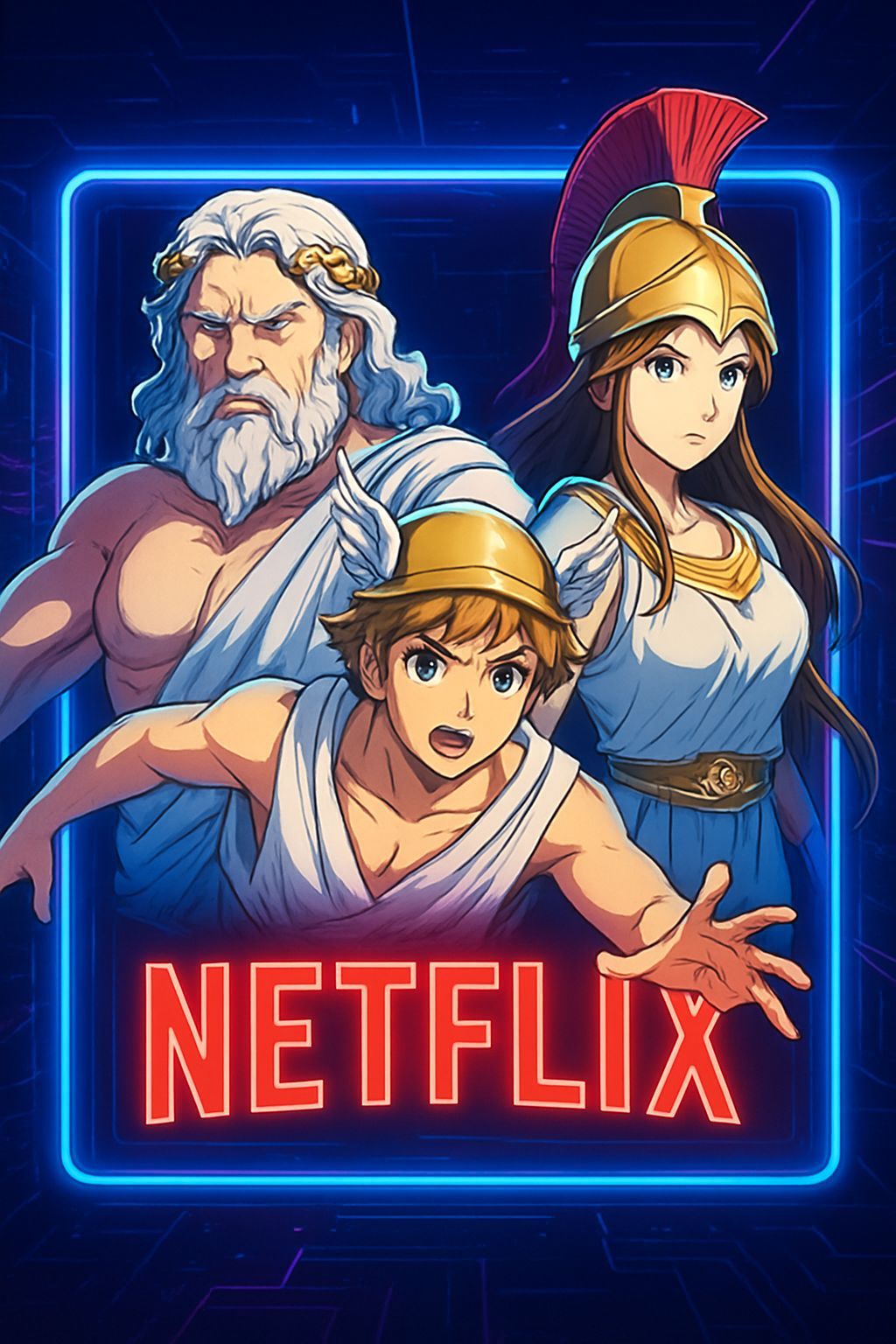
The streaming revolution radically remodeled the global entertainment landscape, opening new frontiers for the production and distribution of content. In this dynamic scenario, platforms like Netflix have taken on a major role, not only as simple film aggregators and TV series, but as real creative innovation engines. The announcement, now dating, of productions as “Gods & Heroes” (later) “Blood of Zeus”), a soul focused on Greek mythology, marked a significant moment in this evolution, highlighting a well-defined strategy by the giant of streaming: investing massively in animation, whether it be of oriental or western matrix, and rediscovering the narrative potential of millennial traditions. This particular project, born from the vision of Charley and Vlas Parlapanides, already known for the live-action adaptation of Death Note, and realized with the experience of Powerhouse Animation, it is not an isolated event, but rather a fundamental piece of a larger mosaic that sees Netflix engaged in expanding its animated offer in every direction. From the acquisition of Japanese cult titles to the creation of animated spin-offs of successful sagas as “Altered Carbon: Resleeved”, passing through strategic agreements with anime production houses such as Anima, Sublimation and David Production, the platform is consolidating its position as a global hub for fans of the genre. This article aims to explore in depth the implications of this strategy, analyzing how Netflix is redefining the approach to animation, fantasy genre and rediscovery of mythologies, outlining a future in which the boundaries between culture and media become increasingly fluid and the stories of gods and heroes can find new life and resonance in a vast and globalized audience. Through the example of “Gods & Heroes” and its broader context, we will try to understand how animation is becoming a universal and powerful language to tell complex and fascinating stories, overcoming linguistic and cultural barriers and profoundly affecting the way we conceive and consume entertainment.
The Ascese of Animation in Streaming: A New Paradigma
The animation industry has lived an unprecedented metamorphosis with the advent and consolidation of streaming platforms, and Netflix, in particular, has placed itself as a central actor in this revolution, redefining not only the mode of use but also the production standards and expectations of the public. Historically, animation was often relegated to a specific children's audience or niches, with television and film productions reflecting this perception. However, Netflix’s approach, focused on diversity and global reach, unleashed animation as a versatile and mature medium, capable of addressing complex issues and capturing the attention of a transversal audience. The ability of the platform to invest significant budgets in original projects has allowed creators to explore innovative visual styles and bold narratives, free from restrictions often imposed by traditional broadcasters, such as stringent hourly bands or sponsorship needs. This led to the birth of masterpieces acclaimed by critics as “Arcane”, which has demonstrated how a high quality animation can elevate a story from a video game to a higher artistic level, or as a series “Castlevania”, who has been able to merge the gothic aesthetics with a hectic action and a compelling texture. This is not just original production; Netflix has also acquired and made available worldwide a dirt catalogue of Japanese anime, contributing to make known works as “The Attack of the Giants” or “Fate/Stay Night” millions of new spectators outside their traditional audience. This unprecedented access has created a generation of viewers more open to different animated styles and unconventional narratives. The elimination of traditional “gatekeeping” allowed less conventional productions, but rich in potential, to find a global audience, challenging the perception that animation was a monocord genre. The new "binge-watching" distribution paradigm has also favored immersive consumption, allowing viewers to devote themselves entirely to a series, appreciating narrative continuity and character development in a way that weekly broadcasts did not allow. In summary, Netflix has not only broadcast animation; it has elevated animation to a primary form of art in the panorama of modern entertainment, demonstrating its power of innovation and its ability to generate deep engagement with public of all ages and cultural background.
The Immortal Charm of the Greek Myths in the Digital Era
Greek mythology, with its pantheon of capricious gods, tormented heroes, terrifying monsters and stories of love, betrayal and revenge, continues to exert an undeniable attraction on the collective imagination, demonstrating a narrative resilience that transcends millennia and means of communication. In the digital age, this charm not only persists, but is amplified thanks to new interpretations and formats that enhance its greatness and complexity. Success “Gods & Heroes”, subsequently issued with the title “Blood of Zeus”, represents an emblematic example of how ancient legends can find new life and resonance in a contemporary audience, demonstrating that the universal themes treated – power, destiny, free will, the struggle between good and evil, human and divine nature – are still incredibly current. In this context animation is a particularly powerful and versatile medium. Unlike live-action productions, which often have to deal with budget limits, complex special effects and the need to make credible fantastic creatures in a real environment, animation offers almost unlimited creative freedom. It displays the gods of Olympus with their supernatural majesty, to represent epic battles with a choreography that escapes the laws of physics and to shape mythological creatures in ways that would be difficult or excessively expensive to replicate in reality. “Blood of Zeus” has been able to grasp this opportunity, presenting a breathtaking visual aesthetic and a dynamic action that brings the viewer directly into the heart of divine clashes and heroic enterprises. The choice to tell a story original set in the universe of Greek mythology, instead of adapting an existing legend, is another strength. This approach allows creators, such as Charley and Vlas Parlapanides, to explore new perspectives, develop new characters and textures that, while respecting the mythological canon, surprise the audience with unexpected twists and psychological insights. The protagonist, Heron, a marginalized man who discovers that he is the secret son of Zeus, embodies the archetype of the hero destined for great things, but with a touch of modernity that makes him relationable. The series manages to balance the drama of divine struggles with the personal challenges of a mortal, creating a bridge between the world of gods and that of men. This ability to reimagine and update ancient narratives, exploiting to the maximum the visual and narrative potential of animation, is the key to Netflix’s success in bringing Greek myths to a new generation of spectators, confirming that, even in the most technological era, the call of immortal stories remains unchanged.
Netflix and the Global Soul Strategy: Beyond Cultural Confinitions
Netflix’s drive to animation is not limited to Western-style productions or reinterpretations of classical mythology; on the contrary, a substantial and strategic part of its global expansion plan lies in massive investment and promotion ofsouls japanese, overcoming cultural boundaries and transforming the platform into a real epicenter for fans of this genre worldwide. The initial announcement of “Gods & Heroes” was already included in a wider context of strategic agreements signed by Netflix with three of the most prestigious Japanese production houses: Soul, Sublimation, and David Production. These partnerships are not simple license contracts, but real collaborations aimed at producing original and high-quality content, consolidating Netflix's position as a primary destination for souls. The goal is clear: to offer a wide and diversified catalog that meets the tastes of a global audience, from long-standing fans to newbies. The success of series as “The Attack of the Giants”, “Fate/Stay Night”, “Devilman Crybaby” or more recently “Cyberpunk: Edgerunners” has demonstrated the enormous potential of engagement of the anime, not only in Japan but in every corner of the world. Netflix has been able to capitalize on this interest, making these works accessible with subtitles and dubbing in many languages, lowering linguistic and cultural barriers that in the past limited the spread of the genre. The strategy also includes creating animated spin-offs of successful franchises, such as the aforementioned “Altered Carbon: Resleeved”, which expands the narrative universe of the live-action series through the animated medium, offering fans a new perspective and neophytes an alternative entry point. Although live-action productions based on popular souls as Death Note, Bleach or FullMetal Alchemist they have often received a mixed welcome by the most purist fans, their role in Netflix’s strategy is undeniable: they act as a bridge, attracting a wider audience and introducing it to the aesthetics and narratives typical of the anime, hoping that these spectators also approach the original animated works. This multi-faceted approach is essential for Netflix’s vision to become the main hub for animation, not only as a distribution platform but also as an active partner in production, affecting gender and contributing to its evolution. The continuous investment in this sector is not only a response to the public’s demand, but a bet on the intrinsic ability of animation to transcend genres and cultures, telling universal stories with an unparalleled visual language.
Behind the scenes: Production, Collaboration and Innovation Animata
The realization of an ambitious animated project as “Gods & Heroes” (now known as “Blood of Zeus”) requires a complex synergy between creative vision, technical experience and a solid production structure, elements that Netflix has masterfully orchestrated. At the heart of this effort were creators, Charley and Vlas Parlapanides, whose experience in narrating compelling stories in fantastic worlds, as demonstrated in their work for the live-action film of Death Note, it turned out to be crucial. Their vision for an original work set in the universe of Greek mythology provided the narrative basis, but it was the collaboration with a first-rate animation studio like Powerhouse Animation to transform that idea into a visual reality. Powerhouse Animation, already renowned for its work on series acclaimed as “Castlevania”, brought to the table a distinctive aesthetic and a deep understanding of the nuances of action animation, ensuring that the epic battles and divine characters were represented with the right magnificence and fluidity. The animated production process is intrinsically long and laborious, starting from writing and writing storyboards, which act as a visual blueprint for each scene. Afterwards, we go to the design phase of the characters, environments and special effects, where every detail, from the muscles of a god to the plot of an armor, is meticulously treated. The choice of animated style, which in “Blood of Zeus” is clearly inspired by the Japanese anime while maintaining a Western footprint, it is essential to establish the tone and atmosphere of the series. To this is added the demanding work of real animation, frame by frame, which requires a large team of artists and technicians. The integration of advanced technologies, from 3D modeling for backgrounds and objects to motion capture for complex movements, blends with traditional techniques to create a high quality final product. The role of Netflix in this process is not only to fund, but also to creative partners and facilitator. John Derderian, chief Soul Division of Netflix, stressed the importance of such collaborations in bringing “unique views of the Olympus Gods” to a global audience, highlighting how the platform is committed to supporting the development and spread of the anime genre. This synergy between creators, animation studios and Netflix’s distribution power not only guarantees high quality standards, but also allows you to experiment and innovate, pushing the boundaries of what animation can accomplish and tell, while providing a global platform for talents that would otherwise have difficulty reaching such a vast audience.
The Cultural Impact and the Future of Animated Entertainment
The wave of high-profile animated productions, led by streaming giants like Netflix, is having a deep and lasting cultural impact, rewriting the rules of entertainment and consolidated perceptions. For a long time, animation has been labeled as a medium intended mainly for children or, at best, for a small circle of adults who are passionate about specific genres. However, the wide range and the ever-increasing quality of the streamed animated series are demolishing these prejudices, raising the animation to a serious and versatile form of art, capable of conveying complex stories, mature themes and deep reflections that resonate with an audience of every age and background. Success “Blood of Zeus” (originally) “Gods & Heroes”), with its mixture of mythological drama and frenetic action, it is a clear demonstration, as well as the acclamation of critics and public by series as “Arcane” or “BoJack Horseman”, which dealt with topics such as mental health, corruption and complexity of human relations with a depth rarely seen previously in the medium. This “maturation” of animation also has significant economic and professional implications. The growing demand for animated content has generated a boom in the industry, creating new job opportunities for artists, animators, screenwriters, dubbing and technicians around the world. Entire studies are emerging or expanding their operations to cope with this request, transforming animation into an increasingly robust pillar of the entertainment industry. Moreover, animation is becoming a powerful vehicle for exploring cultural identity and promoting diversity, allowing stories and visual styles from different parts of the world to reach a global audience. Looking at the future, the animation industry is destined to evolve further, integrating new technologies such as artificial intelligence for the automation of some processes, virtual reality and increased for immersive experiences, or interactive formats that allow spectators to influence the plot. The competition between streaming platforms will continue to push innovation and quality, making animation a key element in offering differentiation. The animation is no longer just a genre, but a universal language that is affirming itself as one of the most dynamic and influential forms of storytelling of the 21st century, capable of exciting, challenging and inspiring an unprecedented audience, demonstrating that the power of visual narrative is stronger than ever.
Ultimately, the announcement and success of “Gods & Heroes”, then realized in “Blood of Zeus”, they represent much more than just adding to the Netflix catalog. They symbolize the convergence of significant trends that are redefining the entertainment industry: the undisputed leadership of streaming platforms in content innovation, the renewed and inextinguishable charm of ancient mythologies as a source of universal narratives and the definitive rise of animation as a mature and diversified medium, able to speak to a global audience without age distinctions or cultural background. Netflix, with its aggressive and enlightened strategy, has proven to have fully understood the potential of these elements, investing huge resources in the production of original animation, whether inspired by Japanese anime or Western sensibilities, and creating a bridge between cultures and genres. From support to emerging talents and leading animation studies, to democratization of access to a vast catalogue of animated works, the streaming giant is shaping a new paradigm in which stories, regardless of their origin or size, can find resonance and appreciation in every corner of the world. The rediscovery of Greek myths through animation, the expansion of the public of the anime and the elevation of the animated medium to vehicle of complex and meaningful narratives, are all dots of a future of entertainment that is always more dynamic, inclusive and visually spectacular. “Blood of Zeus” it is not only a series that tells the deeds of gods and heroes; it is a living testimony of the power of animated narrative and the vision of a platform that continues to push the boundaries of imagination, confirming that, in the digital age, the Olympus is more accessible than ever.


