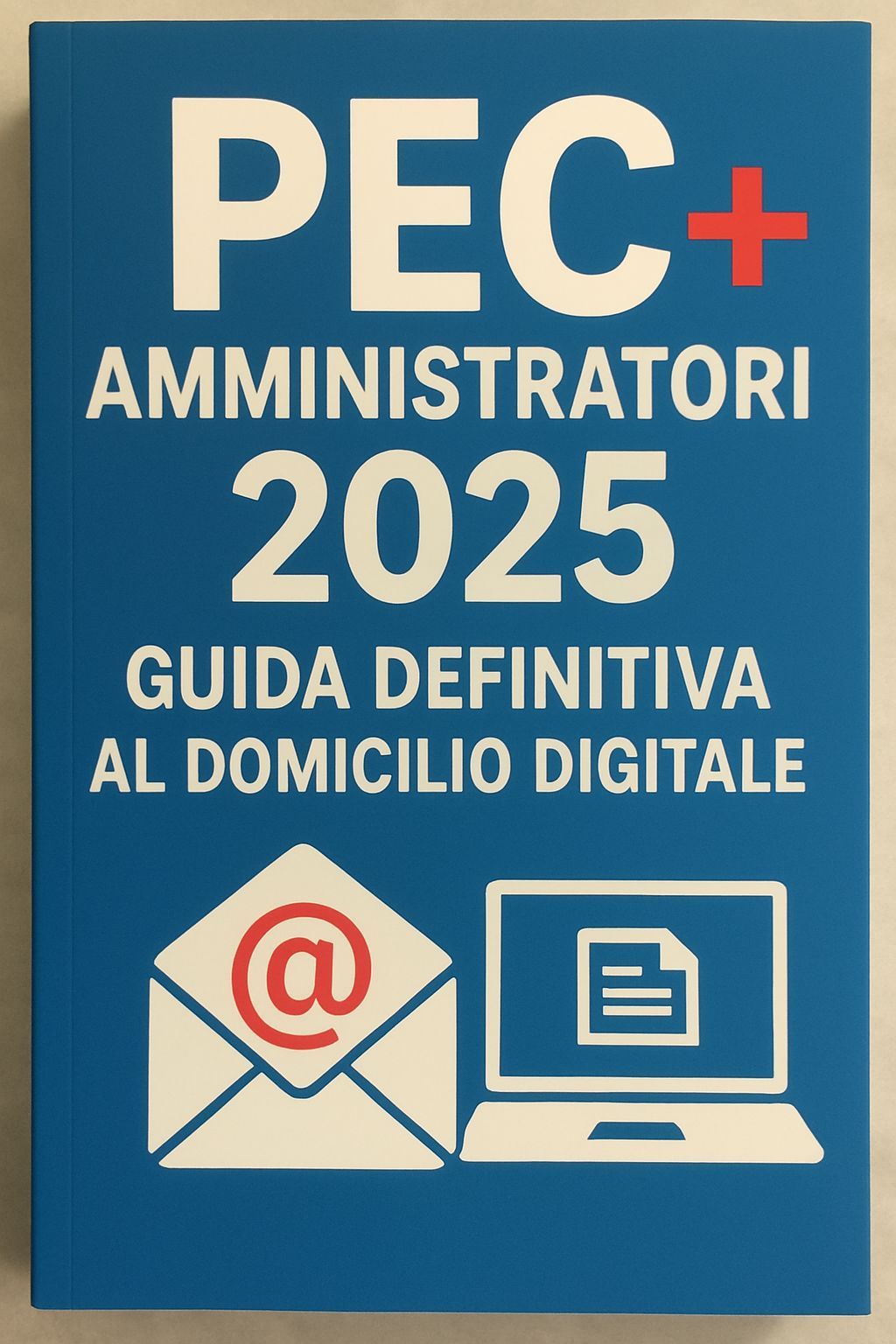
The Italian regulatory landscape on the digitization of enterprises has undergone an epochal transformation, culminating in the introduction ofobligation of Certified Electronic Post (PEC) personal for all company directors from 1 January 2025. This is not merely a bureaucratic addition, but a real structural change in communication between the administrative body and the external environment, first of all the Public Administration and the judicial offices. The provision, conveyed by the Law of Budget 2025 and subsequently clarified by the interpretative note No. 43836 of 12 March 2025 of the Ministry of Enterprises and Made in Italy (MIMIT), unequivocally establishes that each individual who holds the post of administrator, both in companies of persons (S.n.c., S.a.s.) and in companies of capital (S.r.l., S Digital Domicile valid, active and, above all, staff, officially communicating it to the Business Registry. The need for a personal, distinct and non-compared CEEC with that of the administered company is the crucial element of this reform, putting an end to ambiguous practices and ensuring the legal certainty of notifications directed to the decision-making body. The impact of this rule is very vast, touching thousands of professionals who now face an improrogable deadline: the 30 june 2025 for pre-existing societies. The timely adjustment is not only a measure to avoid severe administrative sanctions, which can go beyond the thousand euros, and the consequent suspension of chamber practices, but is an indispensable step towards a transparent corporate governance and fully integrated in the national digital system. This article aims to go beyond the simple utterance of the obligation, analyzing the deep normative context, the implications on the responsibility of the directors, the technical criteria for the choice of the most suitable PEC provider and the operational strategies for an efficient and delegated management of its digital domicile, framing the PEC in the wider context of the European digital transformation. Failure or late adjustment, in fact, does not expose only to fines, but risks paralyzing business activity, making ineffective acts and legal communications vital.
The Background Regulation Contest: From European Digitalization to MIMIT 2025
The introduction of the personal PEC obligation for administrators is not an isolated event in the Italian legal scene, but it is part of a digitalization strategy rooted in European directives and in the evolution of the Italian Digital Administration Code (CAD) . The Digital Domicile (DD), defined by CAD, it represents the valid telematic contact point for legal purposes for electronic communications with legal value, replacing the physical domicile for notifications of the Public Administration (PA). Although the obligation of PEC for companies (intensive as legal persons) was already consolidated, the novelty of 2025 shifts focus on physical person who holds the office of administrator, recognizing his central role and his direct responsibility. The Law of Budget 2025 acted as a catalyst, implicitly modifying the rules relating to the registration in the Register of Enterprises, but it was MIMIT's note n. 43836 to provide the essential interpretative key for practical application. The MIMIT has clearly specified that the obligation extends to all directors of companies of persons and capital, including liquidators and in some particular cases also the Corporate Networks, however excluding simple non-agricultural companies. The underlying motivation lies in the need to ensure that notification acts, especially judicial or administrative acts that impat on the responsibility of the administrator (e.g. sanctions, competition procedures, litigation with the Revenue Agency), directly reach the responsible person, without filters or delays potentially caused by the management of the company PEC, which could be managed by an office or a delegate not directly involved in the act. This requirement uniqueness and personality of the digital domicile strengthens the transparency and effectiveness of the administrative and judicial process, aligning Italy to the European standards of certified communication. The distinction between the JEP of the legal representative (physical person) and the JEP of the body (legal person) is therefore a pillar of compliance 2025. It is essential to point out that the absence of such communication entails the non-progress of the practice of registration for new companies or the application of pecuniary sanctions and the suspension of practices for those already existing, making the performance a requirement existence and operation legal of the administrative body. The provision aims to eliminate past ambiguities where often a single PEC box, head of the company, was used promiscuously by the administrator, creating uncertainties about the legal validity of notifications addressed to the latter as a physical person.
Administrators and Digital Domicile: The Crucial Distinction between Personal and Business PECs
One of the aspects that has generated greater confusion among professionals concerns the strict separation between the personal PEC of the administrator and the PEC Business. Many administrators, for convenience, have historically used the company's certified mailbox also for direct communications as physical persons. However, the legislation introduced by the Budget Law 2025 and consolidated by ministerial interpretations makes this practice no longer acceptable. The Company, by definition, is a digital domicile registered to the legal person (the company) and is intended to receive notifications relating to the life and operations of the company. The Business Registry requires this box to be registered exclusively on behalf of the company. On the contrary, the Digital Domicile of the administrator must be addressed to the natural person and serves to notify acts relating to the personal responsibility of the administrator, his fiscal obligations as an individual or, more generally, acts involving his office (e.g. warnings of warranty, notices of investigations, warnings of default that may result in solidarity or individual liability). The importance of this distinction is inherent in the concept of asset separation and liability: if a legal act addressed to the administrator ended in a box managed by an employee or an office, the notification may be disputed or, worse, the administrator may not be aware of it in good time, aggravating its position. For the administrator who plays roles in multiple companies, the legislation offers flexibility: you can use a single PEC staff for all mandates, provided it is registered to him and is correctly communicated in all relevant corporate files. The alternative, although possible, to hold different PECs for each charge is technically complex and not recommended for reasons of management and monitoring. The essential condition is its validity, his activity and his personal header. If the administrator was using a promiscuous box, it is necessary to provide within the expiry of 30 June 2025 to create a new exclusively personal box and to the contextual communication of this to the Business Registry. The non-adjustment within this period is seen as a formal omission affecting the transparency and legality of the Digital Domicile, triggering the sanctioning mechanism of the Chamber of Commerce of competence, which begins with the suspension of the practice and, in case of persistent inertia, culminates with the rejection and repeal of the pecuniary sanction provided by article 2630 of the Civil Code or related regulations, strengthening the urgency.
Appropriations, Sanctions and Procedures: Manage Business Registry Compliance
The adjustment calendar imposed by the legislation requires maximum attention, distinguishing clearly between the timing for the new corporate constitutions and that for the already operating enterprises. For the companies constituted from 1 january 2025, the indication of the personal PEC of each administrator is a procedural requirement. The address of Domicilio Digitale must be provided at the same time as the application for registration of the company in the Register of Companies. Without this information, the practice of constitution cannot be completed, ensuring that the requirement is respected from the beginning of the activity. For the existing companies before 1 january 2025, the term perentory for the communication of the personal Digital Domicile of the directors is fixed to 30 june 2025. This term applies both to specific corporate events (such as the new appointment or renewal of an administrator, or the appointment of a liquidator) and in the absence of such events, acting as a universal deadline for fulfillment. The communication procedure must take place via telematics, through the platform Communication or Starweb, typically managed by a qualified intermediary like the accountant. It is essential to note that, as specified by the MIMIT, the communication of the JEP alone of the administrator is exempt from stamp tax and secretariat rights, a clear incentive to the separate fulfillment regarding other corporate changes. However, the true deterrent against inertia is the sanctioning regime. In the event of an omission of the indication of the PEC, the Chamber of Commerce does not proceed to the registration or evasion of the practice and notify the administrator of the invitation to regularize his position within a maximum period of 30 days. If the administrator does not provide within this period, the application for registration is rejected. In addition to rejection, the omission exposes the administrator to a pecuniary administrative sanction between 103 euros and 1,032 euros. The standard, however, provides for a reduction to one third of the maximum amount (by bringing it approximately to 344 euros) if the regularization takes place within 30 days from the expiry fixed by the Chamber of Commerce. The severity of the sanctions, together with the suspension of the operation (impossible to record acts, changes in statutes or appointments), emphasizes how the Digital Domicile is perceived by the legislator as an essential element of the legal advertising the company and its management, adapting the highest compliance priorities for the current year. The communication procedure, although technically simple, requires maximum accuracy in the header and in the validity of the box, elements that the camera system automatically checks before accepting the inscription.
PEC as a Governance and Legal Risk Tool: Implications for the Responsibility of Directors
The obligation to equip itself with a personal PEC transcends the mere bureaucratic formality and is deeply rooted in the field of corporate governance and the civil and criminal liability administrators. The PEC, as Domicilio Digitale, is the channel through which the notifications with legal value are perfected, equivalent to a recommended with return receipt. The direct implication is that, once a legal notice (from courts, PA, or creditors) is sent to the PEC registered in the Enterprise Registry, it is legally known by the administrator, regardless of its actual reading. This principle is crucial for the purposes of the designation of procedural and administrative terms. Failure to oversee your personal PEC box can easily vent in a blown omission. For example, the notification of a judicial remedy, a tax injunction or an act of ascertainment that requires an answer within strict terms, if not intercepted promptly, may lead to serious legal consequences, such as relief in judgment or inability to defend itself from serious claims. In a S.r.l., where the responsibility of the directors is already a delicate subject, proof of the knowledge of an act through PEC notification may aggravate the position of the administrator in case of mala managed or failure to implement conservative measures required by law. The registration of the personal digital domicile in the Business Registry gives a presumption of knowledge that the administrator must actively manage. This requires the adoption of rigorous internal monitoring and management of certified mail flow. It is not enough to have the box; it is necessary to access it daily, or delegate verification to qualified subjects (commercialists or lawyers) through formal and traceable delegation mechanisms, as we will see later. The PEC becomes, in this sense, not only a communication tool but a diligence indicator. The administrator who does not verify his PEC, losing essential terms, could see himself challenge the violation of the duty of diligence imposed by article 2392 of the Civil Code. Therefore, the choice of a PEC must be oriented not only to the formal respect of the law, but also to the operational functionality and security, which allows easy access, instant notifications (via SMS or app) and a large storage space to preserve the legal proof of the received and sent communications, essential elements for the protection of your work and for the management of corporate and personal risk. Failure to receive, e.g. from the full or unactive box, is legally equivalent to receiving, with all negative effects resulting from it.
Beyond Aruba: Technical Criteria for the Choice of the PEC Manager and Advanced Multiutence Solutions
Although the Italian market of the Certified Electronic Mail is populated by several managers accredited to AgID (Agenzia per l’Italia Digitale), the choice of personal PEC per il administrator must be based on technical criteria that guarantee reliability and compliance with the role played. It is not enough to select the cheapest service; priority must be safety management capacity and the delegation features. A crucial element to assess is the ability to storage and security. The administrator needs a sufficient volume of space not only for the incoming mail, but also for the security archive (or replacement storage) that guarantees the long-term legal validity of the received messages. Boxes with limited space (often offered in the base plans) can quickly saturate, making the inactive box and, consequently, unlike receiving legal notifications, with the serious consequences already analyzed. The most advanced managers, such as the Business plans mentioned in the article of origin (e.g. Aruba Pro or Premium), offer solutions with multiple GB of space and integrated storage. In addition security of access is fundamental: using two-factor authentication mechanisms (2FA) or integration with digital identity systems (SPID/CIE) are increasingly required to prevent unauthorized access to the box, especially considering the legal and confidential value of the documents contained. From the operational point of view, given the need for the administrator to often delegate the management to their internal team or to the accountant, the services that offer functionality of Advanced Multiutence are to be predicted. These features allow the owner of the PEC (the administrator) to create separate user profiles (e.g. for the accountant or the executive assistant), assigning them granular permits (reading, writing, sending, managing settings only). This ensures that the delegate can operate on the box without knowing the main password, maintaining the control and traceability of the actions. For example, the administrator could only allow the accountant to read and forward, reserve the sending of particularly sensitive communications. Other choice criteria include compatibility with mail clients (IMAP/POP3) for integrated management, availability of instant SMS notifications and general service reliability (uptime and technical support). The administrator must ensure that the chosen PEC is clearly registered as a physical person and that the provider is a certificater recognized by the AgID, ensuring that the box is eligible to be registered as an official Digital Domicile in the Business Registry, avoiding contests during registration. The choice of a professional plan, although it involves an annual cost, is an essential investment in risk management and legal compliance of the administrator.
The Delegation to Commercial and Centralized Management of Corporate Digital Domicile
In everyday practice, it is extremely rare that an administrator personally devotes sufficient time to the meticulous and daily management of his own PEC box. The most widespread and recommended solution, especially for those who manage more mandates or have a very dense agenda, is the operational delegation to the accountant or to the consultant of the job, figures acting as qualified intermediaries and already have access to the telematic tools of the Register of Enterprises. The delegation for the communication of the PEC in the Business Registry is a relatively simple process: the accountant, as an intermediary, can submit the telematic application on behalf of the administrator, using his digital signature to certify the sending. However, the most critical delegation concerns the continuous operating management of the box. The administrator must formalize a proxy agreement that clearly specifies the limits of action and the responsibilities of the professional. Using the multiuser services offered by the PEC providers is in this sense a fundamental advantage, as it allows the accountant to access the box (to consult and forward) without the administrator having to disclose their main access credentials, maintaining a high level of security. The accountant, by virtue of the proxy, assumes a professional responsibility not indifferent: failure to check the box or loss of a term due to its negligence may fall on its professional insurance. For this reason, it is common practice that professionals who accept the management of the Digital Domicile define extremely strict reception and notification protocols, often immediately forwarding legal communications to the customer via secure channels (e.g. encrypted or recommended paper platforms) or ‘Supervisore 360’ platforms that integrate the management of the PEC with other consulting services. For the administrator who runs roles in multiple companies, the centralized delegation to the same accountant for all company PECs and its only personal PEC represents a model of efficiency. This approach guarantees a unique control point and drastically reduces the risk of omission or confusion between corporate and personal communications. The proxy does not exempt the administrator from his final supervisory responsibility on the proper hold of his digital domicile, but it simplifies the operating burden, transforming the legal obligation in a process managed in a professional and traceable way, essential to demonstrate the diligence required in case of litigation. It is crucial that the delegated PEC is equipped with a large archive in order to guarantee the preservation according to the receipts of acceptance and delivery throughout the term.
Future perspectives: Digital Domicile (DD) between PEC, Qualified Resume Services (SRCQ) and eIDAS 2.0 Regulations
The current PEC obligation for administrators, while being an immediate compliance measure, is only a stamp in a rapidly changing European regulatory framework. The Italian Certified Electronic Mail, although it is a certified delivery service, is based on national standards which, although recognized in Italy, are not immediately interoperable with the legal notification systems of other EU Member States. The future of Digital Domicile is closely linked to EIDAS Regulation (Electronic Identification, Authentication and trust Services) and, in particular, its revision, eIDAS 2.0. This regulation aims to standardize and make digital trust services interoperable throughout the EU, including certified electronic delivery systems. The evolution of PEC in Italy is projected towards compliance with the requirements of Quality Certificate Recap Services (SRCQ), also known as Registered Electronic Mail (REM). A SRCQ, in order to be qualified at European level, must ensure not only the certainty of sending and receiving (as the current PEC does), but also the sure identification of the sender and the recipient through robust authentication mechanisms (such as SPID or qualified electronic signatures) and the integrity of the content during transit. Many Italian managers are already working on adapting their CEECs to these standards to obtain European qualification (PEC-ID or REM), which would make the Italian Digital Domicile fully operational in cross-border contexts. For the administrator, this evolution means that the PEC acquired today is not a short-term investment, but a step towards a valid legal notification system throughout the EU. When the Italian PEC will receive the REM qualification, administrators will receive legal notifications from foreign authorities or European counterparties with the same legal validity as a national notification. The obligation of 2025 prepares the ground, ensuring that the physical person of the administrator is already equipped with a digital channel certified and registered publicly. In addition, eIDAS 2.0 promotes the concept of European Wallet of Digital Identity, which in the future could integrate with the Digital Domicile, providing an additional level of security and simplification in access to the digital services of the PA. In summary, the choice of a PEC must already take into account the ability of the manager to rapidly evolve towards REM standards and to support qualified identification, ensuring the longevity and effectiveness of the Digital Domicile of the administrator in an increasingly global and digitized market. The administrator must carefully monitor regulatory developments to ensure that their provider is in line with future European qualification requirements.
Integrated Digital Governance: Additional Measures to Minimize Omission Risk
To adapt to the obligation of personal PEC is only the first step towards a management of digital governance that minimizes the risk of omission and maximizes operational effectiveness. Administrators must implement additional measures to ensure that Digital Domicile is always active and monitored. The first preventive measure is the annual renewal planning of the PEC. Unlike corporate PEC, which is often continuously managed by administrative functions, personal PEC may be subject to forgetfulness in renewal, especially if paid on an annual basis. It is essential to set alert and automatic renewal systems (by credit card or direct debit) to prevent service interruption. A expired PEC box, in fact, ceases to be a valid Digital Domicile and renders ineffective legal notifications, resulting in reactivation of the chamber sanction mechanism and risk of lost notifications. The second measure concerns the backup and storage. As mentioned above, security storage must be automated. For the administrator, losing a notification receipt means losing the legal proof of the date of receipt of an act, a crucial element in litigation. The services that provide replacement storage as a rule, managed by the provider, are therefore an essential element, as they ensure that the content and proof of sending/receiving are kept intact and unaltered for the period of time required by law. The third measure, linked to operational risk, is the establishment of a emergency and replacement protocol. If the administrator is absent for long periods or is unable to act (e.g. disease), there must be a clear plan on who should access the CEEC and with which permissions. Although the PEC is personal, the Multiutence function or a notary formal delegation can ensure that management is not interrupted, protecting the continuity of business management even in the absence of the owner. Finally, for administrators of entities not included in the obligation (such as consortia or some simple companies), voluntarily adopt the personal PEC and communicate it in other registers (if possible) is however a practice of best practices of governance, demonstrating proactivity and alignment with digital standards. The investment in integrated management systems (e.g. platforms that group the PEC notifications, clickWork, electronic billing and other digital compliance) helps keep the entire ecosystem of the Digital Domicile under control, transforming an obligation into a process optimization opportunity.
The obligation of the Electronic Mail Personal Certificate for company directors, in force from 1 January 2025, represents a decisive turning point towards full digitization of legal and administrative relations in Italy. It is not a choice, but a legal imperative with strict deadlines (30 June 2025) and severe penalties in case of default. The directors, both of companies of people and of capital, must act immediately to equip themselves with a valid, active and strictly personal PEC, communicating it to the Register of Companies. The need to separate its box from that company lies in the protection of legal certainty of notifications directed to the physical person, strengthening transparency and responsibility for governance. The choice of the manager (such as Aruba or other qualified certificaters) must be guided by advanced security criteria, the size of the archive and the functionality of multiuser delegation, essential tools for operational management, often entrusted to accountants or intermediaries. Appropriate for time not only avoids fines and paralysis of chamber practices, but places the administrator in accordance with the Italian and European normative evolution towards the future standards of Quality Certificate Recap Services (REM), ensuring the full validity of Digital Domicile in cross-border contexts. The diligent administrator must consider this PEC not as a cost, but as an indispensable tool for risk management and compliance, integrating its monitoring into the daily operating protocol.


