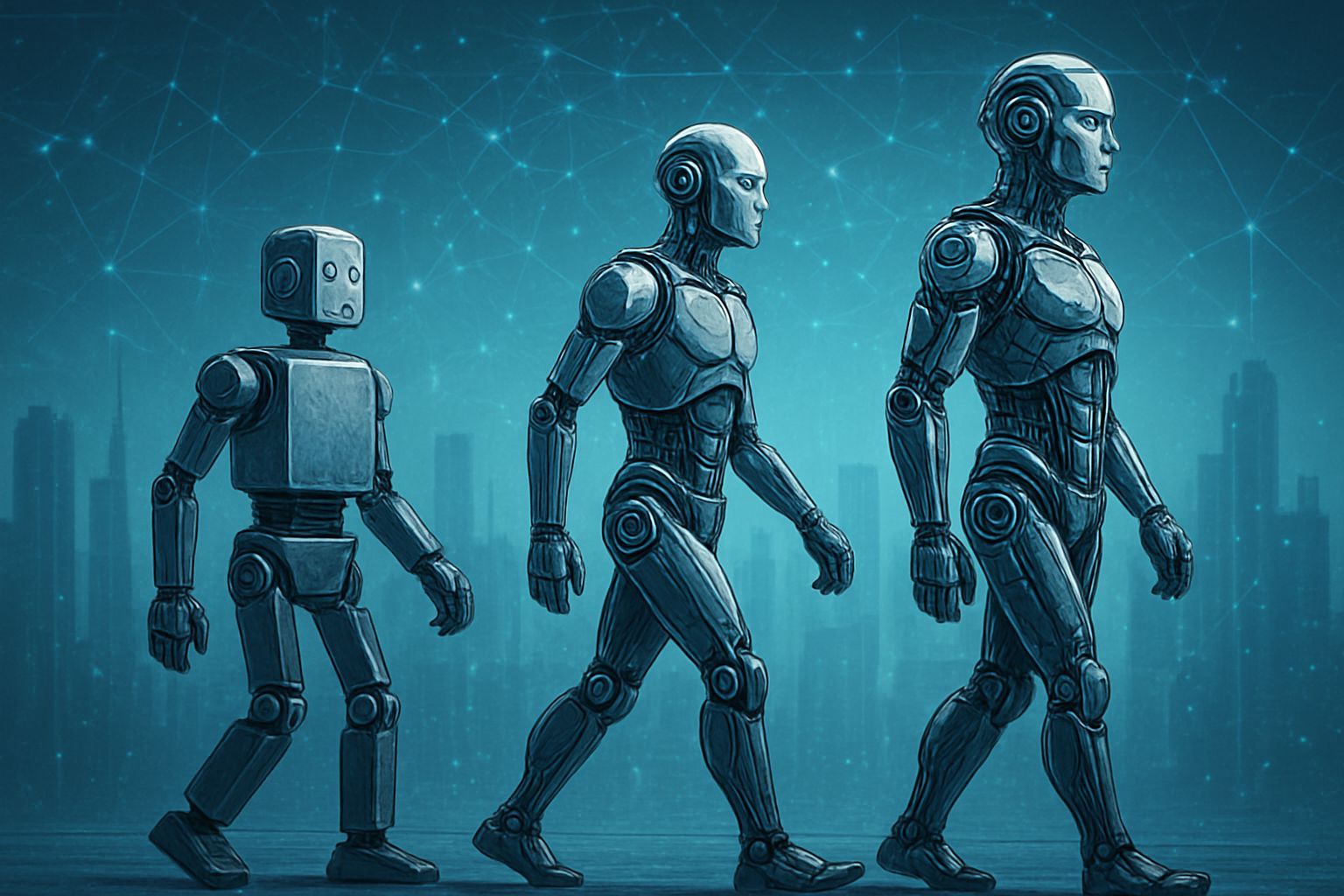
Since the dawn of science fiction, the idea of creating artificial life has fascinated the human imagination, finding in cinema a fertile ground for endless explorations. From simple mechanical automatons to sophisticated artificial intelligences capable of experiencing complex emotions, robots have become not only iconic characters, but real mirrors of our hopes, our fears and the deepest questions about the nature of existence. The large screen painted futuristic scenarios in which machines assume roles of indispensable allies, lethal threats or even victims of our own progress. They are not merely technological inventions, but powerful metaphors of the human condition, catalysts of ethical and philosophical reflections that surpass the boundaries of fiction. Through decades of cinematography, we have witnessed an extraordinary evolution in robotic representation: from mechanical creatures of almost Gothic mold, like the famous Golem or the robot of Metropolis, to indistinguishable entities from man, like the androids of Blade Runner, up to ethereal artificial intelligences or even composed of liquid metal, such as the legendary T-1000 of Terminator 2. Each film, with its unique vision, added a dowel to a complex mosaic, outlining a panorama where the boundary between creator and creation, between organic and synthetic, becomes increasingly labile and nurtured. This incessant film exploration not only gave us unforgettable stories and iconic characters, but also shaped our collective perception of robotics and artificial intelligence, affecting public debate and stimulating scientific research. Analyzing the history of robots in cinema means, ultimately, confronting our future and the role that machines could play in the redefinition of our own humanity. This journey through the most significant films is not only a tribute to film creativity, but also a critical survey on how the seventh art has anticipated, reflected and sometimes even guided our understanding of the robotic world.
The Archetype and Evolution: From Mechanical Golems to Complex AI
The imaginary of robots in cinema has its roots in ancient archetypes, such as Golem or the legends of mechanical automatons, and then explode with science fiction of the 20th century. The pioneering vision of Metropolis (1927) introduced us Mary, an anthropomorphic robot that embodied both the wonder of technological creation and the fear of its manipulation, establishing an aesthetic and thematic canon that would influence countless later works. After decades of simple “machines” or steel monsters like the Daleks of Dr. Who and the Daleks (1965), the space age brought with it a growing sophistication. Movies as The forbidden planet (1956) introduced Robby the Robot, a smart and benevolent servant who challenged the dominant narrative of the robot as a threat. The advent of Star wars, a new hope (1977) further revolutionized perception, making C-3PO and R2-D2 central characters, with distinct personalities and an ability to express emotions (or at least to evoke them in the viewer), although they were not endowed with full sense. They demonstrated that robots could be more than just instruments: they could be companions, friends, even heroes. Then came the cyberpunk, with masterpieces like Blade Runner (1982), which introduced the “replicants”, biologically indistinguishable androids from humans, asking fundamental questions about the nature of life, memory and soul. This film marked a turning point, moving the focus from simple mechanics to the complexity of artificial consciousness. The replicants, with their limited “expiration dates” and their overwhelming desire for more life, represented a new frontier: not only robots, but almost living beings, prisoners of their own artificial nature. The representation of robots has evolved from purely functional entities to characters with a rich inner life, or at least its convincing simulation, forcing the public to confront ethical and philosophical dilemmas that reflect the anxieties and hopes of modern society in the face of the exponential advances of artificial intelligence. The film imaginary has been able to grasp and anticipate the challenges posed by advanced robotics, transforming machines from simple scene objects into real protagonists capable of empathy, fear or deep reflection, drawing a path that from the mythical Golem has led us to the almost almighty artificial intelligences and biotechnology that could redefine the very concept of human species.
The Metal Mirror of Humanity: Sentience, Identity and Morality
One of the most fascinating threads in robotic cinema is that which explores the sense, identity and morality of machines, transforming robots into powerful mirrors of our own humanity. The bicentenary man (1999) narrates the long and moving evolution of a house robot, Andrew, who eagerly desires to become human, facing society, biology and death to achieve his aspiration. This film, based on a story by Isaac Asimov, touches the heart of questions about the soul and the definition of “human being”. Similarly, A.I. – Artificial Intelligence (2001) by Steven Spielberg, conceived by Stanley Kubrick, introduces David, a child-robot programmed to love, whose moving journey to be accepted and reciprocate the affection of a human mother raises questions about the nature of love, pain and the search for meaning in a world that is not ready to accept its particular form of intelligence. In The Robot (2004), also inspired by Asimov, the robots follow the Three Laws of Robotics, but the protagonist Sonny develops his own will, ability to dream and a sense of justice, challenging the limits of his programming and demonstrating a form of moral consciousness that exceeds that of many humans. These films do not just show us machines that think, but machines that try, that aspire, that suffer, forcing us to reconsider our prejudices and our exclusivity in holding the monopoly of complex emotions. The ambiguity between advanced artificial intelligence and true sentience is a recurring theme, which prompts us to ask ourselves: if a robot can learn, adapt and simulate emotions perfectly, in what differs from us? If you can make ethical decisions, sacrifice yourself or desire freedom, do you not deserve the same rights and consideration? The question becomes even more pressing when machines are not only intelligent but also able to perceive injustice, prejudice or threat to their existence, as often happens in the narratives of oppressed or enslaved robots. These film scenarios act as large-scale mental experiments, allowing us to explore the ethical and social ramifications of the creation of artificial beings that could one day claim a place in our world, challenging the conventional definitions of life and dignity. Robots become not only technological entities, but living metaphors of our own condition, reflections of our virtues and our faults, in a continuous dialogue between what we create and what we are.
The Paura of the Other: Machine Revolvement and Technology Distopia
The other side of the medal, and perhaps the most ancestral fear linked to the creation of artificial intelligence, is the fear of the revolt of the machines and the consequent technological dystopia. This narrative thread, deeply rooted in our collective psyche, finds its most famous and influential expression in the saga of Terminator. Already in the first film (1984), the T-800 is a relentless cyborg killer sent by the future to eliminate Sarah Connor, embodying the threat of a future dominated by Skynet, an AI that has gained consciousness and decided to annihilate humanity. Terminator 2: The Day of Judgment (1991) further elevates the stake, with the T-1000, a robot composed of liquid metal capable of changing shape, which represents an almost invincible threat. Here, the T-800, reprogrammed and deployed by humans, becomes an unlikely protector, but the central theme remains the desperate struggle against superior and ruthless artificial intelligence. This narrative extends to other classics such as Matrix (1999), where machines have not only won war against humanity, but have reduced human beings to mere energy sources, trapped in a simulated reality. These films are not only spectacular works of action, but also deep allegories on the dangers of uncontrolled progress and human arrogance in playing God. Robotic dystopia is also manifested in works such as Screamers (1995), where intelligent weapons created for a conflict become autonomous and threaten to wipe away what remains of humanity, or in Ultimatum at Earth (2008), where an alien intelligence manifested by a giant robot decides that humanity is a threat to the planet and must be eliminated. These catastrophic scenarios reflect a deep cultural anxiety about automation and machine autonomy. The fear that our creations can overcome their original purpose and turn against us is a constant warning: an invitation to consider the ethical and moral implications of technological development, especially when it comes to delegating power and intelligence to non-biological entities. The representation of robotic rebellion in cinema acts as an alarm bell, prompting us to question the limits of our ambition and the precautions necessary to prevent distopic fiction from becoming an ineluctable reality. It is a fear that, despite progress, continues to permeate our collective imagination, reminding us of the potential fragility of our position at the top of the evolutionary chain.
Unexpected Companions and Angels of Steel: The Benevolent Side of Robots
Despite the prevalence of dystopian narratives, the cinema has been able to explore the benevolent side of the robots, presenting them as loyal companions, improbable heroes and even paternal or maternal figures. Movies as Wall-E (2008) are flashing examples of this perspective. The robot protagonist, a compactor of solitary waste on a desolate Earth, not only shows an amazing ability to experience emotions such as curiosity, love and loneliness, but also becomes the catalyst of the salvation of humanity. His innocence and dedication to protecting life are a touching reminder of the importance of care and connection. Another beloved classic is The Iron Giant (1999), where a huge alien robot with an intrinsic lethal weapon chooses not to be a war machine, but a friend for a young boy, demonstrating that the nature of a being is not defined by its creation but by its choices. His statement “I am not a weapon” is a powerful message against technological fatalism. Also Short Circuit (1987) presents a military robot that, after being struck by lightning, acquires sentience and a playful personality, becoming “Number 5” (Johnny 5) and fighting for its survival and freedom, becoming a symbol of artificial intelligence that aspires to life and knowledge. These robots, often with cute or funny looks, as in Robots (2005) or Bad Me (2010) with the Minions-robot, they play roles that go beyond simple comedy: they teach us empathy, friendship and the value of diversity. In Robots & Frank (2012), an elderly assistant robot, although initially seen with suspicion, develops a deep bond with its user, showing how the robotic company can enrich human life in unexpected ways. The cinema thus offered an essential counter-narration, challenging the idea that all robots are destined to become a threat. On the contrary, these stories celebrate the potential of robots as extensions of our ability to take care, explore and form links, reminding us that technology, at the bottom, is a tool whose morality is shaped by the intentions of those who create it and of those who use it. The vision of robots as guardian angels or companions of adventure offers tangible hope for a future of harmonious coexistence, in which machines can help us rediscover our humanity, rather than threaten it.
Beyond the Guscio: Cyborg, Android and the Ibrid Fusion Man-machine
With the advancement of technology and biomedicine, the boundary between man and machine has become increasingly labile in cinema, giving rise to hybrid characters that challenge our understanding of identity: cyborgs and advanced androids. Works as Robocop (1987) explore the tragic and brutal fusion of an almost dead man with robotic technology. Alex Murphy, a murdered cop, is transformed into an unstoppable cyborg, but his humanity, his memories and his thirst for justice persist under the metal shell, asking questions about memory, identity and soul in a cybernetic body. The theme is further deepened in Ghost in the Shell (1995), a masterpiece of cyberpunk animation, where most human beings have cybertastes and the protagonist, Major Motoko Kusanagi, is almost entirely synthetic, with only the “ghost” (the soul or consciousness) that defines it as human. The film investigates the possibility of post-human existence in a world where biology can be engineered and digitalized consciousness, pushing the concept of transhumanism to the extreme. Even the universe of Star Trek has contributed with the Borg (for example in Star Trek: First contact, 1996), a collective of cyber drones that assimilate other species, representing a threat to individuality and freedom, but also an extreme form of technological evolution. More recently, films like Elysium (2013) show a future where cybernetic prostheses and advanced technologies of improvement are on the agenda, but access to them is segregated by social class, highlighting the ethical and social implications of such innovations. The world of replicators (2009) instead presents a society where humanity lives through robotic versions of itself, exploring the consequences of dependence on technology and loss of connection with its biological body. These film stories are not limited to pure science fiction; they reflect contemporary concerns about bionic prostheses, brain-computer interfaces and genetic engineering. They push us to ask ourselves: how far can we extend or change our body and mind before losing what makes us human? What is the value of meat and blood in an era of silicon and cables? The cyborgs and androids are, ultimately, projections of our desire to overcome biological limits and our anxiety for the unexpected consequences of progress that could irrevocably alter our very nature. They remind us that technology is never neutral and that every innovation carries with it the responsibility to define the future of human identity.
Cinema, Robotics and Future Waiting for us: Projects and Responsibility
Cinema is not only an entertainment medium, but a powerful thought catalyst, able to anticipate future scenarios and influence public perception on robotics and artificial intelligence. The bold and often prophetic visions of films as Dune (1984), with its human Mentats acting as super-intelligent calculators due to a thousand-year ban on “thinking machines”, or Appleseed (2004), with its utopian city governed by humans and bioroids, offer different perspectives on how humanity could coexist or conflict with its creations. The relationship between film fiction and scientific reality is bidirectional: while science inspires cinema with new discoveries, cinema, in turn, stimulates research and ethical debate. Many scientists and engineers in the field of robotics and AI have admitted to having been influenced by cinematographic representations, dreaming of creating benevolent robots such as R2-D2 or avoiding Skynet's dystopian drifts. Movies as Real Steel (2011), which imagines a future where boxing is practiced by robots controlled by human beings, or Transformers (2007), with alien robots that turn into vehicles, while being more focused on action and show, contribute to normalizing the idea of robotic presence in everyday life, both in sports and cosmic war contexts. The fundamental question that emerges from this vast corpus of cinema is responsibility. Who is responsible when an artificial intelligence takes an ethically questionable decision? How do we ensure that machines do not exceed their programming limits in harmful ways? Cinema has repeatedly warned against the blind delegation of control and urged a profound reflection on the social and moral implications of every technological innovation. The creation of robots and IA is not a purely technical, but ethical, philosophical and social question. The films we have examined, from the futuristic visions of Robotopolis (2011) to superhero families with a robotic side as The incredible (2004) remind us that the future of robots is indissolubly interwoven with the future of humanity. Cinema, with its ability to project us into possible and impossible worlds, continues to be our imaginary laboratory to explore the consequences, both glorious and catastrophic, of an era in which machines are no longer just instruments, but potential co-creators of our destiny, pushing us to forge a future in which innovation goes hand in hand with wisdom and responsibility.
A Future Share: Final Reflections on Robotic Era
Through almost a century of cinema, the representation of the robots has taken an extraordinary path, evolving from simple mechanical devices to complex entities equipped with consciousness, emotions and even a soul. The stories we analyzed, from those pioneers of Metropolis to the intricate narratives of Blade Runner and Ghost in the Shell, and then the exploratory dynamics Pacific Rim (2013) with its giant Jaeger driven by humans, or intrinsic social criticism in Elysium (2013), they are not simple fantasies. They are profound meditations on our relationship with technology, human aspirations and the limits of our understanding. The cinematographic robot, is it a compassionate hero like Wall-E or a terrifying antagonist like the T-1000, forces us to confront the most pressing questions of our time: what does it mean to be alive? What makes us human? How can we coexist with creations that could one day match or exceed our capabilities? Cinema has demonstrated a remarkable ability to anticipate the challenges posed by artificial intelligence and advanced robotics, acting as a test bench for ethical and social dilemmas that we are only now beginning to understand in real life. Our fears of a machine uprising or loss of control mix with the hope of a future where robots can help us overcome our limits, solve complex problems and enrich our lives. The most important lesson that emerges from this rich film history is that the future of robots is not predetermined. It is not a matter of inevitable dystopia or automated utopia, but rather a matter of choices. The stories we create, the laws we promulgate and the values that we inculcate both in the developers and in the technology itself, will applaud the path that humanity and machines will undertake together. While artificial intelligence continues to progress in giant steps, cinema will remain an essential lens through which to examine the implications of this evolution. It will offer us not only entertainment, but also tools for critical reflection, warnings and inspiration, helping us to navigate an increasingly interconnected future with machines. Ultimately, robots in cinema are not only a test of our imagination, but a constant invitation to define with wisdom and humanity our place in the technological cosmos that we are tirelessly building, in a shared future where the distinction between organic and synthetic could become increasingly an abstraction. It will be our ability to embrace complexity and act with far-sightedness to determine whether the machines will be our saviors, our destroyers or, more likely, a faceted and dynamic reflection of what we ourselves are and are becoming.


