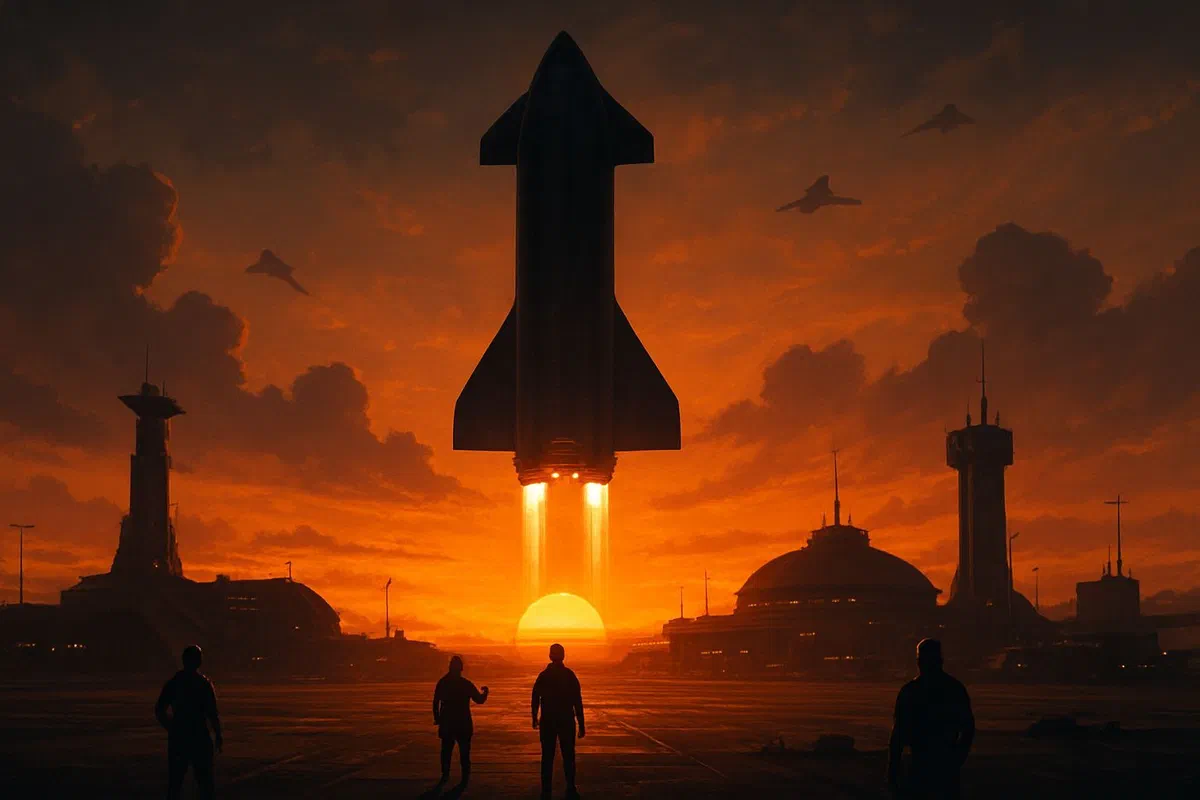
In the dawn of the 21st century, humanity faces a new era of exploration and exploitation of space, an era defined by unprecedented technological innovation and a growing convergence between the commercial space sector and the strategic requirements of national defence. at the heart of this transformation there is a revolutionary concept: the rocket cargo. no more science fiction, the idea of carrying massive loads anywhere in the globe in less than an hour is rapidly becoming a tangible reality, thanks largely to the pioneering efforts of companies like spacex and their flagship vehicle, starship. this bold vision, which promises to redefine the logistic and strategic capacities on a planetary level, has captured the attention and investment of the us air force department. the air force, with an annual budget of approximately 200 billion dollars, is allocating tens of millions of dollars in the rocket cargo program, a clear signal of the seriousness with which the potential of this technology is perceived. the stated goal is to exploit the billions of dollars already invested in the private sector to develop the biggest and completely reusable rockets ever conceived, capable of delivering 100 tons of cargo anywhere on earth in less than an hour. this ambition goes well beyond the simple logistic efficiency; it implies a radical transformation of the ability to projection of power, the response to humanitarian crises and the resilience of supply chains in complex scenarios. the convergence of these forces – commercial innovation, military needs and long-term vision – is drawing a future in which the sky is no longer the limit, but the corridor for a new form of global mobility. however, while the promises of such a system are immense, equally significant are the technical, ethical and geopolitical challenges it entails, requiring an in-depth analysis and a faceted understanding of its potential impact. the initial investment of the air force, although not directed to the development of the vehicle itself, focuses on the creation of the scientific and technological infrastructure necessary to integrate with these new capacities, signaling a strategic and far-sighted approach to the next chapter of spatial logistics.
Starship: the architect of the logistic revolution #
The focus of this transformative vision is starship, the fully reusable spacecraft of spacex, whose capacity and ambition make it the only currently developing system that meets the colossal requirements of the rocket cargo program. with its modular design and the promise of rapid reuseability, starship is more than just a rocket; it is a versatile platform designed to revolutionize not only access to deep space, with missions on the moon and mars, but also mass and high-speed land transport. its impressive load capacity, estimated in about 100 tons for point-point suborbital missions, is the key factor that caught the attention of the u.s. department of defense. no other spacecraft, proposed or advanced development, is approaching to offer such a combination of flow, speed and reusability. the reusable rocket technology, already perfected by spacex with its falcon 9 and falcon heavy, reaches with starship its peak, promising to drastically reduce the launch costs and increase the operating frequency, essential factors for a logistic system that must be economical and efficient. reusability is not limited to the first stage of the rocket, but extends to the entire system, from the powerful super heavy booster to the starship itself, both designed for precise vertical landings. this paradigm reduces the time of preparation between a launch for months or years to potentially hours or days, a fundamental requirement for military operations that often require rapid and adaptable responses. in addition, starship’s ability to take off from unconventional sites and land in a variety of environments opens unprecedented logistic scenarios, allowing to bypass traditional port and airport infrastructures that are often vulnerable or limited. its structural robustness and its ability to operate in different weather and geographical conditions make it an invaluable resource for the projection of strength and humanitarian assistance in remote areas or affected by disasters. the scale of the private commercial investment of billions of dollars that supported the development of starship makes this collaboration particularly attractive to the government, which can exploit an innovation already in progress without having to finance the entire research and initial development. in this way, the air force does not acquire a finished product, but rather invests in interface and integration capabilities that will allow to make the most of this revolutionary technology, making starship not only a carrier for space exploration, but a fundamental pillar of future global logistics.
The rocket cargo strategy: a decisive geopolitical advantage #
The investment of the air force in the rocket cargo program is not simply a technological exploration, but a strategic calculation aimed at obtaining an unprecedented geopolitical advantage. the ability to move 100 tons of cargo, which is critical military equipment, urgent humanitarian aid or even essential medical supplies, in any part of the world in less than an hour, would radically transform the panorama of the projection of power and the response to crisis. currently, military logistics relies on a complex air transport network (with cargo planes like c-17 or c-5) and marine, both slow, expensive and vulnerable. large air transport can take hours or days to reach intercontinental destinations, while maritime transport takes weeks. rocket cargo offers a solution that completely bypasses these limitations, providing an almost instantaneous reaction capacity that could be crucial in fast conflict scenarios, large-scale natural disasters or global health emergencies. we imagine scenarios in which an entire rescue unit with heavy equipment, or a marine battalion with light vehicles and supplies, could be deployed in a distant operating theatre in times that today would be unthinkable. this would not only accelerate the response, but would also reduce the vulnerability of long traditional supply chains, which can be intercepted or blocked. from the point of view of deterrence, the simple existence of such a capacity could alter the calculations of potential opponents. the awareness that the united states can quickly project significant resources anywhere in the globe without significant notice or dependence on external infrastructure creates a form of strategic dissuasion that goes beyond conventional weapons. this system could offer the united states an operational flexibility that no other nation possesses, allowing it to respond to emerging threats or exploit strategic opportunities with unparalleled speed. the air force document emphasizes that this capacity would allow the united states to obtain “ logistical capacity that no other force on the planet could match”. this is not a recent statement and reflects the ambition of maintaining a technological and strategic advantage in an increasingly competitive world. the investment aims to ensure that the united states remains avant-garde in the application of space technologies for defence and national security purposes, consolidating their leadership position in an emerging strategic domain.
Technical challenges and s&t research of the air force #
To transform rocket cargo’s vision into an operational reality, the air force is investing in a number of specific scientific and technological areas (s&t) that aim to solve the complex challenges of interface and integration with a vehicle like starship. these challenges go far beyond the simple construction of the rocket, touching crucial aspects such as load handling, launch and landing logistics, and operational implications in a military context. a key investment area concerns the «novel loadmaster designs to quickly load/unload a rocket». loading and downloading 100 tons of cargo in a vehicle of this size requires innovative systems that go beyond traditional cranes and forklifts. you could imagine automated handling systems, modular loading platforms that can be preloaded and then quickly inserted into the starship load compartment, or quick rolling/roll mechanisms for vehicles. speed is essential: even a minimum delay in loading would vanish the advantage of a trip in an hour. therefore, research will focus on solutions that minimize the time of stay on the ground, maximizing operational efficiency. another focal point is the development of “rapid launch capabilities from unusual sites”. starship is designed for reuse, but current launch infrastructure is complex and fixed. for a global logistics capacity, it is necessary to be able to launch from a variety of locations, which are not only the great spatial bases. this could imply the development of semi-mobile launch platforms or quickly deployable, which can be installed on remote or temporary sites. challenges include fuel management, launch control infrastructure and operations security in unconventional environments. the “characterization of potential landing surfaces and approaches to rapidly improve those surfaces” is equally critical. if starship can land anywhere, you need to understand where it can do it safely and how to quickly prepare a site for landing. this could involve the use of drones for land exploration, remote geological analysis systems and potentially solutions to quickly stabilize the ground or build temporary platforms, even in extreme environmental conditions. the dust and debris raised by a starship landing are significant and must be mitigated, especially near structures or personnel. research on adversary detectability* is a pure military aspect. a starship launch is extremely visible, but how can you reduce your radar or infrared signature during crucial flight stages? this could cover the development of new flight trajectories that minimize exposure or application of stealth technologies. the «new trajectories» are not only for stealth, but also for the optimization of flight time and accuracy of landing, especially for point-to-point missions that cross different climatic zones and aerial jurisdictions. finally, the «s&t investigation of the potential ability to air drop a payload after reentry» opens up further tactical possibilities. instead of landing the entire vehicle, you could unload the load in the air after the air return, using parachute or precision systems. this could allow a more widespread distribution of the load, reducing the need for a precise and consolidated landing of the vehicle and potentially extending the logistics coverage area. all these s&t investments, which will pass from the study phase to the test phase, are crucial to translating the potential of starship into a robust and versatile military capacity, and require congress approval, indicating the strategic reach and significant cost of the program.
The geopolitical implications and the race to military space #
The emergence of the rocket cargo program and the interest of the u.s. department of defense for starship cannot be analyzed isolatedly; they fit into a geopolitical context of increasing competition and militarization of space. the prospect that a nation can quickly deploy forces and materials anywhere in the globe in less than an hour raises immediate concerns and stimulates reactions from other world powers. russia and china, in particular, have already expressed their concern about the expansion of us space military capabilities. statements such as those of dmitry rogozin, former head of russian space agency roscosmos, who insinuated (without proof) that spacex might want to launch nuclear weapons in space, reflect a deep distrust and an aggressive interpretation of any american advance in this field. although rogozin’s accusations are unfounded, they highlight the sensitivity of the theme and the potential rhetorical escalation that could accompany the development of such abilities. this move from the air force could trigger a new arms race, not necessarily with intercontinental missiles, but with global rapid transport systems that could have a dual use, civil and military. the other powers could be encouraged to develop their own similar capacities, leading to a proliferation of technologies that, if on the one hand promise logistic advances, on the other increase tensions and strategic complexity. the distinction between civil and military use of spatial technologies becomes increasingly nurtured. starship, designed to colonize mars, now finds an application in military transport, exemplifying the dilemma of the dual-use. although the air force declares that it wants to transport only cargo, the nature of the “cargo” in a military context is inherently linked to the projection of force. the ability to carry 100 tons could include heavy conventional weapons, military vehicles or even advanced basic components. this raises questions about the definition of “militarization of space”. is it simply enough transport to militarize the spatial domain, or does it refer only to the deployment of offensive weapons? the current international conventions are often ambiguous or insufficient to address these new technological frontiers. the international community will have to confront the interpretation and regulation of these new capacities, seeking a balance between technological progress and global stability. an acceleration in the development of systems such as rocket cargo could also push other nations to intensify their research and development programmes in the space sector, not only for military purposes, but also to maintain economic and technological competitiveness. the competition for control and access to space is no longer confined to satellites, but extends to the ability to exploit space for global mobility and the projection of terrestrial influence, making space an increasingly critical domain for international security and stability.
Ethical dilemma and public perception of spatial militarization #
The integration of state-of-the-art spacecraft such as starship in the military logistic fabric raises a complex ethical dilemma and a debate on public perception that goes beyond the mere technological capabilities. while the transport of spy satellites and communications for the armed forces is now a consolidated practice for spacex and other commercial actors, the passage to the transport of logistics and, potentially, ammunition, represents a significant step that many observers and space enthusiasts find problematic. the spatial movement, in its roots, is often animated by ideals of international cooperation, peaceful exploration and improvement of the human condition. the idea of using the same technology to make us dream of the colonization of mars for military purposes or force projection can create a meaningful dissonance with these founding values. many fear that the militarization of space can pollute its potential as a domain of scientific collaboration and discovery, turning it into an arena for armed competition. public perception is crucial. if the public increasingly associates commercial space innovation for military purposes, it could decrease popular support for space exploration and development, which instead requires broad consensus and long-term investment. transparency and communication by companies such as spacex and government agencies will be fundamental to manage this narrative and to reassure the public about the purposes and limits of such collaborations. there is also the question of technological dual-use. almost every technology with space applications has a potential civil and military use. earth observation satellites can monitor the crops or movements of the troops. gps navigation systems can drive a car or missile. in the case of starship, the transport of «cargo» can be interpreted in very different ways. while the air force emphasizes logistics for humanitarian or rapid support purposes, it cannot be excluded the use for rapid deployment of weapons or offensive equipment. this creates an ethical and strategic grey area. concerns are not limited to spatial activists; international critics, as already mentioned by rogozin’s accusations, will use these developments to strengthen their narratives on the alleged military aggression of some nations. this not only complicates international relations, but can also hinder efforts to establish rules and treaties that regulate the peaceful use of space. it is imperative that open and robust dialogues be initiated between governments, industry, academy and civil society to address these concerns, outline clear boundaries and develop an ethical framework that can lead the responsible use of these powerful new spatial capacities.
The economic impact and the future of spatial logistics #
In addition to strategic and ethical implications, the rocket cargo program and the integration of starship in military operations will have a profound economic impact, both for the space industry and for the broader global logistics sector. the initial investment of the air force, although a fraction of the total development cost of starship, acts as a catalyst, validating the concept of land transport through rocket and pushing further investments and innovations. for spacex, a contract with the department of defense represents a potentially almost unlimited source of revenue and a highly prestigious customer. this flow of money can accelerate the development and production of starship, leading to greater maturity and reliability of the system. a customer of this magnitude not only guarantees the financial survival of the project, but also encourages the optimization and scalability of production, which in turn could make technology more accessible for future commercial applications. the cascading effect could result in a further reduction in launch costs, making access to the cheapest space for all, from scientific satellites to future spatial tourists. the emergence of a high-speed point transport market, although initially dominated by the military sector, could stimulate the emergence of new companies and the expansion of existing ones that develop related technologies. we think of loading/unloading systems, sensors for the characterization of landing sites, trajectory planning software or weather resistant materials. all this innovation will not be confined to the military sector, but will find applications in a wide range of industries, from the management of natural disasters to emergency medicine, from the shipment of high value goods to the creation of new commercial routes that bypass the current logistic bottlenecks. moreover, the ability to quickly move resources could also affect global economic dynamics, reducing delivery times for critical components and, in extreme scenarios, safeguarding supply chains interrupted by geopolitical events or natural disasters. while the first and most obvious customer is the government, the long-term vision for starship includes commercial applications for the transport of goods and passengers. point-point suborbital flights could connect the main cities of the world in times that today are only prerogative of the supersonal planes, but with a hugely higher load capacity. this could revolutionize the transport of luxury goods, the express couriers sector or the movement of urgent industrial components. the investment in rocket cargo, therefore, is not only a military expense; it is an investment in the future of the global transport infrastructure, with the potential to unlock new economic opportunities and redefine our perception of distances and delivery times, shaping a global economy more responsive and interconnected thanks to the capabilities of the new spatial domain.
Towards a future multidomain: beyond rocket cargo #
The rocket cargo program, however revolutionary, represents only the tip of the iceberg regarding the potential military and national security applications of vehicles such as starship and future space infrastructure. looking beyond the logistics point-point of the earth, there are scenarios that prefigure a multidomain future in which space is no longer just a place to operate, but a real enabler for terrestrial, aerial, maritime and cyber operations. starship, with its ability to reach the low earth orbit (leo) and beyond, with a massive payload and relatively low costs per ton, could become a pillar for the construction of complex and modular space infrastructure. we imagine the possibility to quickly deploy constellations of advanced surveillance satellites, resilient communication nodes or test platforms in orbit. the ability to launch hundreds of mission satellites, as proposed by spacex for starlink, could be replicated for defensive constellations, offering unprecedented redundancy and resilience in case of anti-satellite attacks. another application, even more futuristic but not less significant, is the construction and supply of larger spatial bases or orbital stations. these could serve as support points for lunar or martian exploration missions, but also as outposts for space surveillance or as laboratories for the development of new defense technologies. starship’s ability to supply fuel in orbit extends its range of action far beyond leo, opening the way to operations in the cislunar space (between earth and the moon) that may have significant strategic implications. moreover, the technology at the base of starship, in particular its reuseability and the ability to take off and landing vertically, could inspire the development of new generations of planes or personal vehicles that operate at the border between the atmosphere and space. these vehicles could offer even faster reaction times for the transport of personnel or for advanced aerial reconnaissance missions, filling the gap between traditional aviation and space transport. the intersection between starship capabilities and artificial intelligence, robotics and automation promises to create a highly integrated and responsive defence ecosystem. automated loading and unloading systems, drones for reconnaissance of landing sites and ai-based mission management software could maximize efficiency and minimize risk for human personnel. in summary, the rocket cargo is only the beginning. the partnership between the commercial space sector and national defence is laying the foundations for a future in which space is no longer a separate domain, but an integral and crucial part of global operational capabilities, a multidomain era that will redefine power and security in the 21st century. this future will require not only massive technological investments, but also a profound reflection on how to manage these new frontiers ethically and strategically, ensuring that technological progress serves the common good and not the escalation of conflict.