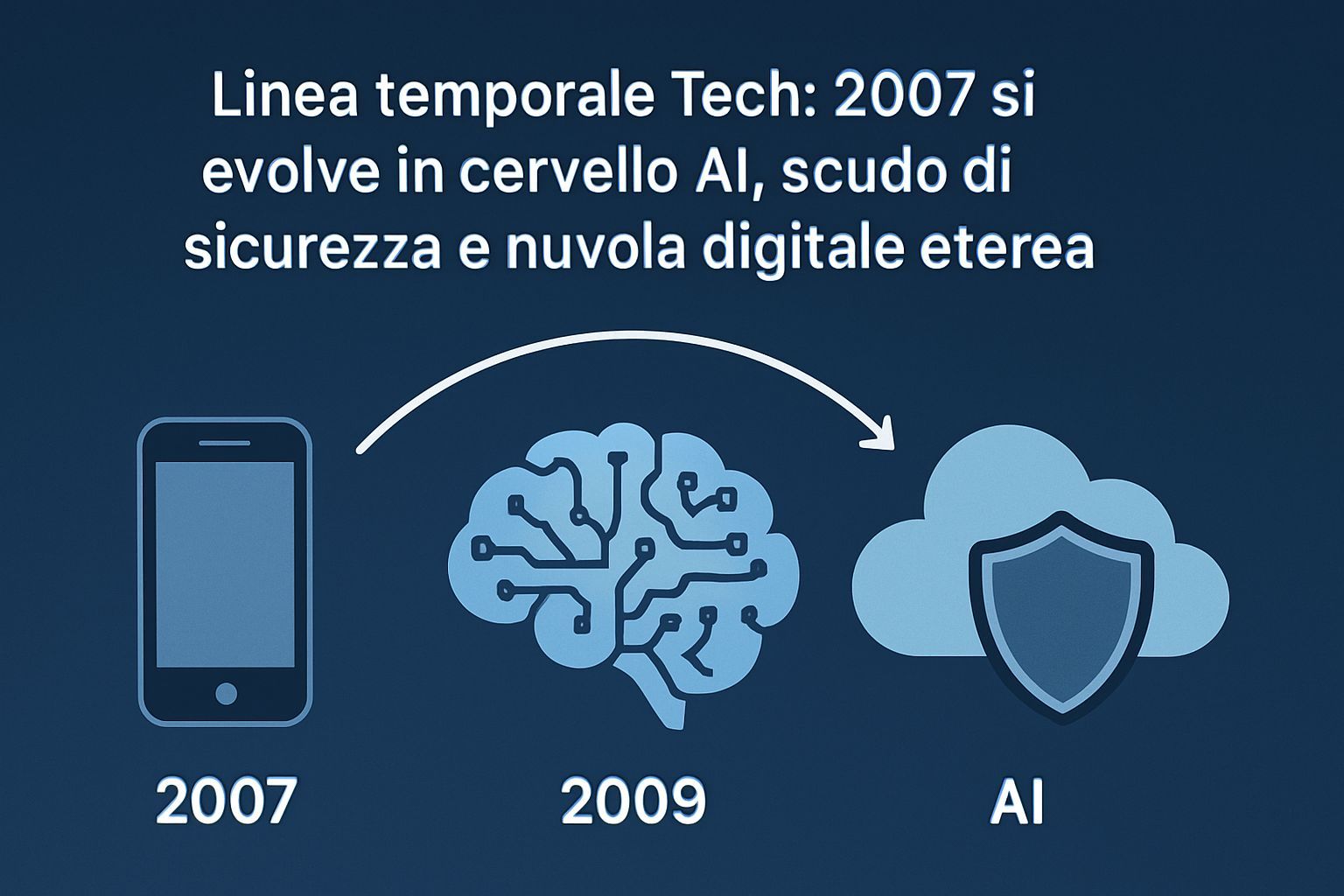
2007 stands as an emblematic year in the chronicle of technological innovation, a crossroads from which many of the currents that today dominate our digital world have begun to take shape or accelerate their race. Going through the pages of Ars Technica of that time, through reporter articles like Jeremy Page, she spreads a fascinating story of a brewing industry, where giants like Microsoft competed for primacy in emerging areas such as virtualization, online services and cybersecurity. What was then avant-garde or even speculation, today is our everyday reality. This deepening aims to trace an evolutionary path, starting from those news and trends of 2007 to explore how they developed, what impacts they had and where they led us, illuminating the gap between aspirations and achievements, between the rising challenges and today's solutions. From the promise of Windows Server 2008 to the first incursions in the cloud with “Live Services”, from the virtualization competition between VMware and the nascent Viridian (later Hyper-V) to the security concerns of operating systems, the technology landscape of 2007 offers us a precious lens to understand the foundations of our digital present and anticipate future directions. It is a journey through a time when the basics for IT ubiquity, data explosion and the pervasiveness of cyber threats were laid, elements that still today define the agenda of technological leaders and organizations of every dimension.
Microsoft Ecosystem: From Windows Server 2008 to the Ascension of the Hybrid Cloud
In 2007, Microsoft was at the heart of an intense phase of renewal of its enterprise ecosystem, with the upcoming launch of Windows Server 2008 (then known as Longhorn Server), a highly anticipated event that promised to redefine standards for server operating systems. The news then highlighted innovative features such as the introduction of the Server Core option, a minimal version of the operating system designed to reduce the footprint, the attack surface and patching requirements, and the integration of IIS 7, which promised to significantly simplify the management of web servers. These were not simple incremental improvements; they represented significant steps towards greater efficiency, security and flexibility in the corporate IT infrastructure. Active Directory management capabilities were upgraded, and there was discussion of the evolution of Terminal Services, an area where Microsoft aimed at competing with giants like Citrix. What emerged was a clear Microsoft strategy to consolidate its leadership in the datacenter, preparing the ground for the virtualization era and, although embryonicly, cloud. Although the concept of “cloud computing” was not yet ubiquitous as it is today, the foundations for what would become Azure were thrown right at this time, with emphasis on data centers and online services (such as “Live Services” and “Penn Live”). The path from Windows Server 2008 to the current domain of Azure was marked by an impressive transformation: from an offer mainly on-premises a hybrid architecture and cloud-first, where the physical server is often only an access point to a virtual and scalable universe of services. The vision of Server Core, which aimed at a more streamlined and resilient infrastructure, today finds its maximum expression in containers and serverless architectures, which push even further the concept of automated resource abstraction and management. The evolution of Active Directory in Azure Active Directory (now Microsoft Entra ID) is another flashing example of how the bases of 2007 enabled the transition to a unified and secure digital identity in the cloud, managing access and authentication for an increasingly distributed and SaaS-based world. The success of this transition has consolidated Microsoft not only as a provider of operating systems and applications, but as one of the main pillars of global digital infrastructure.
Le Guerre della Virtualizzazione: From Hyper-V to Containers and beyond
In 2007, the virtualization world was a rapidly expanding battlefield, with established actors and new challengers competing for supremacy. VMware Workstation 6 had just been released, consolidating VMware's position as an undisputed leader in the industry with advanced features such as Vista support and Paravirtualization. But the focus was also on “Viridian”, the code name of Microsoft’s virtualization project that would later become Hyper-V. The news then reported delays and Viridian’s decision to “leave some core features to ship in time”, a sign of immense competitive pressure and technical complexity. Other actors, such as Citrix, “sailed in the virtualization pool” with new products to manage server farms, and XenSource, with its XenEnterprise, provided alternatives open-source and Linux-friendly. This ferment clearly indicates that virtualization was no longer a niche, but a transformative technology destined to revolutionize the datacenter. The promise was clear: greater efficiency in using hardware resources, server consolidation, application isolation and ease of management. Microsoft’s aggressive entry with Hyper-V, often offered free of charge as part of Windows Server, triggered a real price and innovation war, pushing all competitors to constantly improve their offers. Although VMware has maintained a dominant position, Hyper-V has gained a significant market share, especially among companies with an existing Microsoft ecosystem. Today, the landscape of virtualization has been further fragmented and diversified. Virtual machines (VM) remain a fundamental technology, but have been flanked and in certain contexts overcome by containers, with Docker and Kubernetes who have become the pillars of modern architectures based on microservices. The containers offer an even lighter and portable abstraction level than the VMs, allowing greater density, faster start and simplified management of development and production environments. Moreover, the concept of “serverless computing” has brought virtualization to an even higher level, completely distracting the underlying infrastructure and allowing developers to focus exclusively on code, with resources dynamically allocated and billed based on actual use. From the 2007 virtualization wars, we went to an ecosystem of complementary technologies that offer companies unprecedented flexibility in building and managing their IT infrastructures, laying the foundations for cloud-native development and agile innovation.
Computer Security: From Patch Insulated to Proactive and Intelligent Defenses
In 2007, cybersecurity concerns were already a constant, but the threat landscape and defense strategies were markedly different than today. Ars Technica’s articles at that time spoke of “Sysinternals releases Active Directory Explorer” for problem management and resolution, the opening of the “Microsoft Malware Protection Center” and the “Stirling” initiative to unify security management, a clear attempt by Microsoft to provide more cohesive tools. However, much of the coverage involved specific vulnerabilities: a “new DNS exploit” that allowed access to system level, problems with Word 2007 formats and a “new vulnerability of the animated cursor” that also affected Vista. The narrative was often “patch that patch”, indicating a reactive approach based on the correction of the individual foals after their discovery. Security was seen primarily as a battle against malware and known exploits, often faced with updates and antivirus. Since then, the cybersecurity world has undergone a radical transformation. Threats have become exponentially more sophisticated, persistent and targeted, evolving from mass viruses to attacks ransomware on large scale, campaigns phishing extremely elaborate and advanced persistent threats (APT) supported by state actors. Today's security solutions go far beyond simple signature detection. We witnessed the emergence of architectures Zero Trust, where each user and device is continuously verified, regardless of its network location. Systems of Endpoint Detection and Response (EDR) and Extended Detection and Response (XDR) use artificial intelligence and machine learning to analyze vast volumes of telemetry data, identifying anomalies and suspicious behaviors in real time. I Security Information and Event Management (SIEM) and Security Orchestration, Automation and Response (SOAR) have become indispensable tools to correlate events, automate responses and orchestrate security operations. Microsoft’s approach to security has also matured enormously, from initiatives such as “Stirling” to an integrated suite of cloud-based security products and services, such as Microsoft Defender 365 and Azure Security Center (now Microsoft Defender for Cloud), offering end-to-end protection on identity, endpoint, data, app and infrastructure. The awareness of the threat is no longer only reactive, but proactive, with predictive analysis, threat intelligence shared and bounty bug programs that encourage responsible discovery of vulnerabilities. Cybersecurity has become a holistic discipline, which involves not only technology, but also processes, personnel training and a culture of corporate security, recognizing that the most robust defense is layered and constantly evolving to counter an increasingly innovative opponent.
Dawn of Cloud Services: From Live Services to SaaS Giants
In 2007, the concept of “cloud computing” was still at the dawn for many, but the foundations for its explosion were already under construction. The news from Ars Technica reported Microsoft’s addition of “online storage and photo gallery to its Live line”, labeling it as a potential “Flickr killer” and an advance on Google. These “Live Services” – along with initiatives like “Penn Live” for the University of Pennsylvania, which replaced Craigslist and MySpace for students – were the first seeds of what would become the ubiquity of software as a service (SaaS) and cloud infrastructure. Microsoft’s vision of building “gigant data centers in Quincy, Washington”, in Google’s emulation, was a clear signal of a paradigm shift: the computing power and storage would no longer be just resources on-premises, but services provided by huge remote infrastructure. This passage from property to access, from license to service, was the genesis of the business model that today dominates the technological sector. From those shy beginnings with consumer services, the cloud expanded to incorporate every aspect of corporate IT. What was a “Flickr killer” became OneDrive, Google Drive and a myriad of other storage and collaboration platforms that became essential for everyday work and life. Business applications, once installed and managed locally, are now distributed as SaaS services, with Salesforce, Microsoft 365, Google Workspace and hundreds of other solutions that offer complete functionality accessible from any device and location. Building giant data centers culminated in creating global hyperscale infrastructure networks, such as Amazon Web Services (AWS), Microsoft Azure and Google Cloud Platform, which provide computing power, storage, networking and a wide range of managed services. These platforms not only democratized access to enterprise-level IT resources, but also accelerated innovation, allowing established startups and companies to scale rapidly, experiment new technologies such as artificial intelligence and big data analysis, and launch unprecedented products and services. Cloud computing, whose roots were visible in 2007, is now the engine of the digital economy, transforming the way companies operate, innovate and interact with their customers, far exceeding the initial expectations of those first “Live services”.
Mobility and Connectivity: From BlackBerry Trauma to Smartphone Era
2007 was a crucial year for mobility, although its meaning was fully understood only in retrospective. The news of Ars Technica of a “BlackBerry failure” that left users “in email abstinence” for several hours, highlighted the growing dependence on mobile connectivity for business communications. At the time, the BlackBerrys were the undisputed kings of mobile productivity, venerated for their physical keyboard and the ability to manage emails efficiently. The idea that a break could cause such discomfort showed how much they were already integrated into professional life. However, just that year, another event was about to completely redefine the mobile landscape: the launch of the iPhone. Although not directly mentioned in the news of Jeremy Page (which focus more on the Microsoft and BlackBerry ecosystem), the echo of its impact was imminent and would soon eclipse the supremacy of the featured and the first smartphone business oriented. The BlackBerry, although innovative for its time, was an age of mobility focused on text and voice communication, with limited access to internet and applications. The world was still far from the vision of a pocket computer with an interface multi-touch intuitive and an app ecosystem. From that “BlackBerry failure” we went to an era of ubiquity of the smartphone, where mobile devices are no longer just communication tools, but extensions of our digital life. Phones have become our main means to access the internet, work, play, socialize and manage almost every aspect of our existence. The evolution has led to high-resolution screens, powerful processors, advanced cameras and, above all, to operating systems (iOS and Android) that allowed the birth of an economy of billionaire apps. Connectivity has passed since 2G and 3G to today’s 5G, enabling real-time experiences and scenarios such as IoT (Internet of Things). The email dependence on BlackBerry has been replaced by an even deeper dependence on a myriad of messaging, social media and productivity applications, with service interruptions that today have far wider repercussions. The transition from BlackBerry to iPhone and then to the Android ecosystem has democratized access to advanced mobile technology, transforming not only personal communication, but also the way companies operate, interact with customers and develop new business models based on mobility. That “e-mail abstinence” of 2007 was a premonition of the ineludible centrality that mobile connectivity would assume in our society.
Open Source: From Nicchia Alternative to Innovation Motor
In 2007, the movement open source was a growing actor, but still perceived, in many contexts, as a niche alternative or a solution for developers and enthusiasts, rather than a supporting column of global IT infrastructure. The news of Ars Technica referred to the “update” of OpenOffice. org to version 2.2, a “venerable open-source office suite” that offered a valid alternative to Microsoft Office. Similarly, XenSource was mentioned for adding support to Windows 2000 in XenEnterprise, consolidating its position in the virtualization landscape open source and “Linux-friendly”. These examples illustrate the nature of the movement open source of that time: it provided practical and competitive tools, often with an emphasis on compatibility and cost reduction, but it still struggled to match market penetration and corporate support of its proprietary equivalents. Its adoption was often motivated by specific economic, ideological or technical reasons, without the pervasiveness it would have achieved in the following years. The evolutionary leap made by the movement open source in less than two decades it was extraordinary. Today, theopen source is no longer a niche alternative, but the foundation on which most modern technologies are based, from operating systems (Linux dominates servers and the cloud) to programming languages, from databases (such as PostgreSQL and MongoDB) to framework of machine learning (TensorFlow, PyTorch). Cloud computing itself is largely built on technologies open source. Kubernetes, the most widespread container orchestration system, is open source; Hadoop and Spark are the pillars of big data analysis. Even giants who once saw theopen source with suspicion, like Microsoft, they embraced and actively contributed to the community. Microsoft acquired GitHub, one of the largest hub projects open source, and released a myriad of his projects as open source, demonstrating radical cultural change. This transformation has been guided by several factors: open code transparency and security, the ability to innovate quickly through the collaboration of thousands of developers, the reduction of vendor lock-in and flexibility to adapt solutions to specific needs. Theopen source has become the preferred model for innovation in many sectors, not only for its free nature, but for its inherent robustness, adaptability and ability to foster global collaboration. Its influence extends from the single desktop application to the hyperscale infrastructure, consolidating its indispensable role of modern digital age, far beyond what was imaginable in 2007.
User Experience and Digital Rights: Between Hardware, DRM and Content
Discussions about user experience, consumer freedom and digital rights were already present in 2007, as evidenced by some of Ars Technica's most read articles and news about the world of digital entertainment. The disappointment of users for “smart Amazon displays” bombarded by advertising, or the “regression” of Bose home theater systems in simple speakers, reflected a deep tension between the promises of technology and the reality of consumer experience. These themes predicted the growing awareness that hardware-software integration, if poorly managed, could lead to compromises on the usability and functionality of the products. Also, the news that “Microsoft sings another refrain: Zune will probably sell traces without DRM” was a powerful signal of a change of course compared to the fierce defense of Digital Rights Management (DRM) that had characterized the music industry and software until then. Microsoft’s search for a “Flickr killer” with its “Live services” and discussions on “TrustedFlash” technology to bring your desktop to a keychain they highlighted the desire for greater flexibility and control over their data and their working environment, although they often collided with the restrictions imposed by suppliers. Since then, the conversation about user experience and digital rights has become even more complex and urgent. The explosion of smart devices (IoT), from smart speakers to smart TV and related household appliances, amplified privacy, data collection and privacy concerns vendor lock-in. The tendency to transform physical products into “services” controlled by the manufacturer, as in the case of Bose speakers, has become a common practice, raising questions about the property and duration of useful life of products. The question of DRM, although less debated in explicit terms in the musical context (where the services of streaming have largely replaced the purchase of files), persists in other forms, such as software licenses and protected digital content. The subscription model, which offers access rather than property, has redefined the consumption of media and software. The focus has shifted to data portability, interoperability between platforms and the right to repair, with consumers looking to regain control over the technologies they own. The discussion on “personalization” and “privacy” has become central, with companies looking for a balance between providing tailored experiences and protecting personal information. The journey towards a more transparent, customizable and respectful user experience of digital rights is still ongoing, fueled by consumer pressure, regulation (such as GDPR) and technological innovation that offers new possibilities of control and access.
Innovation Access: Lessons from a Decade and Middle
Reflecting on the technological landscape of 2007 through the lenses of Ars Technica and Jeremy Page offers us a precious perspective on the unprecedented acceleration of innovation. What a decade and a half ago were the “last news” – a new Sysinternals tool for Active Directory, the opening of the Microsoft Malware Protection Center, the launch dates of Windows Server 2008 – today represents a milestone on which the current digital world was built. This retrospective highlights not only the speed with which the technologies evolve, but also the depth with which the decisions and directions made then shaped our present. The virtualization battle between VMware, Microsoft (Viridian/Hyper-V), Citrix and XenSource laid the foundations for data center efficiency and opened the way to cloud computing, which in turn transformed the way companies manage their infrastructure and their applications. Microsoft’s first incursions in “Live services” and the construction of “data center giants” were the precursors of the era hyperscale of the cloud, demonstrating an embryonic but strategic vision of the future. The “ BlackBerry failure” marked the beginning of a mobile revolution, pushing towards a richer user experience and an ecosystem of apps that radically changed communication and work. Similarly, security discussions, although focused on specific vulnerabilities and patches, have anticipated the complexity of a threat landscape that today requires AI-based intelligent and proactive solutions machine learning. The growth ofopen source, from alternative to foundation, emphasizes the power of distributed collaboration and innovation. The lessons learned are many: resilience and adaptability are fundamental for companies and individuals in a changing environment; the importance of a long-term vision, even when the first steps seem uncertain; and the need to balance innovation, security and user rights. Looking at the future, we can expect the convergence of technologies such as artificial intelligence, IoT, and quantum computing and the blockchain will continue to redefine our world at an increasingly tight pace. The experience of 2007 reminds us that current trends are only the prodromes of even deeper transformations, and that the ability to anticipate, adapt and guide change will be the key to success in the next era of technological innovation.
The Persistent Impact of Past Decisions on Modern Tech
The analysis of the technological landscape of 2007, filtered through the news of Ars Technica, is not only an exercise of digital archaeology, but a powerful reminder of how the decisions taken and the directions taken a decade and a half ago continue to resonate and deeply influence modern tech. Every announcement, every development and every challenge of that time has helped shape the present we live. Microsoft’s insistence on Windows Server 2008 with features such as Core Server and IIS 7, for example, was not just a move to maintain leadership in the server operating systems market, but triggered an evolution that led to hybrid infrastructure and cloud-native that characterizes Azure today. The choice to integrate virtualization features with Viridian (Hyper-V) was a strategic move that democratized technology, pushing the entire industry towards more efficient and scalable solutions, up to the current mass adoption of containers and serverless architectures. Also concerns about cybersecurity, which then focused on specific patches and vulnerabilities, have prepared the ground for the holistic and proactive approach to cybersecurity that today employs artificial intelligence, machine learning and Zero Trust models to defend against increasingly sophisticated threats. The launch of “Live Services” and the construction of “Grabal Data Centers” by Microsoft and Google represented the first fundamental bricks for the building of cloud computing, enabling the SaaS model that revolutionized software consumption and distribution. The “BlackBerry failure” and the upcoming launch of the iPhone have accelerated the evolution towards the smartphone as a central device of our lives, opening the era of apps and ubiquitous connectivity. The rise ofopen source, from niche projects to pillars of the global technological infrastructure, demonstrates the power of community collaboration and innovation. Ultimately, the lessons of 2007 teach us that technological progress is a continuum, where every innovation is based on the previous ones, and where the challenges of yesterday often contain the seeds of tomorrow's solutions. Market dynamics, architectural choices and responses to users’ needs have created a lasting legacy, which continues to inform and guide the current wave of digital transformation, stressing the importance of understanding the historical context to effectively navigate the complexity of the technological future.
The Role of Content and Technical Analysis in a World in Evolution
In 2007, the role of technical publications such as Ars Technica, and analysts like Jeremy Page, was already crucial to “separate signal from noise” in a rapidly expanding sector. The ability to offer “a unique combination of technical expertise and a broad interest in the arts and technological sciences” was essential to help professionals and enthusiasts understand what was “important” between a flood of information. Jeremy Page’s stories, ranging from the launch of new Sysinternals tools for Active Directory, to Windows Server 2008 updates, to the opening of Microsoft’s Malware Protection Center, to virtualization challenges with Viridian and VMware, provided an essential snapshot of trends and products that were modeling the IT landscape. What was then an analysis focused mainly on software and hardware, today has become an even more complex and indispensable exercise in a world where technology is interwoven in every aspect of human life. The evolution of technology since 2007 has transformed not only content and tools, but also the very nature of technical analysis. Today, analysis is no longer limited to describing new features or reviewing products; it must interpret complex ecosystems, predict the impact of emerging technologies such as artificial intelligence and blockchain, and understand the ethical and social implications of innovation. The need to “separate the signal from noise” is more acute than ever, given the vastness and speed of the flow of information. Specialist publications and expert analysts continue to play an irreplaceable role in providing context, depth and critical thinking, helping to navigate between hype promises and real innovations. The reliability and acumenity of sources like Ars Technica remain a lighthouse, offering insights that go beyond the simple reportage to explore the long-term ramifications of technological decisions. In an era of disinformation and ultra-fast news cycles, the value of weighted technical analysis, which does not fear to look back to understand more complete the future, has grown exponentially. The lectures of 2007, and Jeremy Page’s approach at the time, remind us that the ability to contextualize innovation and understand its broadest implications is as important as technology itself, if not more, to build a digital future informed and sustainable.


