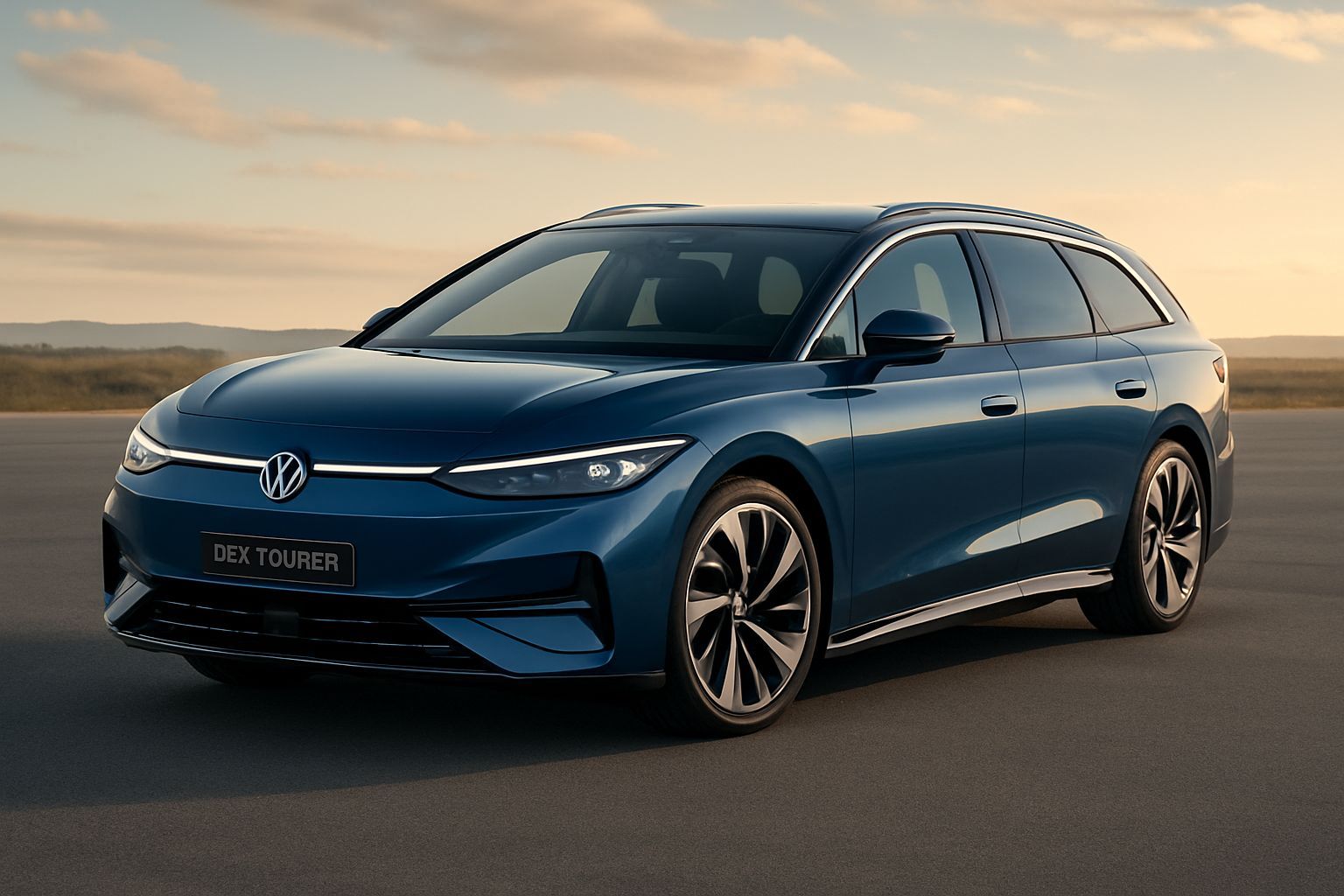
The official presentation of the Volkswagen ID.7 Tourer, although still in the teaser phase, is not simply the introduction of a new model in the growing electric catalog of the Wolfsburg house. It represents a watershed moment, a strong signal that the segment of wagon stations, long considered a fundamental pillar of the European automotive market and a synonym for family practicality and high-performance touring, will not only survive the energy transition, but will be strengthened. The adoption of the name ‘Tourer’ in place of the traditional ‘Variant’ immediately marks a discontinuity, a programmatic statement: the car is thought not only for everyday transport, but for long electric journeys, where efficiency, autonomy and comfort play a crucial role. In a landscape dominated overwhelmingly by SUVs, which often sacrifice aerodynamic efficiency and driving dynamics for greater robustness and a high seat position, the ID.7 Tourer is a mature and intelligent alternative. The fact that Volkswagen has invested to bring a fully electric station wagon on the market, based on the advanced architecture of the MEB platform and promising self-government that range 700 km, demonstrates a strategic trust towards a clientele that appreciates the balance between elegant aesthetics, dynamic performance and maximum functionality. This car, destined to launch on the European market in 2024, is not only an elongated version of the ID.7 sedan; it is a refined engineering work aimed at overcoming the challenges posed by the integration of bulky battery packs with the need to offer a load space at the top of the category, all maintaining an exceptionally low air resistance. We will analyze in detail how Volkswagen has managed to balance these seemingly contrasting elements, examining the critical importance of aerodynamics, the impact of different battery options and the meaning of this model for the future of the brand in segment D.
The Return of the Heir: Why Station Wagon Counts in the Electric Era
The European automotive market has historically venerated the wagon stations, or “sw” as they are often called, for their unparalleled combination of street elegance and pure functionality. Iconic models such as the Passat Variant have defined for decades the ideal corporate and family car concept. However, the advent and relentless dominance of SUVs and crossovers in the last decade have put this segment hard, pushing many manufacturers to resize their offer. The arrival of the ID.7 Tourer marks a reversal of strategic route and an implicit recognition of the fact that, for the European consumer attentive to efficiency and practicality over long distances, the SUV is not always the optimal answer. The electric station wagon, as embodied by the ID.7 Tourer, solves various intrinsic criticalities to the SUVs in the EV transition. The first and most obvious is aerodynamics. A lower and spinning vehicle drastically reduces air resistance, a factor that directly results in greater autonomy, the most critical metric for mass acceptance of electric vehicles. While an electric SUV has to fight with its wider front section and its higher height to maintain a competitive Cx, the Tourer starts from a significant structural advantage. The second reason lies in the driving dynamics: lowering the centre of gravity thanks to the optimal positioning of the battery in the platform and maintaining a silhouette closer to that of a sports saloon, the Tourer promises a handling and stability in the upper curve than most of the SUVs in the same segment. This preference for handling is not secondary, especially in markets such as Germany or Italy, where highway routes and mountain roads require precision. Finally, there is the question of true space. Although the SUVs can offer a high load volume in height, the Tourer maximises the useful length of the compartment, reaching almost two meters with the lower seats (1,714 litres), making it ideal for long objects or sports equipment, an aspect where the vertical height of a crossover is not always sufficient. In this context, the ID.7 Tourer is not only a niche model; it is the electrical heir designated by an entire automotive philosophy that favours engineering expertise and uncompromising functionality.
Aerodynamic excellence and Functional Design: The Magic Cx 0.24
Aerodynamics is the new battlefield in the electric vehicle industry. As the energy density of the batteries continues to represent a physical and chemical limit, the most effective way to increase autonomy without increasing the weight or cost of the battery pack is to reduce air resistance. The standard Volkswagen ID.7 has already established an impressive reference point with an aerodynamic resistance coefficient (Cx) of 0.23. The fact that the ID.7 Tourer, a vehicle with a significantly more square rear profile and a larger volume, manages to maintain a Cx of only 0.24 is a testament to the meticulous engineering used in its design. This result is particularly remarkable if it is considered that the addition of the wagon tail, necessary to expand the trunk, intrinsically introduces aerodynamic challenges related to the separation of the airflow and the creation of turbulence in the ski area. Volkswagen engineers had to apply advanced solutions to control and minimize these low-pressure bags. This probably includes the optimization of the roof and rear spoiler, which is designed to manage the outgoing air flow and reduce the induced resistance. Moreover, active elements are presumed to be used, such as controlled air outlets (active grills) in the front to direct the air only when necessary for the cooling of the battery and the traction components, keeping them closed as much as possible on the march to reduce the dragon. The undercar of the ID.7 Tourer is certainly flat and smooth, a characteristic common to MEB vehicles, which helps to flow the air without interruption. The circles, also optimized aerodynamically, play their crucial part. Comparing this value of 0.24 with equivalent ICE models or with electric SUVs immediately shows the advantage: for each decimal earned in the resistance coefficient, significant percentage improvements are obtained in highway autonomy, which is the driving regime in which aerodynamic friction dominates rolling resistance. A Cx of 0.24 for a station wagon puts it at the top of the category, ensuring that the battery packs of 77 kWh and 85 kWh can best express their touring potential.
The MEB Architecture and the 700 Km Promise: Battery and Efficiency
The backbone of the ID.7 Tourer, as for most of Volkswagen's new electric range, is the modular electrification platform, the MEB. This architecture has been specifically designed to accommodate battery packs efficiently and provide the flexibility needed to produce different types of bodywork. In the case of the ID.7 Tourer, Volkswagen will offer two main battery options: one of 77 kWh net and a larger version, presumably 85 kWh net, the latter crucial to reach the ambivalent autonomy of almost 700 km (WLTP cycle). It is essential to understand that achieving such a wide range depends not only on battery capacity, but is a direct result of synergy between the great energy capacity and the exceptional aerodynamic and transmission efficiency. The efficiency of the MEB cinematic chain, which includes highly optimized permanent magnet synchronous motors and sophisticated thermal management, is essential. Thermal management is particularly critical for lithium-ion batteries: keeping the battery at the optimum operating temperature, both during fast charging and during the gear, not only extends its life, but also ensures that energy is delivered efficiently. The MEB platform in its evolution for top models such as ID.7 (often referred to as MEB+ in some discussions, although VW maintains the MEB name continuously) integrates improvements in cell chemistry and charging architecture that will allow faster charging speeds than the first ID models. This is vital for the concept of ‘Tourer’; a vehicle destined for long journeys must not only have a high autonomy, but also minimize the time of rest for charging. If the ID.7 derision has already demonstrated excellent charging capacity, the Tourer version with the 85 kWh battery pack will benefit from an optimized system voltage to accept DC charging power that will probably exceed 200 kW, significantly reducing the time needed to switch from 10% to 80% charge. The promise of 700 km WLTP, if translated into a real range of 550-600 km in mixed conditions, would position the ID.7 Tourer as one of the most competent electric vehicles on the market for travel without anxiety to recharge.
Maximize Space: Detailed Analysis of the Volume of Loading Tourer vs. Variant
The main reason for the existence of a station wagon is the load capacity, and on this front, the ID.7 Tourer had to confront an almost unbeatable tradition: the Volkswagen Passat Variant. The comparison of numbers is illuminating and reveals the intrinsic challenges of electrification. The ID.7 Tourer offers 545 liters of volume in the standard luggage compartment (up to the height of the hat), a modest increase of only 13 liters compared to the ID.7. The real impact of the wagon body shop is manifested, however, in vertical use and in maximum capacity: with the lower rear seats, the loading space rises to 1.714 liters. This data is excellent, but remains less than 1,920 liters offered by the Passat Variant 2024 based on the MQB platform. This difference of about 200 liters is almost entirely attributable to the need to accommodate the voluminous high voltage battery pack in the floor. The MEB platform, while being extraordinarily efficient in packaging, must lift the load plan slightly to protect the battery below, thus limiting the overall useful height, especially in the rear hatch and near the seats. However, the ID.7 Tourer compensates for this slight loss of absolute volume with better space usability. The regular shape of the load compartment, the wide opening of the typical wagon door and the useful length of almost two meters (when the seats are lowered) ensure that the car can swallow long objects, such as skis or removable furniture, with ease. The smart design of the boot floor, which probably includes hidden compartments under the main floor to store charging cables (a must-have for electric vehicles) and other small objects, optimizes every available inch. Modern engineering is not limited to crude volume; it focuses on modularity and ease of use, elements in which the ID.7 Tourer is destined to excel, offering an electrical load solution that, while not matching the apex of the ICE capacity, approaches very much, establishing a new standard for large SW EV.
Luxury Edge and Comfort Technology: Beyond Propulsion
The ID.7 Tourer, as a practical fan of the ID. family, is not only based on efficiency and space; it incorporates the best of the onboard technology and comfort that Volkswagen has developed to compete in the premium D segment. The Tourer’s cockpit will inherit all the innovations introduced in the ID.7 sedan, designed to improve the driving experience on long routes. Central in this approach are the infotainment system and the human-machine interface (HMI). VW responded to the criticisms of the first ID models. Introducing a massive 15-inch central display, which integrates most of the vehicle functions, but, crucial for comfort, has finally reintroduced the physical or aptic backlit sliders for volume and temperature regulation, making interaction less frustrating while driving. Another distinctive element is the augmented reality display (AR Head-Up Display) that projects essential information such as speed, navigation indications and driving assistance alerts directly into the driver's field of view, so that they seem to float at different distances on the road. This technology reduces the time the driver takes to divert the look from the road, increasing safety and visual comfort, especially at night. As for thermal comfort, ID.7 is known for its electronically controlled ‘smart’ air outlets, which can oscillate to distribute the air evenly in the cabin. Seat options, especially ergoActive seats with massage and ventilation functions, emphasize the orientation touring luxury. In a vehicle intended to cover long distances (almost 700 km with the largest battery), acoustic comfort is equally important. The structure of the MEB platform, which isolates the noise of the engine, combined with an excellent soundproofing and optional acoustic glass, ensures a serene interior environment, transforming long trips to the highway into a relaxing experience. The ID.7 Tourer is the modern and technological definition of great tourism, where the practicality of the station wagon meets the serenity of the advanced electric drive.
Production at Emden: Sustainability and Economic Impact
The decision to produce the ID.7 Tourer, as well as the ID.7 sedan, at the Emden plant in Germany, is a fundamental part of Volkswagen's electrification strategy and has significant economic and environmental implications. The Emden plant, historically associated with the production of Passat, has been subjected to a massive and costly conversion to become a pole entirely dedicated to the production of electric vehicles based on the MEB platform. This investment not only safeguards thousands of jobs in the region, but reaffirms Volkswagen’s commitment to maintaining the production of high volume electric vehicles in the heart of Europe. The production ‘Made in Germany’ is a quality and precision engineering brand, crucial elements for the premium positioning of the ID.7 Tourer. From the point of view of sustainability, the conversion of MEB plants aims to reduce the carbon footprint of production itself. Volkswagen has set itself the goal of making the production of all vehicles of the ID family. neutral budget in terms of carbon emissions, from energy supply (ideally from renewable sources) to final assembly. Emden's production logistics has been optimized to manage the complexity of the supply chain of batteries and electrical components. The Tourer will share many structural and mechanical parts with the ID.7 sedan, ensuring economies of scale and simplifying assembly processes. However, the management of the specific bodywork line for the Tourer, with its precise tolerances necessary to achieve that magic Cx 0.24, requires a high degree of robotization and quality control. Emden’s production is not just about Germany; it serves the entire European market, placing the ID.7 Tourer as a key model for Volkswagen’s leadership in the EV transition of the continent. The success of this station wagon will be a barometer of the ability of the German automotive industry to adapt and compete in the new electric panorama.
Competition in the Electric Segment: Who Challenges the Tourer?
Although the electric station wagon is still a niche segment compared to the EV SUVs, the introduction of the ID.7 Tourer greatly intensifies the competition in the D/E segment of premium family electric cars. The ID.7 Tourer is not alone; it is entering a game field that, although narrow, is presided over by high-level rivals and new contenders. The most direct competitor in Europe is undoubtedly the BMW i5 Touring. BMW, faithful to its tradition of luxury and performance, presented its electric version of the 5 Touring Series, offering superior performance, technologically more complex architecture and an inevitably higher price, but with a slightly lower autonomy than the 700 km promised by the flagship Tourer. Another significant contender is the Kia EV6, which, although technically a crossover, has a silhouette very close to that of a raised shooting brake and offers an excellent 800V platform, guaranteeing charging speeds that could exceed those of the ID.7. However, the EV6 cannot compete with the total load capacity of the Tourer. Looking at the future, rivals could emerge from generalist brands like Peugeot or Ford, but at the moment, the ID.7 Tourer stands as the most sensible and balanced volume choice in the segment. The real challenge for VW will be to convince consumers accustomed to the Passat Variant, and even the premium customers of Audi A6 Avant or Mercedes E-Class Estate, that the ID.7 Tourer offers a technological package, comfort and autonomy that justifies the passage to the electric without compromising functionality. The battle will not only be played on the trunk liters or on the power, but on the overall charging ecosystem, on technological integration and, crucial, on the attack price, where the ID.7 Tourer has the potential to be more accessible than its German luxury counterparts, making it a much more attractive option for the vast European company fleet.
Evolution of Naming: From Variant to Tourer, A Transition Symbol
Volkswagen’s electric station wagon is much more than just a marketing move; it is a linguistic and strategic signal that reflects the profound change in product perception and brand identity in the electric age. The term ‘Variant’ is historically associated with internal combustion, evoking the image of Passat or Golf Variant, cars synonymous with mechanical reliability and practicality. ‘Tourer’, on the contrary, is a vocabulary that immediately suggests an emphasis on long-haul travel, dynamic comfort and a slightly higher sophistication, aligning with a premium perception and driving experience. This rebranding is a common technique in switching to electric: the builders try to break with the mechanical past, creating a new narrative focused on futuristic technology and the silent and fluid experience offered by the EV drive. Using ‘Tourer’ helps to clearly distinguish the electric ID.7 from its thermal engine cousin, the new Passat Variant, avoiding confusion on the market and defining the ID range. as a separate entity and projected to the future. The Volkswagen, through this name, wants to communicate that the ID.7 Tourer is not simply an electrified Passat; it is an intrinsically optimized vehicle for the electric age, with its exceptional autonomy and its native architecture EV. This slim but significant lexical shift aims to position the vehicle not only as a practical means of transport, but as a sophisticated and technologically advanced travel companion, able to face long European routes with efficiency and style. It is a deliberate attempt to associate the ID range. to the values of innovation and high engineering, detached from the most utilitarian image that can sometimes accompany the term ‘Variant’.
Future implications: The ID.7 Tourer as Model for the MEB Next-Gen Platform
The technical and commercial success of the ID.7 Tourer will not only affect the immediate product strategy of Volkswagen, but will also provide crucial teachings for the development of the next generation of the MEB platform, often informally called MEB+. The Tourer, with its emphasis on extreme aerodynamic efficiency (Cx 0.24) and the need to integrate large battery packs (85 kWh) to reach a range of 700 km, pushes the limits of the current MEB architecture. The engineering solutions used to manage weight, aerodynamics and space in this body will be reused in other future models. For example, the techniques used to optimize the air flow in the Tourer queue could be applied to more compact crossovers or vans such as the ID. Buzz to improve its efficiency. In addition, the ID.7 Tourer will serve as a test bench for high performance variants. It is highly probable that VW introduces a GTX version of the Tourer, following the strategy of sports electrification already seen in other ID models. An ID.7 Tourer GTX would combine the practicality of the station wagon with integral traction and a significantly increased power, attracting a segment of buyers who historically addressed the R or GTI/GTD versions of the ICE station wagon. This would show that the MEB platform can support not only the efficiency for long-haul travel, but also the driving dynamic required by the most demanding markets. The innovations in terms of chemistry of the batteries introduced with the 85 kWh package, which contributes to the exceptional range, will be essential for future electric models of the Volkswagen Group, including the Audi and Skoda brands, who all seek to offer competitive autonomous in the premium segment. The ID.7 Tourer is a bridge between the first wave of MEB vehicles (ID.3, ID.4) and the next generation, more efficient, spacious and technologically advanced.
Market and Challenge perspectives: Price, Perception and Infrastructure
Despite engineering excellence and impressive specifications, the Volkswagen ID.7 Tourer will face different market challenges. The first is the price. Located in the upper D segment, the cost of purchase of the Tourer, especially in the 85 kWh battery versions, will be significant. Volkswagen will have to justify this price by offering a perceived value that exceeds the equivalent ICE models and competing electric SUVs. The brand’s perception is crucial; although VW is seen as a top quality mainstream brand, it must compete against intrinsic luxury perceptions at brands like BMW and Mercedes, which are also electrifying their high-end wagon stations. Long-term success will depend on VW’s ability to penetrate the markets of business fleets, where total efficiency and cost of ownership (TCO) are decisive. High real autonomy and fast charging speed reduces charging anxiety and dead times, making the Tourer economically advantageous for long distances. The last challenge, and perhaps the biggest for all electric vehicles intended for touring, is the charging infrastructure in Europe. The infrastructure is growing, but its reliability and density vary enormously between countries. The 700 km range mitigates this problem, but the user experience during longer trips will depend on the smooth integration of the Tourer navigation system with the public charging network. If VW will be able to offer an impeccable plug-and-charge charging experience, combined with the efficiency and spacious promises, the ID.7 Tourer will not only be a success for Volkswagen, but could catalyze a renewed interest and acceleration in the adoption of electric wagons such as reference touring vehicles for the European future, finally exceeding the obsession for SUVs.


