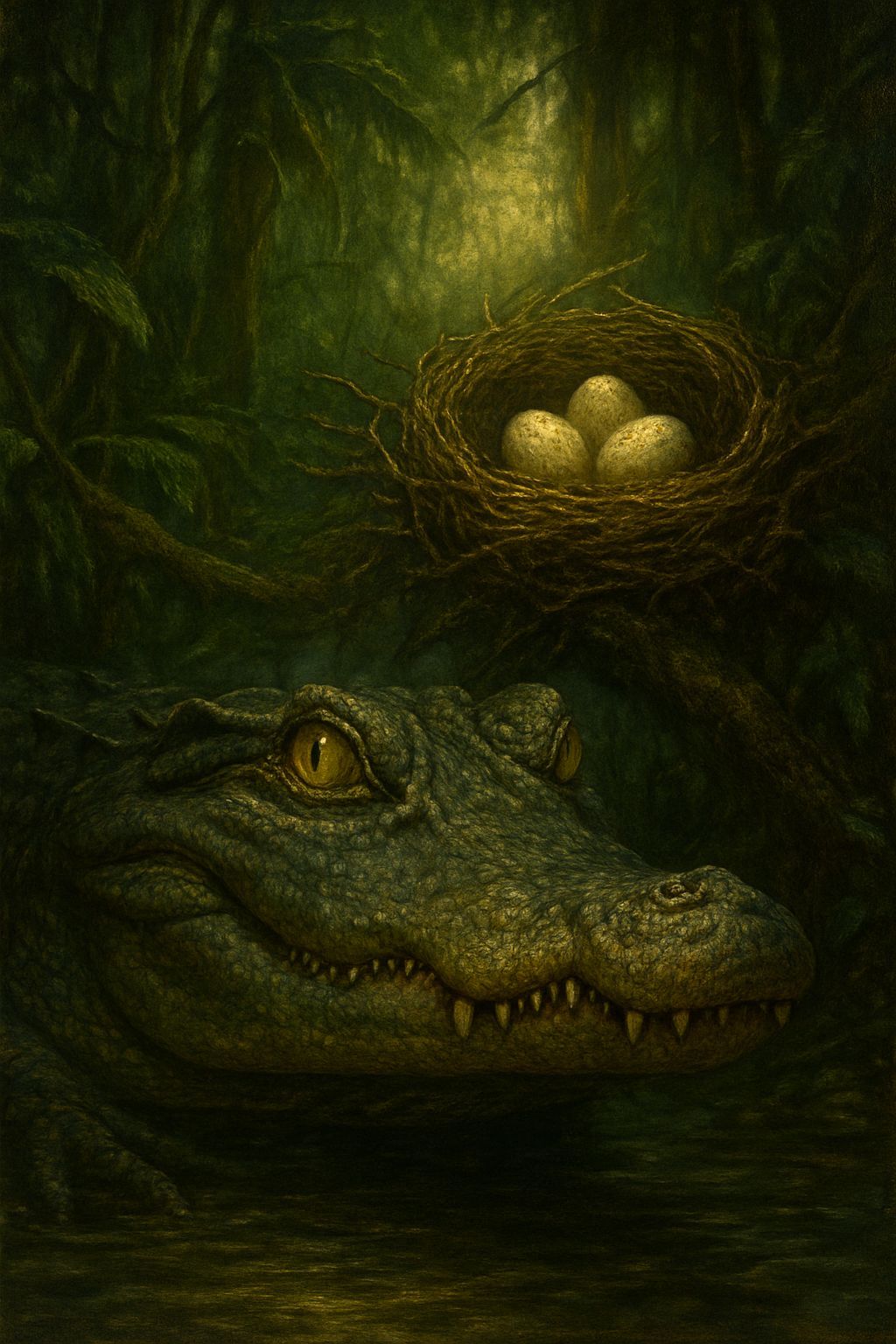
In the intricate and often brutal theatre of nature, survival strategies evolved by species to perpetuate their own lineage can be extraordinarily complex, even counterintuitive to the human eye. One of these narratives, recently emerged in the collective imagination through short and sometimes misleading online fragments, describes a phenomenon that at first glance appears as a horrible paradox: the idea that birds ‘buy’ protection from alligators for their nests through the ‘sacrifice’ of their own little ones. This premise, which generated the evocative title of ‘the horrible truth behind the memes on the cute birds’, is not a metropolitan legend, but the dramatic synthesis of a deep and fascinating scientific observation on predatory and symbiotic interactions in the ecosystems of the wetlands. It is not a conscious barter or ritual by birds, but rather a complex evolutionary strategy dictated by the ruthless logic of natural selection. In these dynamics, the proximity to a fearsome predator like the alligator turns, for some species of birds, into a decisive advantage, a bitter but effective compromise for the survival of a greater number of offspring. We will deepen how this interaction, which challenges our perception of altruism and predation, is a brilliant example of how life always finds a way, even the most cruel, to thrive in a world in constant struggle for existence. We will explore ecological mechanisms, reciprocal (or unilateral) benefits and evolutionary implications of this silent pact, revealing the extraordinary intelligence of nature.
The Protection Paradox: Nidi In the Predatory Fauci
The primary environment where this peculiar interaction is manifested is that of the tropical and subtropical humid zones, such as the immense expanses of Florida marshes, the coastal mangroves or the dense forests of cypresses, habitats reserved by a wide range of species of colonial aquatic birds. Here, herons, egrets, spatulas, cormorants and storks build their nests, often in hundreds or thousands, on trees that rise from low waters. The choice of nesting in colonies is in itself a survival strategy, offering greater vigilance against predators and a potential ‘dilution of risk’ where the probability that your nest is attacked is less in such a large group. However, even in these air strongholds, the dangers abound. Predators such as raccoons, opossums, arboreal snakes and raptors are constantly looking for helpless eggs and chicks. The threat of these terrestrial and arboreal predators can decimate entire colonies, pushing the birds to look for extreme solutions. And this is where the American alligator comes into play (Alligator missippiensis), or similar species of crocodiles in other geographical contexts. These gigantic reptiles, undisputed masters of their aquatic ecosystem, are the apical predators of the wetlands, whose presence instills fear in almost every creature that dares to venture into their territory. The idea that a bird chooses to nidify directly over an alligator seems, to a first analysis, suicidal. Yet, for airony of nature, it is their formidable presence that creates an almost impenetrable free zone. The raccoons and opossums, which otherwise would encamp without hesitation on the trees to reach the nests, are extremely reluctant to cross the waters infested by alligators. The mere threat of a fatal encounter with these deadly jaws acts as an invisible but incredibly effective deterrent. The alligators, while not knowingly 'body looks', create an unsurpassed security perimeter for many of the most common and devastating predators for bird colonies, transforming a potential executioner into an unexpected protector.
The Survival Coin: An Inevitable Newborn Tribute
Nature does not know sentimentalism, and the survival of the species is the only currency of exchange. In this context, the ‘sacrifice’ of the little ones is not an intentional or conscious act of offering by the birds, but rather an inevitable consequence of their reproductive strategy and natural selection. The colonies of aquatic birds produce a very high number of eggs and chicks, a common strategy among the predicted species to maximize the possibilities that at least some individuals reach adulthood. Not all children are destined to survive, regardless of the presence of alligators. Some are born weak, others fall accidentally from the nest, especially during storms or in case of overcrowding. This is where alligators come into play, not as a deliberate tribute collector, but as opportunists. The chicks fallen from the nest, now irrecoverable for parents and condemned, become an easy source of food for alligators patrolling the waters below. This seasonal abundance of additional food – a sort of ‘manna dal cielo’ for reptiles – not only contributes to their nutritional well-being, but also strengthens their constant presence in bird nesting areas. Alligators are attracted by the potential source of food and their persistence in those places intensifies the deterrent effect on terrestrial predators. Therefore, the ‘price’ paid by birds – the loss of some chicks – is a calculated and accepted cost, almost an investment. The percentage of chicks lost due to alligators is statistically lower than the number that would be deducted from mammals and snakes if alligators were not present. He is a bitter trade-off evolutionary: losing a small part of the offspring in favor of a dominant predator to ensure the survival of the majority, and therefore the total reproductive success of the colony. This cruel but effective mechanism emphasizes the brutal and pragmatically efficient logic of natural selection, where the imperative is the continuity of the genetic line, regardless of individual losses.
Ecosystem benefits: Beyond Simple Predation
The interaction between nesting birds and alligators goes well beyond a simple predator-preda ratio, transforming itself into a complex ecosystem dynamic that generates unexpected benefits for both parts, albeit with asymmetrical costs. For bird colonies, the primary and most evident benefit is the drastic reduction of predation by land mammals and arboreal snakes. These predators, which represent a constant and ubiquitous threat to eggs and chicks in the absence of defenses, are effectively kept under the reputation and physical presence of alligators. The simple sight or smell of an alligator is enough to discourage most raccoons and opossums from approaching nesting trees, creating in fact a safety zone. This indirect protection allows a significantly greater number of chicks to complete the development in the nest and to fly, ensuring the total reproductive success of the colony. In an environment where the mortality of chicks is naturally high, any factor that can increase the survival rate is a crucial evolutionary advantage. But the benefits are not limited only to reducing predation. The presence of large predators such as alligators can positively influence the general health of the ecosystem. They act as key species of time, regulating the populations of other species and maintaining the balance of the food chain. In this specific case, their deterrent role against intermediate predators indirectly preserves bird populations, which in turn play vital roles in seed dispersion, insect control and nutrient transfer within the ecosystem. In addition, the ‘wealth failure’ of birds towards alligators could be a learned or evolved behaviour, an adaptation that balances the minimum risk of flea loss with the macroscopic benefit of protection. This delicate balance shows how interspecies are rarely linear, but rather intricate networks of costs and benefits that support biodiversity and resilience of ecosystems.
The Crucial Role of the Apicale Predator: The Alligator As a Silent Guardian
On the other side of this surprising ecological equation, alligators take a clear and direct advantage from the settlement of aquatic bird colonies. For alligators, chicks who accidentally fall from nests or who are too weak to survive are an additional source of food, easily accessible and rich in protein, available in a specific period of the year: the nesting season of birds. This availability of food, although it does not constitute the basis of their diet, can be crucial, especially for younger individuals or for females in the reproduction phase which require extra energy. Access to a guaranteed and effortless meal can contribute to their growth, general health and reproductive capacity, strengthening the population of alligators in those specific areas. The alligator is not an ‘guardian’ in the active sense of the term; it does not consciously patrol waters to protect nests. Rather, its territorial and predatory nature pushes it to occupy and defend certain areas, which often coincide with the richest areas of resources, including bird nesting places. Its mere presence is enough to create a hostile environment for most other predators. Imagine a hungry raccoon approaching a nested tree: the risk of falling into the water and becoming prey of an alligator far exceeds the potential gain of some egg or chick. The fear of the alligator is such a powerful deterrent to allow birds to nest in relative safety, despite the ‘tax’ they have to pay. This report translates into a sort of asymmetric mutualism or mediated commensalism, where a partner (the birds) gets a huge benefit of protection, while the other (the alligators) receives a lesser but constant food benefit, without making any conscious effort or specific adaptation of their behavior to favor the first. It is a magnificent example of how the cynical forces of evolution can shape complex and seemingly contradictory interactions, culminating in a balance that sustains life in unexpected ways.
Evolutionary Dynamics and Natural Selection: A Desperate Strategy but Vincent
To fully understand how such a brutal survival strategy can evolve and persist, we must fall into the ruthless logic of natural selection. This is not a ‘negotiated’ agreement, but the result of millennia of evolutionary pressure. The populations of birds who, for some genetic or behavioral reason, showed a propensity to nest near the alligators, would have, on average, had a higher reproductive success rate than those nesting elsewhere. Although a number of chicks ended up in alligators' skins, the total number of offsprings was significantly greater, as the predation by other animals was almost zero. This small competitive advantage, repeated on countless generations, would favour the spread of genes associated with this particular choice of the nesting site. This is a classic example of differential fitness: individuals who adopt this strategy, despite immediate losses, transmit more copies of their genes to the next generation. The alligator, for his part, did not have to evolve any behavioral specificity for this relationship; his opportunistic diet and his territorial nature were already perfectly suited to taking advantage of the situation. Birds, however, have undergone selective pressure to tolerate the proximity of the predator, overcoming the natural instinctive repulsion. It could also have developed a capacity to recognize safe areas, those with a sufficient density of alligators to dissuade other predators, but not so crowded to make the predation of unsustainable chicks. This delicate balance shows how life is a constant compromise. Nature does not seek absolute perfection, but the ‘good enough’ solution that guarantees the continuation of the species. It is a powerful demonstration of the flexibility of animal behavior and the ability of evolution to forge adaptive responses to seemingly insurmountable environmental challenges, even when these answers appear to us, through the human lens, tragic or bizarre.
Ethical and Moral Contrasts: The Dura Law of Nature vs. Human Sensitivity
The discovery of interactions like that between birds and alligators inevitably raises issues that go beyond mere biology, touching the sphere of our ethics and morals. For human sensitivity, the idea of a ‘sacrifice’ of newborns, although not intentional, for the survival of the species, is deeply disturbing. We are led to project our values of protection of life, innocence and family ties also on the animal kingdom. This is the heart of the ‘bad truth’ to which the initial meme refers. However, it is essential to recognize that nature operates according to principles completely different from ours. In the wild world, there is no morality, nor just or wrong in the human sense. There is only survival, reproduction and continuity of the species. A weak chick falling from the nest is not a ‘martyr’, but an individual who, for various reasons, failed to overcome the initial challenges of life, and its disappearance becomes part of the nutritional cycle that supports others. Theanthropomorphicism, the tendency to attribute human characteristics and motivations to animals is an obstacle to the understanding of natural dynamics. Birds do not ‘plan’ the loss of their children as a human parent would, nor ‘celebrate’ protection as a conscious benefit. They act according to instincts and behaviors shaped by millions of years of natural selection, which favor what maximizes their overall survival. Accepting this reality requires an intellectual effort to detach ourselves from our preconceptions and embrace the raw, but incredibly effective, logic of nature. It is a reminder that the beauty of the natural world lies not only in its harmony or tenderness of its creatures, but also in its ruthless efficiency, in its ability to find pragmatic solutions, however hard, to the problems of survival. This perspective invites us to a greater humility and deeper admiration for the complexity and ingenuity of living systems, beyond all human moral judgment.
Examples Analogs in Nature: Unexpected Survival Strategies
The interaction between birds and alligators, although unique for its specific characteristics, is not an isolated case of survival strategy that challenges our expectations. The natural world is filled with examples of complex and often counterintuitive interspecies, where apparent costs conceal crucial benefits. We think, for example, at mutual cleaning, like the one among the clean fish (for example, the labrids) and the great predatory fish. Cleaners feed on parasites and tissues dead from the skin, gills and predators' mouth, obtaining food, while predators get an essential hygienic service for their health. It is a relationship in which a predator tolerates the presence of a potential prey, and the potential prey consciously approaches a danger for a mutual benefit. Another example, more similar for its apparent cruelty, is the phenomenon of cainism in some species of birds, where the first born or the strongest of chicks kills the weakest brothers to ensure more resources and a greater chance of survival. Although shocking to us, it is a strategy that guarantees that at least one chick has the best chances in environments with limited resources. Or, we consider the ants that ‘alarm’ the aphids, protecting them from predators in exchange for the melata, a sweet sugar secretion. The ants act as guardians, but their ‘gregge’ is composed of creatures that, in other contexts, could be a source of food. These examples, though different, share a guiding thread: nature is a plot of compromises, where life finds ingenious and often brutal ways to persist. The species do not act in isolation, but are strictly interconnected in a complex network of predatory, symbiotic, competitive and commensal relationships. Every strategy, however bizarre or morally questionable may seem to us, is the fruit of a long selection process that has favored the most effective adaptations for the survival of the species in its specific ecological nest. These scenarios remind us that the animal kingdom is a treasure of lessons on how life fits and thrives, often in ways that challenge our more superficial understanding.
Research Methodologies: Unveiling the Mystery of Ecosystems
The understanding of complex interactions like that between nesting birds and alligators is not the result of random anecdotes, but of years of rigorous scientific research conducted on the field by echoes, ethologists and conservation biologists. To reveal the mechanisms and implications of such a pact, researchers employ a variety of methodologies. First, thedirect observation is fundamental. Scientists spend hours, days, months, sometimes years, in the wetlands, monitoring the colonies of birds and the movements of alligators. They use binoculars, telescopes and closed-circuit cameras, often placed discreetly, to document the frequency of fall of the chicks, the predation by alligators and, crucially, the frequency of predation by other animals (such as raccoons and snakes) both in the presence and in the absence of alligators. The counting of nests and the monitoring of reproductive success are other essential techniques. Researchers map nesting sites, count eggs and chicks in each nest at regular intervals, and calculate the number of chicks that can fly successfully. They then compare these data between colonies located above water mirrors with high density of alligators and colonies in areas with less or no alligator. The diet of alligators is studied through the analysis of stomacal content (obtained by gastric lavender, a non lethal method) or isotopic tissue analysis, to determine how much the chicks actually contribute to their feeding. Finally, the use of telemetry and GPS to track alligators movements can reveal habitat usage patterns and their preference for bird nesting areas. All these methodologies, combined with statistical analysis, allow scientists to quantify the costs and benefits of this interaction, to confirm the hypothesis of an advantage for birds and to map the complex network of relationships that characterize these ecosystems. Scientific research is the only tool that allows us to go beyond sensationalism and understand the true, fascinating and sometimes raw, logic of the natural world.
Implications for Conservation and Management of Ecosystems
The deep understanding of the pact between birds and alligators is not only a scientific curiosity, but it brings with it significant implications for the conservation and management of ecosystems in the humid areas. This example illuminates the crucial importance of considering ecosystems as interconnected systems, where the health of a species often depends on that of many others, including apical predators. If the populations of alligators had to decline due to habitat loss, pollution or other threats, the colonies of birds that depend on their protection would suddenly be exposed to a devastating increase in predation by mammals and snakes. This could lead to a fall in reproductive success and, in the long term, to the decrease in populations of birds. Similarly, the destruction of wetlands or the decrease in nesting areas suitable for birds would have a cascading effect on alligators, depriving them of a seasonal additional food source that contributes to their prosperity. Effective conservation cannot therefore focus only on the protection of a single species, but must aim to safeguard entire species ecological landscapes and their complex dynamics. This includes protecting crucial habitats, managing water resources to maintain the ideal conditions of wetlands and reducing pollution that can affect the health of all organisms. In addition, studying these interactions, conservation biologists can identify biomarkers the health of the ecosystem: the presence of colonies of healthy birds and their association with stable populations of alligators can indicate a robust and functional ecosystem. Therefore, research on these dynamics not only instructs us on the extraordinary ingenuity of nature, but also provides the essential tools to develop more holistic and effective conservation strategies, ensuring that future generations can continue to admire the complex and fascinating dance of wild life.
Conclusions: The Complex Beauty of Survival
The apparent ‘bad truth’ behind the memes on cute birds and alligators is, at a more thorough examination, an extraordinaryly complex and profoundly educational narrative on survival strategies in the animal kingdom. Far from being an act of free cruelty or a conscious pact, the interaction between nesting birds and alligators is a brilliant example of how natural selection unexpected and counterintuitive relationships. We have explored how the presence of the fearsome reptiles offers effective protection against other predators, allowing birds to achieve greater overall reproductive success, despite the loss of some chicks. This ‘tribute’ is not an intentional sacrifice, but an inevitable and statistically manageable consequence of a strategy that, in the long evolutionary period, has proved to be a winner. Alligators, for their part, benefit from an additional source of food that contributes to their health and presence in the ecosystem, consolidating a cycle of interdependence. This macabre but effective dance reminds us that nature does not adhere to our moral codes; it pursues the survival and propagation of species through mechanisms that are, sometimes, ruthless but always pragmatically efficient. From the evolutionary logic that shaped this behavior to the scientific methodology necessary to decipher it, and to the implications for the conservation of ecosystems, every aspect of this history emphasizes the deep interconnection of life. The beauty of the natural world is not only in its sweetest and harmonious manifestations, but also in its raw efficiency, in its ability to forge precarious but lasting balances between prey and predator, between birth and death. Understanding these dynamics offers us not only a more realistic view of wild nature, but also a deep respect for its complexity and its infinite ingenuity, an invitation to look beyond the surface and to appreciate the wonder of every single card in the grandiose mosaic of life.


