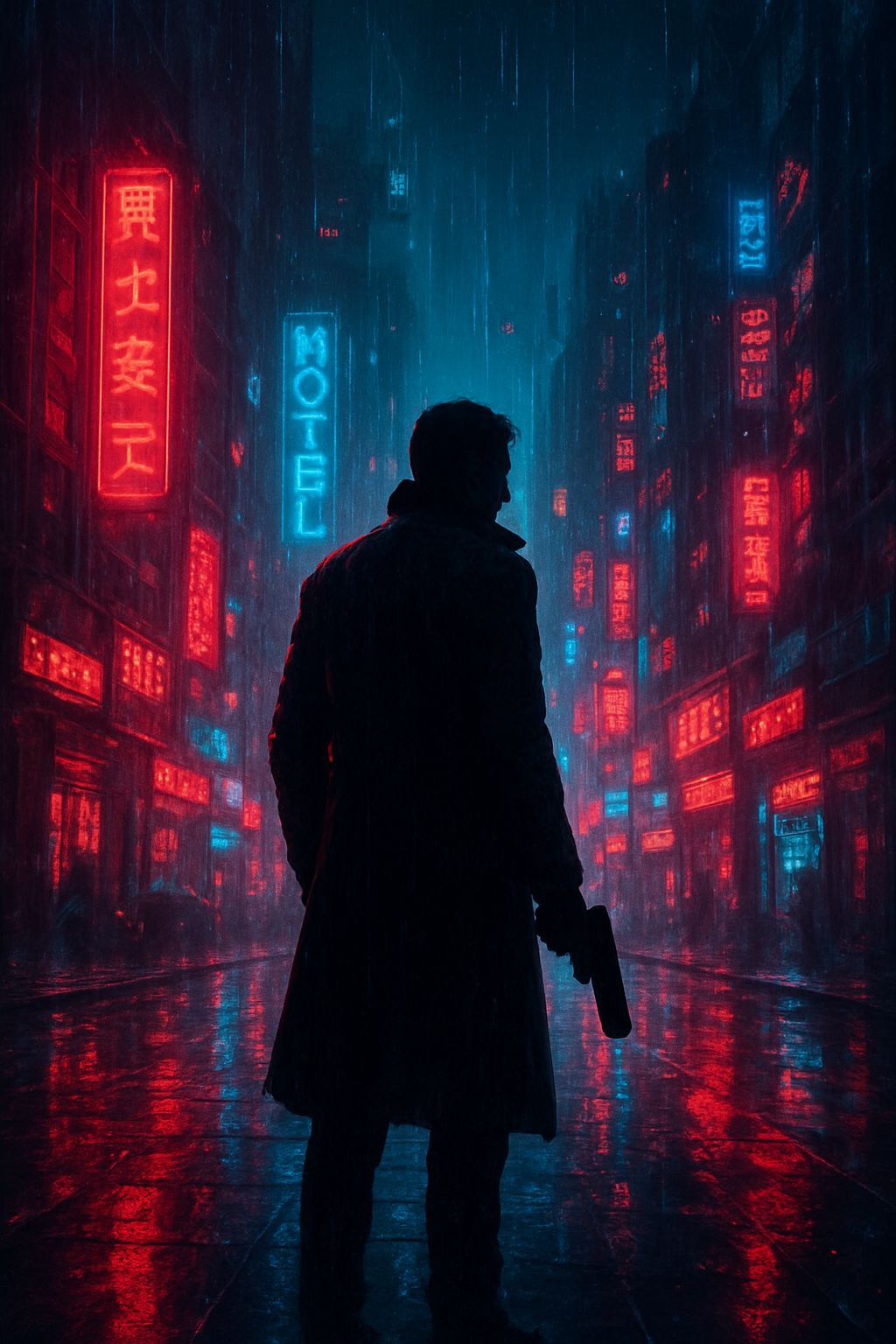
When, in February 2015, news of the return Harrison Ford for a sequel of Blade Runner it leaked and was officially confirmed, the echo in the world of cinema and among fans of science fiction was deafening and loaded with a mixture of euphoria and trepidation. The idea that one of the most enigmatic, influential and celebrated films of all time could have a follow, more with its iconic protagonist, was a dream for many, but also a source of deep concern. Blade Runner, the neo-noir masterpiece of Ridley Scott of 1982, it was not any film; it was a cinema experience full of atmosphere, philosophical questions and dystopian visions that had redefined the sci-fi genre. Freely based on the novel of Philip K. Dick, The Android Hunter (Do Androids Dream of Electric Sheep?), the film had painted a dark and rainy future in Los Angeles in 2019, populated by “replicants”, bioengineered androids virtually indistinguishable by humans, and by “blade runners” in charge of “retracting them.” The film, with its deliberately ambiguous plot and its multiple cuts, had fueled decades of debates, especially on the very identity of the protagonist, Rick Deckard: was he a human or a replicator? Ford's return, thirty-four years after the original, not only promised to explore this central question, but also opened the door to an expansion of a narrative universe that had demonstrated an extraordinary resilience over time. The announcement, which he saw Denis Villeneuve to direct and Ridley Scott as executive producer, with a script entrusted to Hampton Fancher (co-writer of the original) and Michael Green, suggested a respectful but also innovative approach, a promise to deepen the rich thematic fabric that makes Blade Runner a work so enduring. This event not only marked the beginning of the production of a new film, but rekindled the discussion about inheritance, meaning and infinite possibilities of a work that continues to question our understanding of what it means to be human in an increasingly technological world.
The Inoxidable Myth of Blade Runner: An Indelible Film Heritage
The original Blade Runner 1982 is more than just a science fiction film; it is a cultural pillar, a work of art that has transcended its genre to become a reference point for the aesthetics and philosophy of cyberpunk. When he was released, his initial reception was mixed, not reaching an immediate success of box office or criticism, partly because of his contemplative nature and the lack of a happy conventional end, factors that clearly discouraged him from the blockbusters of the time. However, through its various cuts (including the famous Director’s Cut and the Final Cut), the film gradually built an impressive reputation as a cult movie, admired for its incredible visual depth, its ethereal soundtrack Vanise and its bold thematic explorations. The influence of Blade Runner is palpable in countless cinematographic works, television, videoludes and even later architectural works, which have attracted its representation of a dystopian, hyper-technologized but decadent future, illuminated by neon signs and intrigued by a perennial rain. The Los Angeles of 2019, a hybrid of oriental and western cultures, populated by anonymous masses and almighty corporations, has become the archetype of the futuristic metropolis. At the heart of this dark universe, the film poses fundamental questions about existence: what makes a human being such? Is it the soul, memory, emotion, or empathy, measured by the Voight-Kampff test? The replicants, despite their artificial origin, often show a vitality and a desire to live that makes them tragically human, challenging the simplistic definitions of authenticity and consciousness. The confrontation between Deckard and the rebel replicants, especially with the charismatic and philosophical Roy Batty, culminates in a final monologue that became an icon of cinema, highlighting the evacuation of life and the beauty of consciousness, regardless of its origin. It is this wealth of thought and this timeless aesthetic that have made Blade Runner a “impossible film to follow”, a work whose integrity seemed almost sacred, making the enterprise of a sequel not only ambitious but almost temerary. The complexity of its fragmented narrative and the different interpretations generated by its multiple cuts have cemented its position as an open work, inviting continuous new readings and reflections, rather than definitive answers, a formidable challenge for any continuation.
Harrison Ford’s Return and the Challenge of “Cannot Sequel”
The return Harrison Ford in the role of Rick Deckard for Blade Runner 2049 it was not just a marketing twist, but a crucial event that gave the project an immediate legitimacy and loaded the sequel of immense expectations. Ford, known for his reticence to resume iconic roles of the past – although he had already ceded for Star Wars: The Reveal of the Force – for decades represented Deckard's ambiguous voice, refusing to stand on the matter if his character was a replicator. His acceptance suggested that the creative team had developed a compelling story, capable of honoring the legacy of the original while exploring new directions. Pressure on Blade Runner 2049 was huge: not only had to satisfy old-time fans, but also to introduce the universe to a new generation, maintaining the philosophical and visual integrity of the predecessor. The choice of Denis Villeneuve as a director, it turned out to be an inspired move. With a portfolio that included thesis and psychologically complex thrillers Prisoners and Sicario, and a deeply reflective science fiction work as Arrival, Villeneuve had demonstrated a mastery of creating immersive atmospheres, managing suspense and placing existential questions without providing easy answers. His sensitivity to visual narrative and his ability to instill gravitas in each frame made him the ideal candidate to navigate the complex waters of the universe of Blade Runner. Although Ridley Scott was initially intended to direct, his role as executive producer allowed him to lead the vision without imposing his direction, entrusting Villeneuve with the creative freedom needed to impress his style. The screenplay, entrusted to Hampton Fancher, co-writer of the original, and Michael Green, tried to build a bridge between the past and the future. Fancher brought an intimate knowledge of the original characters and themes, while Green helped expand the plot and introduce new narrative elements. They had to face the delicate question of how Deckard fit into a narrative that took place decades later, and if his story finally revealed his origins. The challenge was not only to create a compelling plot, but to maintain that balance between mystery and revelation that was a distinctive feature of the original, avoiding falling into the trap of too simple answers that could have ruined the ambiguity that fans so loved. This carefully balanced approach, combined with the talent of a stellar cast that also included Ryan Gosling, he laid the foundations for a sequel that attempted the impossible: to expand a legend without sacrificing the soul.
The Enigma of Deckard: A Replicant or Human? New Perspectives and Ambiguities Maintenance
The question about Rick Deckard’s identity has been, since its first release, the heart of the debate around Blade Runner. Is he a human who hunts replicants, or is he himself an unaware replicator of his true nature, a hunter who hunts himself? The original film offered many clues, but no definitive answer. The dream scene of the unicorn, included in Director’s Cut and Final Cut, suggested that Deckard could have implanted memories, just like replicators. The origami of a unicorn left by Gaff at the end of the film seemed to confirm this theory, indicating that Gaff was aware of Deckard's dreams. In addition, some versions of the film showed a flash of red light in the eyes of Deckard, a visual trait associated with replicators. Ridley Scott he has always supported his interpretation: for him, Deckard is a replicator, and he never hid this vision, even if Ford preferred to maintain ambiguity for the good of the character. This disagreement between director and actor has only further fueled the mystery and discussion among fans. Blade Runner 2049 had the delicate task of facing this puzzle without betraying the essence of the original. The sequel takes place thirty years later, and finds Deckard in a sort of self-imposed exile. The new protagonist, Agent K (later Joe), also a replicator, is obsessed with the discovery of a secret that could undermine the entire social structure: the possibility that a replicator was born, not created, a “miracle” that could trigger a war between species. His research leads him to Deckard, who turns out to be the father of this “special” child. The revelation that Deckard had a daughter with Rachael, a replicator, opens up new perspectives on his identity. If Deckard was a human, the birth of a replicator from a union between a human and a replicator would be in itself a biological “miracle”. However, if Deckard had been a replicator, the birth of a two- replicant child would be even more revolutionary, an authentic violation of the limits imposed on their species. The film plays subtly with these possibilities, offering clues that seem to lean towards a conclusion, but never completely seal the debate. The persistent ambiguity is perhaps the greatest homage to the original, recognizing that some questions are more powerful if left without a definitive answer. Instead of giving a final judgment, 2049 deepens the theme of memories, real or implanted, and their centrality in the definition of identity. Deckard himself wonders about the veracity of his memories with Rachael, accepting that what matters is not their origin, but their emotional meaning and impact on his perception of himself. In this way, the sequel strengthens the notion that authenticity does not reside in genetics or production, but in experience and consciousness, making Deckard's enigma even more stratified and ultimately more universal in its philosophical resonance.
Blade Runner 2049: World Expansion and New Philosophical Themes
Blade Runner 2049 it was not simply a sequel, but a monumental expansion of the universe created by Philip K. Dick and Ridley Scott, a work that has managed to maintain the atmosphere and the philosophical depth of the original, while introducing new and complex themes. The film introduces us to Agent K, masterfully interpreted by Ryan Gosling, a new blade runner, also a replicator, in charge of withdrawing older models. His solitary existence is mitigated by the company of Joi, an artificial intelligence hologram designed to be the ideal companion. This relationship, apparently a surrogate of love and intimacy, immediately raises new questions about the nature of consciousness and affective bond: can a form of digital life, devoid of physical body, try or inspire authentic feelings? K’s desperate search for an identity and a sense of uniqueness, fueled by what he believes to be a real childhood memory, leads him through a world even more desolate and polluted than that of 1982. The extended Los Angeles, the vertical farms, the landfills of San Diego and the radioactive ruins of Las Vegas, illuminated by an almost biblical orange powder, show a planet further devastated by human inconvenience and ecological collapse. The cinematography of Roger Deakins it is a masterpiece in its own right, with breathtaking frames that transform each scene into a painting, earning him a well-deserved Oscar. The sound design, along with the soundtrack that honors Vanise while introducing the new sounds of Hans Zimmer and Benjamin Wallfisch, contributes to creating an enveloping and disturbing sensory experience. The film introduces new memorable characters like Niander Wallace (Jared Leto), a blind and megalomaniac industrial who detected the production of replicants from Tyrell Corporation, and his deadly replicating assistant, Luv (Sylvia Hoeks). Wallace embodies the dehumanization of power and the thirst for control over life itself, seeing in replicants only tools for his vision of galactic expansion. The themes explored by 2049 they push beyond those of the original. It is no longer just to define humanity through empathy or memories, but to investigate the authenticity of planned love, the dignity of a digital existence and the hope of a procreation that transcends the biological limits imposed. The “miracle” of replicating birth is the catalyst of a potential new world order, an element that challenges categorizations and threatens to destabilize the balance between humans and replicators. The search for K for the truth about its presumed origin and the encounter with Deckard culminate in a deep reflection on the meaning of “true” and “false”, of “real” and “artificial”. In the end, K discovers that his memories are implanted, but his decision to sacrifice for a greater good, to protect Deckard's daughter, shows that true humanity is not defined by biological origin, but by choices, free will and the ability to altruism. Blade Runner 2049 not only did he honor his predecessor, but enriched him, expanding his universe and his philosophical questions, consolidating his position as one of the most significant and visually amazing works in the history of cinema science fiction.
The Future of Franchising: Between Prequel, Sequel and New Narrations in the Universe Blade Runner
The initial announcement of the sequel of Blade Runner, as evidenced by the source, it was not only the news of a film, but the first step of Alcon Entertainment towards the construction of a whole franchise. Acquired the rights in 2011, producers Andrew Kosove and Broderick Johnson had an ambitious plan in mind that included “prequel and sequel on site”. With the success of criticism, albeit not of box office, of Blade Runner 2049, this vision began to take shape, demonstrating the vitality and adaptability of the universe of Philip K. Dick. The expansion of franchising has already seen light with Blade Runner: Black Lotus, an animated series in anime style that takes place in 2032, between the events of the original film and 2049. This series offered a new perspective, deepening the history of replicators and introducing new characters and conflicts into a distinctive visual format. The anime allowed us to explore corners of the universe that live-action films had not touched, such as Off-World colonies and different factions within replicating society. The real potential for the future of franchising lies in the vast narrative canvas that the universe of Blade Runner offers. The origins of Tyrell Corporation and the first replicants could be explored, or the early years of Off-World colonization, providing a deeper context to human migration and the role of replicators in this process. Other possible sequels could focus on Deckard's daughter, or on other blade runners operating in different cities of the world, each with its own dystopian peculiarities. However, the expansion of such an iconic franchise brings intrinsic risks. The fear of diluting the impact and mystery of the original is always present. The magic of Blade Runner largely resides in its atmosphere, silences and unresolved questions. Excessive exploration or the offer of too many answers could erode its essence. The delicate balance between honoring the source and innovating is a constant challenge. On the other hand, the continuous interest in the themes of Blade Runner – artificial intelligence, environmental crisis, social inequality, nature of consciousness – guarantees its relevance. As our technology advances and questions about AI and biotechnology ethics become more and more current, the universe of Blade Runner offers a powerful lens through which to examine our present and our future. The attraction for creators lies in the possibility of narrating complex and morally ambiguous stories in a visually stunning world. Creating animated short films (like Blade Runner Black Out 2022) and live-action (as 2036: Nexus Dawn and 2048: Nowhere to Run) preceding the exit 2049 demonstrated the flexibility of the format and the ability to generate interest through different platforms. Ultimately, the future of franchising Blade Runner not only depends on the production of new content, but on their ability to support and enrich the theme richness and artistic integrity that made the original a timeless work. The bet is if future narrators will know how to keep humanity's spark in a world of machines, and continue to ask the right questions, rather than provide trivial answers, thus ensuring the legacy of Blade Runner to continue to shine like a lighthouse in the darkness of the future.
The Duration Impact and the Eternal Relevance of a Ski-Fi Workplace
The announcement of the return Harrison Ford in the role of Rick Deckard for Blade Runner 2049far from being a simple production news, he was a catalyst for further exploration and reassessment of the lasting impact of a film masterpiece. Blade Runner has shaped entire generations of filmmakers, designers and thinkers, offering a vision of the future that is both terrifying and fascinating, a warning about the direction that society could take but also a celebration of the resilience of the human spirit. Its ability to arouse deep debates and reflections has remained intact for decades, with the question of Deckard’s identity acting as a metaphor for our own search for meaning in a world increasingly mediated by technology. The sequel, under the wise direction of Denis Villeneuve, not only was he able to honor this inheritance, but he expanded it, deepening the existential themes and introducing new nuances in the rich narrative fabric. Blade Runner 2049 has shown that it is possible to achieve an ambitious and respectful sequel of an “untouchable” work, offering a visually stunning and intellectually stimulating cinema experience. The ability of franchising to explore concepts such as implanted memory, sentient artificial intelligence, digital consciousness and humanity's redefinition in a post-human age, makes the universe of Blade Runner more relevant than ever. At a time when advances in artificial intelligence and biotechnology raise ethical and philosophical questions daily, replicant stories and blade runners continue to resonate powerfully, acting as a mirror for our anxieties and hopes about the future. The inheritance of Blade Runner it is not static; it is a living inheritance, constantly evolving, that adapts to the times keeping intact its fundamental questions. It is not just about knowing whether Deckard is a replicant, or whether K is “special”; it is about what it means to be alive, feel, love and die, regardless of its origin. Franchising, with its films and extensions, continues to ask these universal questions with a rare depth and beauty. The universe of Blade Runner remains a place of endless exploration, a melting pot of ideas that challenges our perceptions and invites us to look beyond the surface, to seek humanity in the most unexpected forms and to confront us with the ethical implications of our incessant search for progress. Its impact is not only historical, but prophetically current, making it a real timeless masterpiece, whose light continues to shine in the darkness of the future.


