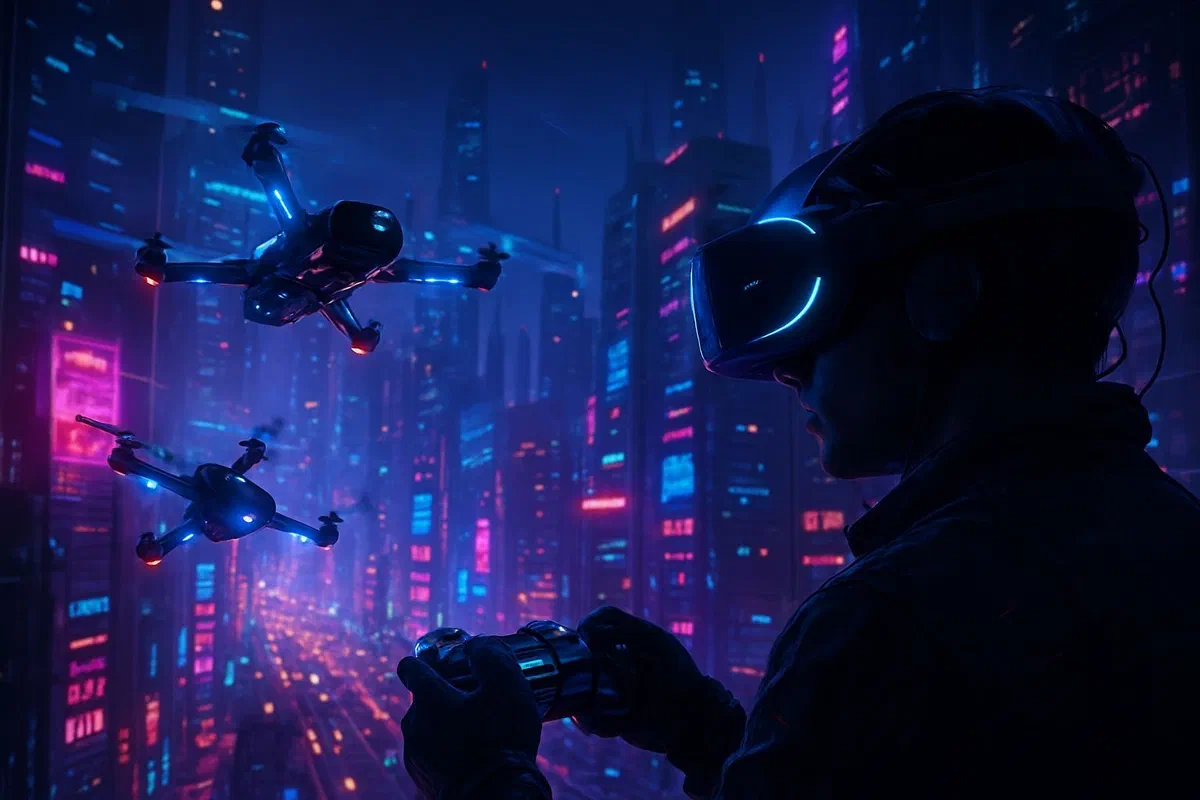
Ten years ago, the idea of piloting a drone simply tilting the head, observing the world through a virtual reality viewer, seemed a daring incursion in science fiction. diego araos experiment with oculus rift and a parrot ar drone in 2014 was not just a technological toy, but a spark that would light a silent revolution. that year, virtual reality was still a futuristic promise, and drones began to take off in the consumer market, but their union suggested immense potential: to extend our senses beyond the boundaries of the body, allowing us to explore and interact with remote environments with an almost physical presence. today, looking back, that first rudimentary step has opened the way to an ecosystem of advanced technologies that are redefining not only the way we pilot unmanned aircraft, but also how we conceive the human-machine interaction in areas ranging from entertainment to industry, from safety to scientific research. this article aims to thoroughly explore the extraordinary journey undertaken by the immersive control of drones, analyzing the exponential evolution of vr/ar technology, the progress of drones themselves, the challenges overcome and those that await us, and the vast horizon of applications that promise to transform our world, offering a detailed perspective on how araos’s vision is matured in a complex and multifaceted reality, shaping the future of flight and only a few interactions. the immersion, the ability to see and perceive as if we were on board the drone, became the key to unlock unthinkable levels of control and spatial awareness, raising the role of the pilot from simple operator to virtual co-exploratory, a paradigm shift that is still unveiling its full potential, promising to redefine the very concept of remote presence and operation.
From science fiction to reality: the dawn of immersive control of drones #
On april 9, 2014, when roberto caccia published the article on tom’s hardware, the news that a german developer, diego araos, had connected an oculus rift development kit (dk1) to a parrot ar drone, transforming the head movements into flight controls and the drone visual into a virtual reality experience in real time, was a revelation. what could seem like a simple experiment today was a real leap into the future. the oculus rift dk1 was a rudimentary device compared to today’s standards: low resolution, evident screen-door effect, perceptible latency and a limited field of view, but its ability to generate a sense of presence was already stunning. araos demonstrated that, by tilting the head, the pilot could move the drone, an incredibly intuitive interaction that transcended the traditional manual controllers. this first step set the basis for the concept of fpv (first person view) immersive, far beyond the simple external monitor. the success of araos was not isolated; the intuitive aerial group had already explored similar solutions with custom drones, and skulab mobilesystems had implemented the rotation of the webcam with head movements. these pioneers were not only building prototypes; they were defining a new paradigm of human-machine interaction. the real strength of these early experiments was the democratization of the concept: araos made available his open source code on github, allowing anyone with an oculus rift and a compatible drone to try. this open source* aspect was crucial to catalyze a community of innovators, accelerating research and development in a still nascent field. the enthusiasm was palpable: imagine flying over landscapes, inspecting structures or even competing, actually feeling * there*, on board the drone. despite the inevitable crashes against branches, as witnessed by araos’ video, the promise of more natural control and superior situational awareness was undeniable. these initial experiments showed that virtual reality was not only for video games, but had the potential to revolutionize control of aerial vehicles without pilot, extending human perception in ways previously confined to pure science fiction. it was the dawn of an era in which the border between piloting and perceiving would become increasingly thinned, opening scenarios of practical use and fun that continued to expand exponentially.
The extraordinary evolution of virtual reality and increased #
Since 2014, the world of virtual reality*** (vr) and *** augmented reality** (ar) has taken giant steps, passing from bulky and experimental prototypes to sophisticated and accessible devices, and this evolution has had a direct and profound impact on the immersive control of drones. the viewers like the oculus rift dk1, with their low resolution (640×800 per eye), a limited field of view and the inevitable latency, have been replaced by products such as the series meta quest* (quest 2, quest 3), valve index, htc vive, pico*, sony psvr2* and, more recently, these latest-generation devices offer resolutions that exceed 4k per eye, ensuring almost photorealistic visual sharpness, crucial for accuracy in professional applications and to reduce visual fatigue. the latency, the delay between the movement of the head and the updating of the image, has been drastically reduced to a few milliseconds, eliminating most of the sea sickness and making the piloting experience extremely fluid and natural. the field of vision has expanded, offering a more complete peripheral perception, fundamental to situational awareness. the advent of tracking inside-out, which does not require external sensors, has greatly simplified the configuration and made vr systems much more portable and practical for field use. the integration of powerful processors directly into the viewers, such as the snapdragon xr2 gen 2 in quest 3, has allowed to process high-resolution video streams in real time directly from the drone, with efficient compression and transmission, further reducing system latency. in addition to vr, the augmented reality************ (mr) are emerging as a game-changer. devices such as the quest 3 and the vision pro offer high-fidelity passthrough capabilities, allowing the rider to see the real world superimposed with digital information. this means that a pilot can see the drone and the surrounding environment in real time, with flight data (altitude, speed, telemetry) and overlapping maps directly in his field of view, or even a 3d model of the drone itself. this fusion between the physical and digital world exponentially increases situational awareness, allowing for safer and more informed control, especially in complex contexts such as industrial inspections or research and rescue operations. the ability to interact with virtual interfaces floating in the real environment, using hands or eye tracking, opens new frontiers for mission planning and drone supervision, making the experience not only immersive but also extremely practical and functional.
The drones of the future: between artificial intelligence and autonomy #
Not only did vr/ar technology undergo radical transformation, but also drones themselves have gone from relatively simple toys to sophisticated precision tools, real flying robots with increasing intelligence. the parrot ar of a decade ago, with its limited stability and basic recovery capacity, was replaced by a myriad of specialized models. today, we have fpv drones****, agile and very fast, designed for minimal latency and maximum responsiveness; ** professional photo and video cameras*** (such as the dji mavic and inspire series), equipped with 3-axis stabilized gymbals, advanced sensors and cameras capable of capturing images in 4k or 8k; and ** robust industrial platforms*********, designed for inspections, 3d mappings, precision agriculture and deliveries, capable of transporting specific useful loads such as thermal sensors, lidar or equipment. the real revolution in drones is, however, the integration of the** artificial intelligence** (ai) and their growing ** autonomy**. modern drones are equipped with onboard processors capable of performing complex real-time algorithms. this allows functionality such as theself avoidance of obstacles, where the drone is able to navigate in complex environments without the direct intervention of the pilot; the tracking of subjects, to automatically follow people or vehicles; and the advanced planning of the route, where the drone can optimize its trajectory to complete a mission efficiently and safely. the fusion of sensors (gps, glonass, galileo, optical, thermal cameras, lidar, ultrasound) allows the drone to build an accurate three-dimensional representation of its environment, making it capable of flying in spaces where the gps is absent (as inside buildings or underground) and maintain incredible stability even in adverse conditions. the ai also enables the ** skillability*** (swarm intelligence), where more drones can coordinate to perform complex tasks, such as patrol vast areas or create synchronized light shows. in this context, immersive control is no longer limited to direct piloting. the vr/ar viewer becomes a window through which the operator can supervise autonomous missions, set flight parameters, interpret complex data generated by the ai (such as thermal maps or analysis of crop status), or intervene in unexpected situations. the increased reality, in particular, allows you to view directly in the field of view of the pilot diagnostic information on the drone, pre-programmed routes, zones of aerial exclusion, or even points of interest detected by the ai, turning the pilot into a highly informed conductor rather than a simple maneuver, a real human-in-the-loop that guarantees security and reliability in the most critical operations. this synergy between ai, autonomy and immersive control is opening the way to complex and large-scale operations, redefining the concept of efficiency and safety in the drone world.
Immersive control: beyond the simplicity of the head #
The diego araos experiment, based on the simple inclination of the head, was a brilliant starting point, but the evolution of the immersive control of drones went far beyond, embracing a myriad of more sophisticated and natural interaction methods. today, control is no longer limited to the single head; professional fpv drivers often use a traditional radiocommand* (rc) for fine maneuver, with expert hands manipulating sticks and switches for surgical precision. however, the integration of this manual control with immersive experience has become crucial. modern vr/ar viewers offer new interaction sizes. hand controllers, such as those provided with meta quest viewers, allow intuitive gestures: an operator can * grab* virtually an interface, draw a cursor or press a virtual button, managing menus, telemetry or drone camera settings without having to remove their hands from the physical remote control. the ** eye tracking**, present in viewers such as the Apple vision pro or the varjo xr-3, revolutionizes interaction: the pilot can simply look at an interface element (a waypoint, a function icon, a map area) to select it, a hovering command or a point of interest for inspection. this technology not only makes interaction faster and less invasive, but can also be used to analyze where the driver is paying attention, providing valuable data for training or to optimize user interfaces. haptic feedback*, or tactile feedback, is becoming more sophisticated. while the first systems were limited to simple vibrations, the new technologies allow to simulate more complex sensations, such as air resistance, impact with an obstacle (although only simulated), or drone vibrations. this can be integrated into the controllers, special gloves or even complete all aptics***, drastically increasing the immersion and providing a deeper sense of connection with the aircraft. in addition, the voice* has become an important control medium. modern voice assistants and natural language recognition systems allow pilots to impart voice commands for secondary functions, such as changing flight modes, activate recordings or regular camera parameters, thus freeing hands and concentration for primary drone control. finally, the search for ** brain-computer interfaces (bci)** is exploring the ability to control drones directly with thought. although still in an experimental phase for practical applications, the bci could one day allow a very fine and intuitive control, transforming the drone into a true extension of the pilot’s will. the ultimate goal of all these innovations is to create a control experience so intuitive and seamless that the pilot does not feel to operate a machine, but to be himself in flight, with the machine that responds to his most subtle desires, merging man and drone in a single operational entity.
Revolutionary applications: where immersive control makes the difference #
The convergence of advanced drones and vr/ar technologies has unlocked incredible potential, bringing immersive control from testing laboratories to a wide range of revolutionary applications in key sectors. in the field of entertainment and gaming****, fpv drones, driven through vr viewers, have turned drone racing into an adrenaline and highly spectacular sport, with professional leagues and a growing audience. in addition, photorealistic flight simulators based on real geographical data allow users to explore exotic cities or landscapes from unique perspectives, offering an immersive virtual tourism form. in the field of industrial and maintenance****, immersive control is a game-changer. drones with high resolution cameras, thermal sensors and lidar can inspect complex structures such as wind turbines, bridges, pipelines, electrical lines, roofs of buildings or oil platforms. the pilot, wearing a vr/ar viewer, can navigate the drone with millimeter precision, identify structural defects, cracks, corrosion or abnormal overheating with unprecedented clarity, feeling almost physically present on the infrastructure. the increased reality can overlay technical data, reference patterns or points of interest directly on the drone visual, facilitating analysis and documentation. in the security and emergency services, the use of drones with immersive control is becoming vital. during research and rescue operations (sar), drones can search vast areas or access dangerous areas (such as collapsed buildings or contaminated areas) providing rescuers with immediate and immersive situational awareness. order forces use drones for surveillance, patrol or management of critical events, with pilots who can monitor the situation from a secure location, having a privileged and detailed vision of the environment, improving response times and reducing risks to staff. logistics and deliveries* also benefit from this technology. although many deliveries with drones are autonomous, in complex urban scenarios or in case of unexpected, a human operator with immersive control can take remote control to overcome obstacles not provided by the ai or to carry out precision deliveries in restricted spaces, ensuring the safety and reliability of the service. in the**** precision agriculture***, drones with multispectral and thermal cameras monitor crop status, soil health and irrigation. a farmer or agronomist with an ar viewer can virtually fly the fields, displaying maps of water stress or abnormalities in the growth of plants superimposed to the real-time visual of the drone, making informed decisions to optimize crops and reduce waste. the telepresence and remote robotics represent another frontier: to operate robots or explore hostile environments (such as nuclear power plants, active volcanoes, the ocean fund or even other planets) through an immersively controlled drone/robot, extending the human capacity to operate in in inaccessible and dangerous places without risking human lives. finally, the film and television industry also benefits from immersive fpv drones, which allow to capture dynamic and unique frames, such as pursuits in tight spaces or breathtaking acrobatic flights, with a control and creativity that exceed the capabilities of traditional cameras, making possible new forms of artistic and narrative expression.
Challenges and opportunities: latency, ergonomics and regulation #
Despite the phenomenal progress, the immersive control of drones is still facing a series of technical, ergonomic and regulatory challenges that limit its diffusion and full potential. one of the most critical issues is the latency, i.e. the delay between pilot action, drone response and visual feedback in the viewer. although drastically reduced compared to 2014, excessive latency can still cause disorientation, sea sickness* and, in critical applications, incorrect decisions. solutions include ultra-low latency video transmission protocols, the use of 5g or 6e wi-fi networks for greater bandwidth and improved hardware-software integration between drones and viewers. the ** visual fidelity and ergonomic comfort***** of the viewers are equally important. the resolution, the field of view and the frequency of updating are improved, but a balance between performance and weight/dimensions is required to ensure prolonged usage sessions without fatigue. the cost of professional and high-end vr/ar systems remains an obstacle for many, although the consumer market is making technologies more accessible. another significant challenge is the formation. piloting a drone in fpv, especially in immersive mode, requires specific skills that go beyond the sight piloting. advanced simulators and training programs are needed to develop the coordination, spatial perception and reactivity necessary to operate safely and effectively. the regular** panorama is perhaps the most complex barrier. the use of drones for operations bvlos* (beyond visual line of sight), where the pilot relies solely on the immersive view of the drone, is often subject to severe restrictions and special authorizations due to risks to air safety. each nation has its own regulations, which can vary considerably, making adoption on a large scale difficult. *privacy and data security issues are equally pressing: who controls the video and telemetric data collected by drones? how are they protected from unauthorized access? and what are the ethical implications of using drones for immersive surveillance? the opportunities, however, far exceed the challenges. the standardization of communication protocols between drones and viewers, the additional miniaturization of components, the development of more efficient batteries and the integration of increasingly sophisticated ai for assistance to the pilot promise to make immersive control more robust and reliable. the opening of platforms and the collaboration of the open-source community will continue to lead innovation, while a continuous dialogue between industries, governments and citizens will be essential to shape a regulatory framework that supports technological development while guaranteeing the security and protection of individual rights. education and awareness of the potential and limits of this technology will be fundamental to overcome resistance and promote responsible adoption.
The future is today: mixed reality, brain-computer interfaces and drone swarms #
The journey of the immersive control of drones, begun with a rudimentary oculus rift, is far from being concluded; indeed, it is accelerating towards borders that promise to be even more surprising and transformative. the next major evolution lies in the mixed reality (mr), where the distinction between the video feed of the drone and the physical environment of the operator completely cancels. devices such as the Apple vision pro or next-generation viewers with high fidelity passthroughs will allow not only to see what the drone sees, but to overlap that crucial data vision and virtual interfaces perfectly integrated. imagine piloting a drone through a complex warehouse, seeing not only the video feed in real time, but also a 3d model of the warehouse with the optimal overlay path, the positions of the other drones, the highlighted inventory and instructions for the next task, all directly in your field of vision, interacting with holograms with simple gestures of hands or looks. this level of fusion between physical and digital reality will radically change the planning, execution and supervision of missions with drones. another exciting research area is the interfaces brain-computer (bci). although still in embryonic phase for practical drone control applications, the ability to directly translate neural thoughts or intentions into flight commands is the apex of intuitive interaction. if one day it will be possible for a pilot simply think to a movement or goal and see it performed by the drone, the man-machine synergy will reach an unprecedented level, exceeding the limitations of physical and verbal controls. this could not only make piloting incredibly faster and more accurate, but also accessible to people with motor disabilities, further democratizing access to this technology. the future will also see an exponential expansion of drone management. instead of piloting a single drone, immersive operators could oversee and direct entire fleets. the ai would manage the individual tasks of each drone within the swarm (such as navigation, avoidance of obstacles, maintenance of training), while the human operator, through an mr interface, would give high-level strategic commands (e.g. “experience this area”, “create a 3d map of that neighborhood”). this intelligent machine orchestra, led by a immersed operator, will open scenarios for logistics, safety, agriculture and entertainment on stairs never seen. moreover, the development of feedback aptic*** even more refined, able to simulate not only vibrations but also surface textures, resistance and temperature, will further increase the sense of presence, making the experience of “being” on board the drone almost indistinguishable from reality. finally, the generating ai** could play a crucial role, allowing drones to independently adapt their behaviors based on abstract commands or unexpected scenarios, with the immersed operator who would provide strategic vision and ethical approval. the future of the immersive control of drones is not only a question of advanced technology, but of how it will allow us to extend our capabilities, to perceive the world in new ways and to interact with it in an unprecedented symbiosis, shaping an era in which the concept of ’telepresence’ will become a daily reality and deeply integrated in our lives.
In conclusion, the journey from diego araos’ pioneer experiment in 2014, which linked an oculus rift to a parrot ar drone, up to the sophisticated contemporary applications of drones and virtual reality and increased viewers, was an extraordinary path of innovation. what ten years ago seemed to be a technological curiosity or a glimmer of science fiction, turned into a field of vibrant research and development, which is revolutionizing countless sectors. we have witnessed an exponential evolution both in vr/ar technology, with increasingly immersive, performing and accessible viewers, both in the drone world and from simple aircraft have become complex flying robots equipped with artificial intelligence and autonomy. immersive control has progressed beyond the simple inclination of the head, embracing multimodal interfaces that include gestures, voice, eye tracking and, in perspective, brain-computer interfaces. these innovations have unlocked revolutionary applications, from entertainment and fpv racing to precision industrial inspections, from public safety and research to precision agriculture and robotic telepresence in hostile environments. despite the persistent challenges of latency, ergonomics, costs and especially regulatory complexity, industry continues to push the boundaries of the possible. the future is even more exciting, with the mixed reality that will perfectly merge the real world with the digital world, the swarms of drones managed with an immersive awareness and the promise of brain-computer interfaces that could one day erase the border between thought and action. the araos experiment has shown us a window on a future where our senses and our ability to operate are no longer confined to our body, but can be projected anywhere from a drone. this is not only a technological advance; it is a profound transformation of the way we perceive our environment and interact with it, an increasingly solid bridge between the physical and digital world that promises to redefine our concept of presence and operational power in the 21st century. the vision of 2014 is now a solid reality in continuous expansion, and its full potential is still all to write.