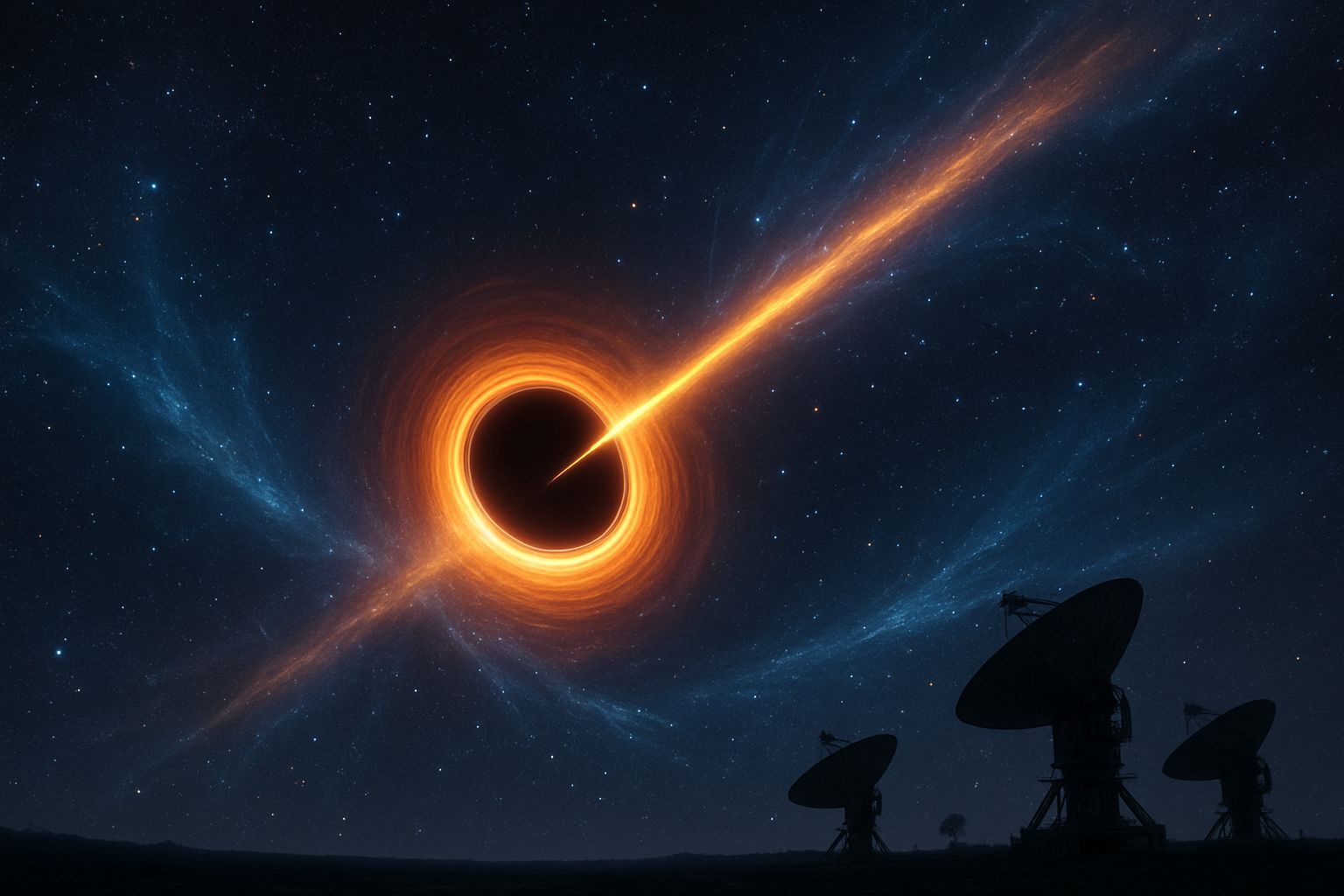
In the heart of the galaxy cluster of the Virgin, about 55 million light years from the Earth, lies a cosmic giant whose only existence challenges imagination: Messier 87, or more commonly M. This supergiant elliptical galaxy houses at its center one of the most fascinating and powerful mysteries of the universe, a supermassive black hole designated as M87. For decades, M87* has been the subject of intense studies, known not only for its colossal mass – estimated at approximately 6.5 billion times that of the Sun – but also for a spectacular phenomenon: a relativistic plasma jet thousands of light years that erupts from its core with a stunning power, visible through different wavelengths of the electromagnetic spectrum. However, on April 10, 2019, M87* took an unprecedented role in the history of astronomy: it was the first black hole to be directly immortalized, with the Horizon Telescope Event (EHT) which revealed the shadow of its uniqueness in an iconic image that made the world round. This monumental enterprise has not only represented a technological and scientific triumph, but also inaugurated an era of new discoveries, especially when it emerged that, at the same time this historical visual observation, had been detected significant emissions of gamma rays from the same region. This incredible synchronism between the first direct image of a black hole and the revelation of its high-energy activity opened the door to a new paradigm of cosmic investigation:multi-message astronomy. The possibility to observe a single celestial event through different windows – from visible light to radio waves, X-rays to gamma rays, and even through neutrinos and gravitational waves – promises to revolutionize our understanding of the most extreme phenomena of the universe. The event of M87*, with its image and the simultaneous “explosion” of gamma rays, has become not only a tangible proof of Einstein’s General Relativity in extreme conditions, but also in a lighthouse for future explorations of the cosmos, pushing the boundaries of our knowledge and offering an unprecedented perspective on the mechanisms that feed these cosmic “monsters” and their impact on the evolution of galaxies. This article aims to explore in depth the intricate scientific and technological ballet that has led to these discoveries, analyzing the meaning of M87*, the operation of EHT, the nature of gamma emissions and the transformative potential of multi-message astronomy in revealing the most hidden secrets of the universe.
The Enigma of M87*: A Giant at the Heart of the Galaxy
The M87 galaxy, first catalogued by the astronomer Charles Messier in 1781, is much more than a simple elliptical galaxy in the cluster of the Virgin; it is a natural cosmic laboratory that houses at its center one of the most extreme and studied phenomena of the universe: the supermassive black hole M87*. With an estimated 6,5 billion times that of our Sun, M87* is not only one of the most massive black holes known, but it is also the engine of a spectacular relativistic jet, a phenomenon that has fascinated astronomers for over a century. This jet, a column of super-energetic plasma that extends for thousands of light years in intergalactic space, is a visible expression of the immense power of the black hole and the complex interaction between the matter that falls within it and the magnetic fields surrounding it. His observation even dates back to 1918, when the astronomer Heber Curtis of the Lick Observatory described for the first time the appearance “strange of light”, intuendo his abnormal nature. Since then, the M87* jet has been studied in all wavelengths, from radio to X-rays and range, revealing its complex structure, variability and its crucial role in shaping the galactic environment. Its energy is such as to influence the distribution of hot gas in the cluster of the Virgin, preventing its cooling and consequent massive stellar formation, a process known as feedback AGN (Active Galactic Nucleus). Understanding how to forge and propane such a powerful jet is one of the central challenges of modern astrophysics, requiring a detailed analysis of the growth process around the black hole and rotational or magnetic energy extraction mechanisms. M87* offers a unique opportunity to test theories about these processes, thanks to its relative proximity and its intrinsic luminosity. Its imposing angular dimension – its horizon of events, although infinitesimal, appears relatively large in the sky compared to other black holes – made it the ideal candidate for an unprecedented enterprise: getting its first direct image. This ambitious goal required the development of cutting-edge technologies and methodologies, combining telescopes from around the world into a single virtual “lente” and represented the culmination of decades of studies on its jet and its extreme environment. The journey to decipher the secrets of M87* is far from being concluded, but every new observation, especially those that combine different perspectives, adds a fundamental to our understanding of these silent but incredibly active guardians of the cosmos.
The Global Eye: The Horizonting Telescope of Events and the First Image
The historical image of M87* released in April 2019 was not the result of a single telescope, but of a monumental international collaboration known as Event Horizon Telescope (EHT). EHT is, in fact, a “virtual telescope” of Earth’s size, created by synchronizing a global network of radio telescopes through a technique called Very Long Baseline Interferometry (VLBI). Imagine you want to photograph a grain of sand on the Moon: you would need an incredibly high angle resolution, something that no single telescope, however large, could ever achieve. The VLBI exceeds this limit by combining the signals of several remote radio telescopes, simulating a large aperture equal to the maximum distance between the telescopes involved. For the observation of M87*, EHT radio telescopes spread from the South Pole to Europe, from the Americas to Hawaii, including sites such as the Atacama Large Millimeter/submillimeter Array (ALMA) in Chile, the South Pole Telescope, the Green Bank Telescope in the United States and the IRAM 30-meter Telescope in Spain, among others. Each telescope recorded raw data on the black hole for several nights in April 2017, converting radio signals to digital data and recording them on thousands of hard drives. This data was then physically transported to “super-computer” correlaters in Germany and the United States, where they were synchronized with a femtosecond accuracy – the equivalent of virtually connecting all telescopes with a perfect chronometer. The data processing process was equally complex and took years. The amounts of data were so immense, of the order of petabytes, that it was impossible to transmit them via the internet; hence the need for physical transport of hard drives. Researchers faced significant challenges, including the calibration of differences in the Earth’s atmosphere on each site and the application of sophisticated algorithms to recreate the final image from a series of incomplete “data points”. The result was an image that showed a bright ring of glowing plasma around a central dark region:black hole shadow. This shadow is the area from which light cannot escape, surrounded by light deviated from the extreme gravity of the black hole. The image not only confirmed the predictions of Albert Einstein’s Theory of General Relativity for the first time on scales of distance of the event horizon, but also provided an incompetable visual proof of the existence of black holes, transforming them from theoretical concepts to observable realities. The unprecedented resolution obtained by EHT – equivalent to reading a newspaper in New York in Paris – opened a new era in astrophysics, allowing scientists to study directly the extreme environment around a black hole and investigate the mechanisms behind the formation of relativistic jets and the growth of matter.
M87 Range Rays*: Beyond the Simple Visual Image
The revolutionary observation of M87* was not limited to the capture of its iconic shadow through radio waves. An equally significant aspect was the simultaneous detection of intense gamma-ray emissions. The quiz mentioned in the introduction emphasizes that the most significant feature of this “explosion of gamma rays” was its contemporaneity with the first image of the black hole. It is essential to clarify that, in the context of M87*, the expression “explosion of gamma rays” does not refer to a classic Gamma-Ray Burst (GRB), such as those generated by the collapse of massive stars or by the fusion of neutron stars, events that usually happen to billions of light years away and are transients of short duration. Rather, it's about high energy emissions from M87* relativistic jet, which have been monitored and characterized in detail in the period of observations of the EHT. M87* is in fact a ♪, a type of Active Galactic Nucleus (AGN) in which the relativistic jet is oriented almost directly to the Earth, making its high energy emissions particularly intense and variable. The EHT collaboration conducted a broad campaign of simultaneous multi-wavelength observations with the radio data collection in 2017, involving numerous spatial and terrestrial telescopes operating in the spectrum from X-rays to gamma rays. Among these, telescopes like the Space Telescope Gammaray and the MAGIC (Major Atmospheric Gamma-ray Imaging Cherenkov) Telescope they played a crucial role in detecting variations in gamma-ray emission. These observations revealed that the jet of M87* was undergoing periods of intense activity, with “flares” or increases of brightness in gamma rays. The correlation between the activity of high energy in the jet and the morphology of the shadow of the black hole is of capital importance. The ability to observe the shadow of the black hole with the EHT, while at the same time measuring the energy of the photons emitted from the jet, offers an unprecedented view of the mechanisms that connect the region more internally around the black hole – the origin of the jet – with its manifestations on galactic scales. In particular, scientists hope to understand how energy is extracted from the rotating black hole or the surrounding matter and conveyed into the jet, accelerating the particles at speeds close to that of light and producing high energy emissions. The simultaneity of observations allowed researchers to “capture” the black hole and its jet at a precise moment of their dynamic evolution, providing a crucial context to interpret EHT data. This integrated approach, which combines direct imaging of the event horizon with the monitoring of emission across the electromagnetic spectrum, represents a milestone in multi-message astronomy and a confirmation of the immense utility of complementary observational approaches to reveal the nature of these cosmic puzzles.
Multi-Messagger astronomy: The New Cosmic Frontier
The M87* episode, with its image of the shadow of the black hole and the contemporary revelation of gamma rays from its jet, perfectly embodies the spirit and potential of themulti-message astronomy (MMA). This revolutionary discipline is not content to study the universe through a single “window” (such as visible light or radio waves), but seeks to grasp a more complete and dynamic picture by combining different “cosmic messengers”: electromagnetic waves (from radio waves to gamma rays), neutrinos, cosmic rays and, the most recent addition, gravitational waves. Each type of messenger offers a unique and complementary perspective on celestial events. The light, in all its forms, provided us with most of our knowledge on the universe, but it can be absorbed or distorted by the interstellar matter and reveals only the energy distribution of electrons and magnetic fields. Neutrinos, subatomic particles with almost nothing mass that interact very weakly with matter, can travel undisturbed through dense cosmic regions, bringing direct information from nuclear processes that generate them, such as the interior of stars or the most extreme regions of active galactic nuclei. The cosmic rays, atomic nuclei and protons with high energy, can indicate the location of powerful cosmic accelerators, but their path is deviated from galactic and intergalactic magnetic fields, making it difficult to trace back to their origin. Gravitational waves, ripples in space-time predicted by Einstein and first detected by LIGO in 2015 are generated by catastrophic events such as the fusion of black holes and neutron stars and offer a completely new way of “hearing” the cosmos, allowing us to probe dark regions in light. The importance of MMA was clearly demonstrated by epochal events. An emblematic example was the observation of the fusion of two neutron stars (GW170817) in 2017, detected both as a gravitational wave from LIGO/Virgo, and as a short gamma-ray lightning from the Fermi satellite, and later as a glow (kilo) throughout the electromagnetic spectrum. This single observation provided the first direct proof that neutron star fusions are the source of short-lived GRBs and cosmic “ovens” where most heavy elements are formed, such as gold and platinum. In the case of M87*, although gravitational or neutral waves were not involved (at least not with a direct and definitive association so far), the combination of radio astronomy (EHT for the image of the shadow) and gamma rays (for jet activity) represented a significant step forward. It allowed scientists to connect the dynamics that occur on scales of the event horizon (billion-kilometre center) with the energy manifestations of the jet on much larger scales (millions of light years). This integrated approach is crucial to building more complete and consistent physical models of supermassive black holes, their growth, jet training and their impact on galactic evolution. MMA is not only the sum of its parts; it is a synergy that opens completely new windows on the universe, allowing us to “see” and “ listen” phenomena that would otherwise be unobservable, leading to discoveries that redefine our theories and our understanding of the cosmos.
Future Horizons: What Black Holes and MMA Reserve Us
M87* observations by the Event Horizon Telescope and the simultaneous detection of gamma-ray emissions were not only a point of arrival, but rather a springboard for future exploration. The success of M87* has demonstrated the feasibility of “photographing” black holes and triggered a race to new challenges and objectives in astronomy. The next major milestone for EHT is, without a doubt, getting a sharper and more detailed image of Sagittarius A*, the supermassive black hole in the center of our Milky Way. Although Sgr A* is much closer (about 26,000 light years) and smaller than M87* (about 4 million solar masses), its observation is significantly more complex due to the matter and gases surrounding it, creating a much more dynamic and variable environment, making the shadow less stable. However, EHT updates, which include adding new telescopes and using even more advanced data processing techniques, promise to overcome these difficulties, offering a unique opportunity to compare two very different types of supermassive black holes. In addition to Sgr A*, the future of EHT foresees the observation of other black holes in nearby galaxies, the creation of “videos” that show the dynamics of plasma around the horizon of events and the even more rigorous verification of General Relativity in extreme gravity conditions. The ultimate goal is to push our understanding to the point where we can test alternative gravity theories and search for any deviations from Einstein’s model. In parallel, multi-message astronomy continues to expand its horizons. New third-generation gravitational wave detectors, such as Einstein Telescope and Cosmic Explorer, are in the design phase and promise much greater sensitivity, allowing to detect fusions of black holes and neutron stars at even greater cosmological distances and to probe the primordial universe. Neutrino detectors, such as IceCube, are constantly improved to identify high-energy cosmic neutrino sources, which could be connected to blazars and other active galactic nuclei, potentially revealing the mechanisms of acceleration of the most energetic particles of the universe. The synergy between these “eyes” and cosmic “ears” is the key. Imagine you can observe the fusion of two black holes with gravitational waves, see its glow with electromagnetic telescopes, and then trace the neutrinos or cosmic rays with very high energy that could result. This integrated approach will allow us to build a multidimensional “map” of the universe, revealing not only where violent events occur, but also how galaxies evolve, how heavy elements are formed and, ultimately, how the universe itself works. The MMA era is opening a new frontier of knowledge, promising to unravel the deepest mysteries of the cosmos and to push the boundaries of human ingenuity into our incessant search for understanding.
The legacy of M87*: A New Vision of Cosmos
The observation of M87*, with its iconic image and the contemporary revelation of gamma-ray emissions, cemented its status not only as one of the greatest scientific achievements of the 21st century, but also as a watershed event that redefined our ability to explore the universe. Before 2019, black holes were purely theoretical entities, whose existence was inferior to gravitational effects and indirect emissions. The image of the shadow of M87* has transformed a mathematical abstraction into a tangible reality, providing the most direct visual proof of their existence and confirming, with unprecedented precision, the predictions of Einstein’s Theory of General Relativity in one of the most extreme environments of the cosmos. This is not only a victory for theoretical physics, but also a triumph for global engineering and human collaboration, demonstrating what it is possible to achieve when scientists and engineers from around the world join forces for a common goal. The simultaneity of multi-length wave observations, in particular the detection of gamma rays from the jet of M87*, has further elevated the meaning of this discovery. It was not only a question of “seeing” the black hole, but of “ listening” its voice to high energy in real time, offering crucial clues to the mechanisms governing the formation and feeding of relativistic jets and the interaction between the black hole and its environment. This has opened a new era formulti-message astronomy, a holistic approach that promises to reveal the most complex mysteries of the universe through the combination of all cosmic messengers: electromagnetic waves, neutrinos, cosmic rays and gravitational waves. The legacy of M87* is not only the image of a black hole, but the awareness that our universe is a place of incredible dynamism and complexity, which requires increasingly sophisticated tools and methodologies to be understood. The future generations of telescopes, satellites and detectors will continue to push the boundaries of our knowledge, bringing to light new discoveries and perhaps revealing phenomena that we can only imagine today. M87* showed us not only a black hole, but the unlimited potential of science in deciphering the great book of the cosmos, one chapter at a time, illuminating the darker regions and bringing us closer and closer to understanding our place in this vast and wonderful universe.


