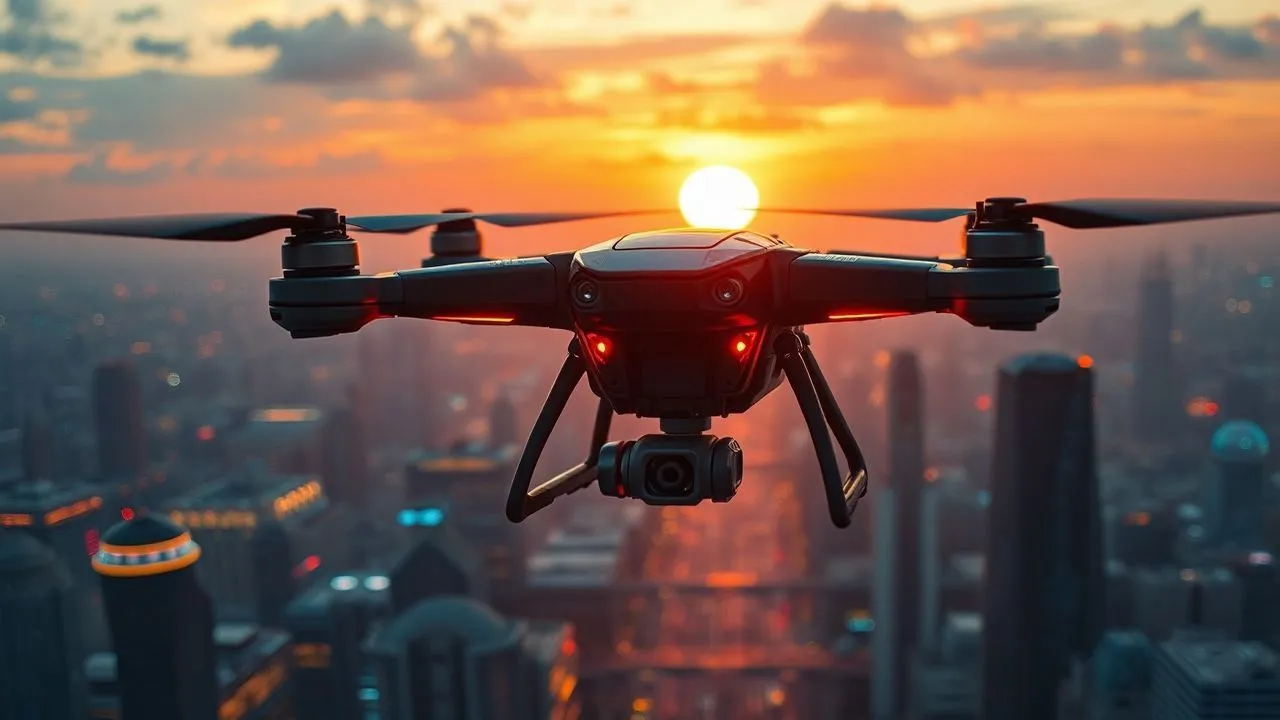
In the technological landscape of 2026, understand how does a drone work has become essential not only for modelling enthusiasts, but for anyone wishing to approach one of the most disruptive innovations of the last decade. These devices, technically known as remote-driven aircraft or UAV (Unmanned Aerial Vehicles), have undergone an extraordinary evolution, from simple toys to sophisticated work tools able to perform millimeter mappings, cinema shooting and advanced environmental monitoring. The fundamental principle that regulates the movement of a drone is based on a complex interaction between laws of physics, precision electronics and artificial intelligence algorithms that coordinate every single instant of flight. While in the past the control was entrusted almost exclusively to the manualness of the pilot, today most of the stability is managed independently by powerful onboard processors. In this in-depth guide, we will explore every aspect of their architecture, analyzing how the various components communicate with each other to ensure a safe and efficient flight experience. Whether you are interested in small consumer drones or giants used in heavy industry, understanding their internal mechanism will allow you to appreciate the complexity and potential of these extraordinary aircraft that are literally changing our way of observing the world from above.
Anatomy and fundamental components of a drone
Brushless and propeller engines: the heart of the movement
The button heart that determines how does a drone work resides in its propulsion system, consisting mainly of brushless electric motors and its propellers. Unlike old brush engines, brushless models used in 2026 offer superior energy efficiency, longer service life and almost nothing maintenance, as they do not have mechanical contacts subject to wear during rotation. These engines are able to achieve very high rotation systems in fractions of a second, allowing the drone to react instantly to the pilot's commands or to the automatic corrections of the onboard software. The power supplied by each single engine is independently managed, a crucial factor in maintaining the aircraft’s setup in the presence of turbulence or during rapid manoeuvres requiring an asymmetric push to vary the direction.
The propellers, on the other hand, act as an interface between the mechanical power of the motor and the surrounding air, transforming the rotation into a vertical or directional push. In modern drones, the design of the propellers is optimized through advanced fluid dynamic simulations to minimize noise and maximise portance while guaranteeing greater battery autonomy. Each propeller is designed to rotate in a specific direction: in a common four-copper, two propellers turn clockwise and two anticlockwise to compensate for the torque effect and prevent the drone to rotate on itself without control. This dynamic balance is essential for overall stability and is why choosing high quality propellers can dramatically affect flight performance and operational silence of the device.
Electronics: ESC, flight controller and IMU
To fully understand how does a drone work, we need to analyze his electronic brain, where the flight control unit or Flight Controller stands out. This component constantly receives data from the internal sensors and controls sent by the pilot, processing them to decide exactly how much power to send to each engine. Together with the control unit, the ESC (Electronic Speed Controllers), acting as intermediaries between the battery and the engines. ESCs receive high-speed digital signals from the flight controller and turn them into three-phase electric impulses that power brushless engines, adjusting their speed with a thousandthmal precision. Without the millimeter coordination guaranteed by these components, the drone would not even be able to rise from the ground in a controlled way, since even the slightest discrepancy of rotation would cause an immediate overturn.
An equally vital role is played by the IMU (Inertial Measurement Unit), a module that integrates gyroscopes and accelerometers to monitor the spatial orientation of the aircraft in real time. The IMU detects every slight change in inclination, acceleration or rotation, sending thousands of updates to the second to the flight controller. Thanks to this data, the stabilization software can apply automatic micro-corrections to the engines to keep the drone perfectly leveled, even when the pilot does not touch the controls or in the presence of strong wind gusts. In 2026, these inertial measuring units have become so sophisticated that drones can perform complex acrobatic manoeuvres with natural fluidity, making remote piloting an activity accessible to those who do not have specific technical training.
Flight physics and remote control
As a drone rises and moves in the air
The physical principle that explains how does a drone work during take-off and displacement is based on the variation of the rotation speed of the propellers to alter the distribution of the thrust. When all four propellers of a four-copper increase their speed simultaneously, the thrust down generated exceeds the force of gravity, allowing the aircraft to rise vertically. On the contrary, to get down, the speed of the engines is reduced evenly. The maintenance of height, known as hovering, occurs when the total thrust produced by the engines is exactly equal to the weight of the drone, a condition that requires constant energy management by the onboard system to compensate for the natural variable density of the air or slight atmospheric disturbances.
To move forward, backwards or laterally, the drone alters the balance of the thrust between its engines. For example, to advance, the rear motors increase speed while the front ones reduce it slightly; this causes the slope of the chassis forward, projecting a part of the thrust horizontally and pushing the aircraft in the desired direction. The rotation on the vertical axis (yaw) is achieved by changing the speed of the pairs of propellers that turn in the same direction than the other two. This complex game of forces is managed instantly by flight algorithms, which translate the analogue input of the pilot joystick into thousands of digital controls directed to the motors, ensuring that each movement takes place smoothly, harmoniously and without sudden shots.
Radiocomandi, app and communication protocols
The remote control system is the link between the operator and the machine, defining largely how does a drone work in everyday use. In 2026, most drones use 2.4 GHz radio frequencies, 5.8 GHz and new 6 GHz bands to transmit the controls from the radio control to the aircraft and receive the video return signal. These communication protocols are designed to be extremely resistant to interference, using frequency jumping techniques that change channel hundreds of times a second to ensure a stable connection even in congested urban environments. Many modern controllers integrate high brightness screens and dedicated operating systems that allow you to manage not only the flight, but also all camera settings and onboard sensors.
In addition to physical radio control, smartphone and tablet applications play a key role in the ecosystem of modern drones. These apps allow you to view flight telemetry in real time, such as altitude, distance from base, battery status and GPS location on an interactive map. Through the touch interface, the operator can activate intelligent flight modes, program automatic routes or manage the update of the drone firmware. In 2026, the integration between hardware and software has become so deep that many drones are able to take off and land automatically with a simple touch on the screen, making user experience intuitive and drastically reducing the risk of accidents due to human errors during the most delicate phases of the flight.
- OcuSync transmission and derivatives: Proprietary protocols for long distance HD video.
- Wi-Fi 7 control systems: Used for short-range consumer drones with low latency.
- GCS interfaces (Ground Control Station): Professional software for complex autonomous missions.
- ELRS protocols (ExpressLRS): Open-source systems loved by enthusiasts for extreme flow.
GPS navigation systems and intelligent stabilization
The role of GNSS and geofencing in 2026
The integration of GNSS systems (Global Navigation Satellite System) has revolutionized the very concept of how does a drone work, providing the aircraft with precise geographical awareness at the centimeter. Thanks to the reception of signals from different satellite constellations, such as GPS, GLONASS and Galileo, the drone is able to know its absolute position in space, allowing advanced functions such as the maintenance of the automatic position even in the absence of input from the pilot. This technology is the basis of the “Return to Home” system (RTH), which allows the drone to return autonomously to the point of departure in case of emergency, loss of signal or imminent exhaustion of the battery charge, guaranteeing an unimaginable safety level only a few years ago.
Another crucial aspect of satellite navigation is geofencing, a virtual barrier that limits flight in sensitive or prohibited areas. In 2026, the "No-Fly Zones" databases are updated in real time via internet connection, preventing drones from taking off or entering protected areas such as airports, prisons or military areas. These systems not only protect national security and privacy of citizens, but also help drivers comply with current regulations without having to manually consult complex paper maps. The onboard software constantly crosses GPS coordinates with the restriction zones loaded in memory, providing visual and sound alerts to the operator and, in critical cases, forcing immediate landing or removal from the entire area.
Antique sensors and computer vision
To operate safely in complex environments, understand how does a drone work means also studying its artificial vision systems and obstacle detection sensors. The 2026 high-end drones are equipped with a network of optical, infrared and ultrasound sensors on all sides of the frame, which create a three-dimensional map of the surrounding environment in real time. Thanks to powerful neural processors, the drone is able to identify trees, electric cables, buildings or people moving, instantly calculating an alternative trajectory to avoid collision. This ability, known as “Obstacle Avoidance”, is essential for automatic tracking missions, where the drone must navigate autonomously through natural obstacles while keeping the shot on the subject.
The computer vision is not only used to avoid accidents, but greatly enhances the creative and operational capabilities of the vehicle. Through visual recognition, a drone can “attach” a subject and follow it accurately cinema without the pilot having to intervene on the controls. These systems are able to distinguish between different types of objects, predict motion trajectories and adjust camera exposure according to the ambient light detected. Moreover, in areas where the GPS signal is weak or absent, such as the interior of industrial sheds or dense forests, the drone uses the lower optical sensors to carry out the “view positioning”, maintaining stability thanks to the analysis of the pixel shift on the ground below, a mechanism that imitates the way insects maintain balance during the flight.
The immersive world of FPV drones
Low latency video transmission and viewers
First Person View is one of the most exciting frontiers on how does a drone work today. In this mode, the pilot does not observe the drone from the ground, but wears special viewers who receive the video signal directly from the onboard camera, offering an identical perspective to what would be sitting within the aircraft. The key to the success of FPV drones lies in the very low latency of video transmission: in 2026, advanced digital systems are able to transmit high-definition images with a delay of less than 20 milliseconds. This response speed is essential to allow riders to react instantly to obstacles while flying at speeds that can exceed 150 km/h, making the experience incredibly immersive and adrenaline.
Modern FPV viewers are equipped with high resolution OLED screens and large visual fields, which minimize eye fatigue and maximize realism. The transmission technology uses MIMO systems (Multiple Input Multiple Output) to maintain signal quality even when the drone flies behind solid obstacles or at considerable distances. Many fans still prefer analogue systems for racing competitions, where each millisecond is vital, but the sector is moving definitely towards digital thanks to the cleanliness of images and the possibility to record the flight directly in the visor. Understanding the operation of these systems requires a thorough knowledge of frequency bands and antenna tracking, components that ensure that the video stream is not interrupted during the most extreme maneuvers.
Differences between acrobatic flight and assisted flight
When we talk about how does a drone work FPV, it is necessary to distinguish between the mode of assisted flight and the acrobatic (or manual) mode. In assisted mode, typical of commercial drones, the sensors remain active to prevent excessive inclination and ensure that the drone returns horizontally as soon as the controls are released. This makes the flight very safe but limits the freedom of movement of the pilot. On the contrary, the “Acro” mode disables most electronic aid, leaving the pilot total control over each rotation axis. In this configuration, if the pilot tilts the drone of 45 degrees, it will remain in that position until an opposite command is given, allowing to perform turns of death, sightings and breathtaking beats.
The acrobatic flight takes hundreds of hours of practice, often done initially on software simulators, because a minimum error can lead to a destructive crash. However, it is precisely this lack of electronic filters that allows FPV videomakers to create unique dynamic shootings, capable of going through narrow windows or following deraped racing cars with impossible angles for a traditional drone. The software that manages these drones, such as Betaflight or EmuFlight, allows an extreme customization of the response parameters (PID tuning), allowing expert drivers to “seat on” the aircraft’s behaviour according to their own driving style and the physical characteristics of the components chosen for the construction.
First-person flight is not only a piloting technique, but a real extension of human senses in the sky, where digital technology cancels the distance between man and machine.
Professional camera drones and scanners
Gimbal and optical sensors for film shooting
One of the most frequently asked questions about how does a drone work concerns the incredible stability of the images we see in movies or documentaries. The secret lies in the gimbal, or three-axis mechanical stabilizer, a motorized support that supports the camera and compensates for every movement of the drone. Thanks to dedicated brushless motors and an independent inertial sensor, the gimbal reacts instantly to the oscillations of the drone caused by the wind or the maneuvers of the pilot, keeping the camera perfectly leveled. In 2026, gimbals became so precise that high-frequency vibrations were cancelled, allowing powerful optical zoom without the image being moved, opening new possibilities for high-level aerial cinematography.
In addition to mechanical stabilization, the image quality is determined by optical sensors, which in professional drones reach dimensions comparable to those of the reflex cameras. These sensors allow you to record 8K videos with a wide dynamic range, fundamental to manage the contrasts between the shadow areas and the strong lights typical of the shooting from above. Dual Native ISO technology and logarithmic color profiles allow flexible post-production, making drones indispensable tools in film sets around the world. The onboard software also manages the continuous autofocus and tracking of the subjects, ensuring that the action remains always clear and at the center of the frame, regardless of the complexity of the movements of the aircraft or the subject resumed.
LiDAR technology and photogrammetry for industry
Industrial, how does a drone work assumes a connotation linked to the accuracy of the geographical and structural data. Scanner drones mainly use two techniques to map the territory: photogrammetry and LiDAR. Photogrammetry consists of taking hundreds of high-resolution photos from different angles, which are then processed by computer vision software to create 3D models and Orthodox maps. The LiDAR uses a laser sensor that emits thousands of pulses per second to measure distance from objects. This technology is particularly effective because lasers can penetrate dense vegetation, allowing you to map the soil below the forests or detect micro-fractures in dams and bridges with a millimeter precision that would be impossible to obtain with simple photographs.
The use of scanner drones in 2026 drastically reduced the costs and times of traditional topographic reliefs. A drone can map in a few hours an area that would require working days to a team on the ground, with the added advantage of being able to reach impervious or dangerous areas for man. The data collected is geo-referentiated thanks to RTK GPS modules (Real-Time Kinematic), which correlate the error of the satellite signal in real time bringing the accuracy of the position from meters to a few centimeters. These tools are now fundamental in precision agriculture, where multispectral sensors analyze the health of crops, or in the construction industry to monitor the progress of work and compare the built with the initial digital project (BIM).
- FLIR thermal sensors: Used for inspections of solar panels and search for missing persons.
- Multispectral analysis: Monitoring of chlorophyll photosynthesis and water stress of soils.
- RTK/PPK modules: Systems to obtain cylindrical accuracy in the topographic reliefs.
- Cloud Processing: Remote processing of the Big Data collected during scanning missions.
Advanced applications: military drones and rescue
Features of UAV drones and strategic monitoring
Explore how does a drone work in the military field leads us to a world of ultra-sophisticated technologies, where autonomy, stealth and resistance are the main requirements. Military UAVs range from micro drones to tactical reconnaissance to giants flying to stratospheric quotas for surveillance missions that last days. These aircraft are equipped with encrypted satellite communication systems that allow to be driven by thousands of kilometers away with a minimum latency. Their sensory features high-resolution cameras that can identify a face from kilometers of height, as well as synthetic open radar systems (SAR) that can see through clouds, rain and even vegetation, providing sharp images in any weather condition.
In addition to surveillance, military drones play crucial roles in border monitoring and convoy protection. In 2026, the use of artificial intelligence on board allows these aircraft to independently analyze movements on the ground, reporting suspicious activities without the need for constant monitoring by the human operator. These advanced systems can operate in swarms, where dozens of drones communicate with each other to cover vast areas of territory in a coordinated way, saturating opposing defense systems or providing a distributed sensor network that is extremely difficult to break down. Military technology often acts as an incubator for innovations that, after years, arrive in the civil market, as happened for GPS and long-range digital video transmissions.
Cargo drones and logistics in the modern era
In 2026, the way we think of the delivery of the goods has changed radically thanks to the cargo drones. Understanding how does a drone work for freight transport means to analyze aircraft with high load capacity and autonomous navigation systems designed to move in dedicated air corridors. These drones are designed to transport packages, medicines or biological samples between hospitals, bypassing city traffic and reducing CO2 emissions. They are equipped with redundant security systems, such as emergency parachute and multiple batteries, to ensure that a possible technical failure does not turn into a danger for people on the ground. The logistics of the last mile is becoming more and more automated, with drones taking off from electric vans to deliver the parcel directly on the client's balcony.
The main challenges for cargo drones concern integration into urban airspace and energy autonomy management. To overcome these limits, many companies are testing vertical take-off drones and horizontal flight (VTOL), which combine the versatility of a helicopter with the efficiency of an airplane. Once the cruise is reached, these drones use fixed wings to generate portance, drastically reducing energy consumption and allowing to cover much higher distances than common multi-copters. The control of these fleets is through unmanned traffic management systems (UTM), which coordinate the flights of thousands of drones simultaneously, ensuring spatial separation and priority according to the criticality of the load, as in the case of organs for transplants or emergency supplies in areas affected by natural disasters.
Frequently asked questions
How long can an average drone fly in 2026?
In 2026, the average autonomy of average-end consumer drones is between 40 and 55 minutes of actual flight. Thanks to the introduction of solid state batteries and the optimization of brushless motor efficiency, flight times have increased significantly compared to past years. However, environmental factors such as strong wind or extremely cold temperatures can still reduce these performance, making careful planning of flight missions necessary.
Is it mandatory to have a driver's license to fly a drone?
According to EASA regulations in 2026, most drones require a certificate of expertise, especially if the weight exceeds 250 grams or if the drone is equipped with sensors that collect personal data, such as a camera. Even for the ultralight drones “sub-250g”, although not always required a complex examination, the insurance and registration of the operator on the national portal remains mandatory, with the application of an identification QR code on the aircraft.
How does the anti-collision system work in economic drones?
In entry-level drones, the anti-collision system is often limited to infrared or ultrasound sensors located only on the front or lower side. Unlike professional models using the 360-degree computer vision, these devices can detect solid obstacles but may have difficulties with thin objects such as electrical cables or branches without leaves. Therefore, it is always advisable not to rely on these electronic aid when flying in restricted environments.
Can you fly a drone in the rain?
Most commercial drones are not waterproof; water can easily penetrate the engine air vents or inside the shell, causing lethal short circuits for electronics. However, there are certified “Enterprise” professional models with degree of protection IP54 or higher, designed specifically to operate during light rainfall or in very dusty environments. For the common user, flight is strongly advised in the presence of rain or excessive humidity to avoid permanent damage.
What is the maximum distance to which a drone can arrive?
Technically, modern transmission systems such as OcuSync 4.0 or higher can reach distances greater than 15-20 kilometers in open field conditions. However, European and Italian laws almost always impose the flight in VLOS (Visual Line of Sight), that is, the pilot must be able to see the drone naked at any time. This limits the practical distance to a few hundred meters, unless you have special permissions for specific operating scenarios.
Explore thoroughly how does a drone work allows us to understand how much these machines are a concentrate of aeronautical and computer engineering. From the stability guaranteed by satellite sensors to the precision of brushless engines, each element aims to make the flight a safe and productive experience. Whether your interest is aimed at aerial photography, industrial inspection or pure sports fun with FPV drones, knowledge of basic technology is the first step to become conscious drivers and prepared for the challenges of the sky. If you want to further deepen current regulations or discover the best models available on the market in 2026, please consult our specific guides dedicated to safety and the choice of your first remote pilot aircraft. Read the guide to start your journey into the world of drones today.


