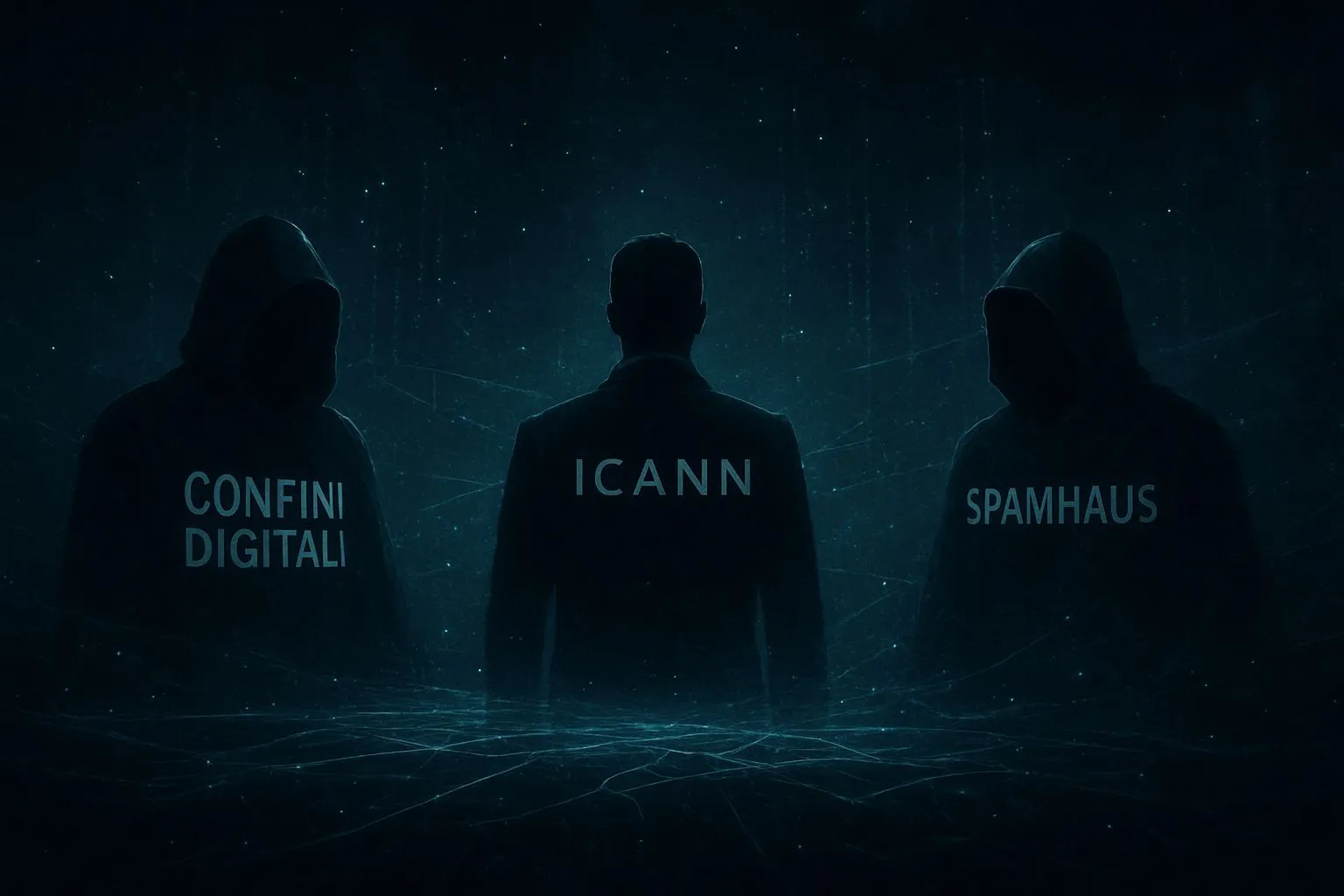
In the heart of the first decade of 2000, a seemingly minor judiciary shred the veil on the intricate dynamics of power and jurisdiction that support the global Internet infrastructure. The dispute between email marketing company e360insight and anti-spam organization Spamhaus, culminated in an attempt to order ICANN to turn off the Spamhaus.org domain, acted as a real stress test for the principles of digital governance, revealing the deep tensions between national sovereignty and the transnational nature of the network. At the time, in 2006, many gave for granted the ability of the courts to impose their will on any entity operating within their judicial boundaries, but the Internet was already demonstrating to operate according to much more fluid and complex logic and boundaries. This confrontation was not only about injunction or damage; it was a battle on authority, the limits of judicial power in a world without physical boundaries, and the same resilience and decentralization that define the Internet. The case forced ICANN, the body responsible for the domain name system (DNS), to publicly declare its inability and lack of authority to act as an executive arm of an American court to suspend a domain registered by a Canadian company. This position has raised fundamental questions about those who hold the true power to control digital identities and how terrestrial laws may or may not bend the will of a global infrastructure like the Internet. The echo of that debate still resounds today, while new challenges of jurisdiction, censorship and digital governance continue to emerge with prepotence in the age of artificial intelligence and proliferation of cyber threats.
The E360insight vs. Spamhaus: An Angolan Stone of Internet Governance
The episode that has seen contrasts e360insight and Spamhaus was not a mere legal beating, but a real corner stone e360insight, an email marketing company, felt disappointed by the inclusion in the Spamhaus blacklists, a non-profit organization dedicated to the fight against spam, labelling it as a “ fanatical and vigilant organization”. The controversy resulted in a lawsuit filed in a state court of Illinois, a move reflecting the belief that local laws could extend to global entities. However, Spamhaus, with a strategic move that underlined its understanding of the transnational nature of the Internet, decided not to defend itself in court in the United States, claiming the lack of jurisdiction of the American courts on a matter concerning an organization based outside the U.S. and whose activity was inherently global. This decision led to a judgment of over $111 million against Spamhaus, ordering to remove e360insight from its blacklists. Spamhaus's response was even more decisive: ignoring the sentence, declaring it unenforceable. This stubborn resistance by an anti-spam non-profit organization has revealed their deep conviction in the autonomy and necessity of their work, which they considered above national jurisdictions. The audacity of Spamhaus in questioning the authority of an American court triggered a chain reaction that directly involved ICANN, leading to the proposed order to suspend the Spamhaus.org domain. This event has transformed a commercial dispute into an emblematic case on the limits of state power on the global Internet infrastructure, a precedent that would influence the debate on digital governance for years to come. The stake was incredibly high: not only the survival of Spamhaus, but also the stability and functionality of an entire global network that relied on its blacklists to filter billions of spam messages every day, a figure that highlighted the critical role of these non-state actors in safeguarding network cleanliness.
ICANN and Power Limits: When the Authority Meets the Global Network
The request to ICANN to act as a court executive arm in the dispute between e360insight and Spamhaus was a critical moment, questioning the perception of his power and authority over the global network. ICANN, theInternet Corporation for Assigned Names and Numbers, is responsible for coordinating the unique Internet identifiers, including domain names and IP addresses. Its main function is to ensure the stability and security of the DNS, the system that translates man-readable domain names into numerical IP addresses. However, its authority does not extend to censorship of content or arbitrary suspension of domains based on local legal disputes. ICANN responded to the order proposed with a firm statement: “can not conform” to this request, nor to any other order which requires it to suspend a specific domain name, since “it has neither the capacity nor the authority to do so”. This declaration was not an act of challenge, but a lucid delimitation of its powers, rooted in its operational and contractual structure. ICANN does not directly manage the domain names of individual users; it does so through a delegate network of registrar (such as Tucows, in the case of Spamhaus) and registry. Its role is to coordinate these actors, establishing rules and policies, but not to intervene directly in the contractual relations between recorder and registrant. The tension between the jurisdiction of a national court and the global mandate of ICANN highlighted one of the biggest challenges of Internet governance: how to apply the laws of a state to an infrastructure that by its nature transcends borders. If ICANN had given the order, it would have established a dangerous precedent, exposing the entire network to potential requests for censorship or interruption by courts around the world, risking the stability and interoperability of the Internet. This situation forced me to reflect on the real nature of ICANN’s power, not as an almighty central authority, but as a crucial coordinator working within a complex ecosystem of stakeholders, each with well defined roles and responsibilities. Its position has strengthened the decentralization principle which is the basis of the Internet's operation, although it has created an intense debate on its real autonomy and its ability to resist political and legal pressure.
The Delicate Architecture of DNS and the Role of the Recorders in the Suspension of Dominions
To fully understand the position of ICANN in the Spamhaus case, it is essential to enter the complex and stratified architecture of the Domain Name System (DNS), the invisible pillar on which the whole Internet is held. DNS is not a monolithic entity, but a hierarchical and distributed system that operates through different levels of authority. At the top is the Root Zone, which is ultimately managed by ICANN, which delegates first-level domain management (TLD, such as .com, .org, .net) to the registry. These registry, in turn, authorize registrars, companies like Tucows, to sell and manage domain names on behalf of end users, registered users. The relationship between the register and the registrar is of a contractual nature: the registrar is the entity with which the owner of the domain has a direct relationship and which holds the administrative control of the domain. It is this contractual relationship that gives the registrar the technical power and the practical authority to suspend or transfer a domain, in accordance with the policies established by the registry and ICANN, and with the applicable laws. When ICANN declared that he had no power to suspend Spamhaus. org, he was underlining that, while being the ultimate DNS coordinator, operating control over a specific domain falls on the registrar. In the case of Spamhaus, the registrar was Tucows, a Canadian company. This geographical detail was not insignificant; it made the application of the order of an extremely problematic American court. An American court should have obtained the execution of the order in Canada, a notoriously complex and often unsuccessful process due to differences in legal systems and principles of international jurisdiction. The “passing the ball” at Tucows was not a mere expedient for ICANN, but a statement of how the system actually works, highlighting the decentralization of operational responsibility. If government agencies or tribunals could bypass this facility to order ICANN directly to suspend domains, it would create a dangerous precedent that would reduce DNS stability and predictability. Each jurisdiction could attempt to impose its own will, transforming the Internet into a mosaic of disconnected legal enclaves. The resilience of the Internet, largely, derives from this distributed architecture and the clear (uncomplicated) sharing of responsibilities, which prevents a single failure point or a single authority from controlling or blocking the entire network. The episode then served as a reminder of the delicate institutional and technical engineering that protects the global openness and functionality of the network, and how every attempt to subvert it can have far-reaching consequences on its integrity.
War at Spam: Evolution, Strategies and Blacklist Ethics
The dispute between e360insight and Spamhaus was rooted in the perennial and complex battle against spam, a phenomenon that, from 2006 to today, has undergone a profound evolution. At the time, spam was mainly voluminous and annoying; today, it turned into a more sophisticated and targeted threat, which includes phishing, malware, ransomware and social engineering campaigns. Spammer techniques have refined, using botnets, compromised domains and waste tactics to evade filters. In this changing context, the role of organizations such as Spamhaus has remained crucial, if not even more relevant. Spamhaus and other similar entities operate as independent sentinels, maintaining blacklists of IP addresses, domains and senders known for sending spam. These lists are used by Internet service providers, companies and individuals to filter unwanted mail before it reaches user mailboxes. Their effectiveness lies in the rapid identification and blocking of new threats, often faster than reaction times of law enforcement or government regulations. However, the label of “surgent organization” affixed to Spamhaus by e360insight was not deprived of a fund of truth and raised important ethical and governance issues. As private entities operating outside a formal legal framework, blacklists can be perceived as devoid of a fair process, transparency or effective remedies for those who believe they have been mistakenly included. The impact of an incorrect classification can be devastating for a company, paralyzing its communications and reputation, as e360insight claimed. The balance between the need to protect users from spam and the guarantee of fair treatment for legitimate senders is a constant challenge. The legitimacy of blacklists is largely based on their accuracy and perception of impartiality. Some blacklists, in fact, offer removal or appeal processes, but these can be slow and honest. The ethical issue is acute when anti-spam organizations act as de facto arbitrators of email traffic, exercising a significant power without the supervision or responsibility you would expect from a state authority. This ambiguity has stimulated the debate on blacklist regulation and the creation of industrial standards that can ensure both the effectiveness in the fight against spam and the protection of the rights of legitimate senders, a discussion that continues to evolve as the e-mail remains a primary carrier of communication and cyber attacks.
Digital judgment: The Challenge of Applying National Laws to an Internet Without Confinitions
The Spamhaus case has dramatically highlighted the complex challenge of digital jurisdiction, or the difficulty of applying national laws to an intrinsically global phenomenon such as the Internet. Spamhaus’s decision not to appear in an American court, claiming the absence of jurisdiction, was not an act of arrogance, but a legal strategy based on the principle that an entity that has no significant physical presence or direct economic activity in a given territory should not be subject to its laws. This concept, known as 'personal jurisdiction' or 'long arm judgment', has traditionally been linked to geographical factors and physical presence. The Internet, however, has dissolved these boundaries, potentially making a website or service accessible from anywhere in the world, greatly complicating the determination of jurisdiction. Since 2006, international jurisprudence has sought to evolve, developing new criteria such as "intentional tax" or "voluntary business" in a given jurisdiction, but the solution remains elusive. The challenge is twofold: on the one hand, how to protect citizens and local businesses from cross-border damage (such as spam or online defamation); on the other, how to prevent a single jurisdiction from imposing its laws to the rest of the world, suffocating the freedom and innovation of the network. If each country could impose its laws on any accessible website within it, it would create a cascade effect of contradictory regulations, making it impossible to operate on a global scale. This scenario, sometimes referred to as "balcanization of the Internet" or "cyber-survity", threatens the principles of interoperability and universality that are the basis of the success of the network. The Spamhaus case has prefigured a series of subsequent disputes, such as legal battles on the removal of online content (think about the “right to oblivion” in Europe or the requests for removal of diffamatory content), where national courts collide with the global nature of digital service providers. These situations continue to highlight the need for cooperative solutions and international agreements to address jurisdiction issues rather than isolated attempts to impose the law of a single State. The lack of a uniform global legal framework forces companies to navigate a labyrinth of potentially conflicting laws, while governments struggle to assert their authority without compromising the open and global nature of the Internet.
The Future of Internet Governance: Between State Sovereignity and Multi-Stakeholder Models
The debate on the Spamhaus case in 2006 laid the foundations for a wider and more persistent discussion on future of Internet governance, a constantly evolving field where the tension between state sovereignty and multi-stakeholder models remains a driving force. While nation states legitimately seek to protect their interests, national security and the rights of their citizens online, the intrinsically global nature of the Internet requires a collaborative approach that involves not only governments, but also the private sector, the technical community and civil society. ICANN, as a multi-stakeholder organization, is a striking example of this model, where decisions are made through a consensus process that seeks to balance different interests. However, its authority is often put to the test by governments who would like greater control over aspects such as censorship, surveillance and data management, reflecting a growing trend towards "cyber-substance". The Spamhaus case has anticipated these conflicts, demonstrating how a local judicial order can collide with the logic of a global system. Since then, we have witnessed the emergence of new threats and challenges, such as the regulation of artificial intelligence, the fight against disinformation, the protection of data privacy (with laws like the European GDPR) and the management of increasing threats to cybersecurity. Each of these areas requires a complex governance that cannot be effectively managed by a single state. Forums such as the Internet Governance Forum (IGF) have become crucial platforms for dialogue, but their recommendations are not binding, leaving room for fragmented solutions. The future will probably see a continuous iron arm among those who advocate a free and open Internet, governed by multi-stakeholder principles, and those who seek to exercise greater state control, often invoking public security or morality. The challenge is to find a balance that takes innovation and global connectivity while guaranteeing responsibility and protection against abuse. The adaptability of governance models, the ability to incorporate new technologies and respond to emerging threats, will be fundamental. Spamhaus's lesson is clear: no actor, whether it is a court, a government or a technical organization, can act in isolation if you want to maintain the stability and functionality of the Internet. International cooperation and the development of shared standards are the only way to navigate the complexity of digital governance, ensuring that the Internet continues to be a global resource for all.
Lesson Apprese and Resilience of Digital Ecosystem
The e360insight case against Spamhaus, while dating back almost two decades ago, continues to offer deep lessons sulla natura e la resilienza dell’ecosistema digitale, lezioni che sono diventate ancora più pertinenti nell’attuale panorama tecnologico. La prima e più evidente lezione è la conferma della natura decentralizzata e distribuita di Internet. Nonostante i tentativi di un tribunale di esercitare un’autorità monolitica, la rete ha dimostrato la sua capacità di resistere a interventi centralizzati grazie alla sua architettura intrinsecamente stratificata e interconnessa. Il rifiuto di ICANN di cedere all’ordine e la sua spiegazione dei limiti della sua autorità hanno rinforzato il principio che nessun singolo attore può facilmente spegnere o controllare una parte sostanziale di Internet senza il consenso o la collaborazione di numerosi altri attori indipendenti. Questo elemento di decentralizzazione, se da un lato rende più difficile l’applicazione di singole leggi nazionali, dall’altro è una garanzia fondamentale per la libertà di espressione e la stabilità operativa della rete su scala globale. Una seconda lezione riguarda l’importanza degli attori non statali, come Spamhaus, nel mantenimento della funzionalità e della sicurezza di Internet. Queste organizzazioni, spesso operanti come «guardiani» informali, colmano le lacune lasciate dalle leggi o dalle risposte ufficiali, fornendo servizi essenziali per l’igiene digitale della rete. Il loro ruolo, benché talvolta controverso per le implicazioni etiche e di processo, è innegabile nel proteggere gli utenti da una miriade di minacce. Il caso ha sottolineato la necessità di riconoscere e integrare questi attori nell’ampio quadro della governance di Internet, pur cercando meccanismi per garantire responsabilità e trasparenza. Infine, la disputa ha messo in evidenza la continua e crescente tensione tra i principi di sovranità nazionale e la natura transnazionale di Internet. Questo è un dibattito che non è affatto risolto, ma che si è intensificato con l’aumento delle minacce informatiche, la diffusione di notizie false e la necessità di regolamentare le nuove tecnologie come l’intelligenza artificiale. I governi cercano sempre più di estendere la loro autorità al di là dei confini fisici, mentre la comunità globale di Internet lotta per mantenere la rete aperta e interoperabile. Il caso Spamhaus è stato un campanello d’allarme, spingendo a una maggiore consapevolezza delle sfide legali e politiche che il mondo digitale avrebbe continuato a presentare. La sua eredità risiede nella sua capacità di averci costretto a confrontarci con questioni fondamentali sull’autorità, la giurisdizione e la natura stessa del controllo nell’era digitale, promuovendo un dialogo continuo su come bilanciare la libertà, la sicurezza e la governance in un mondo sempre più interconnesso.


