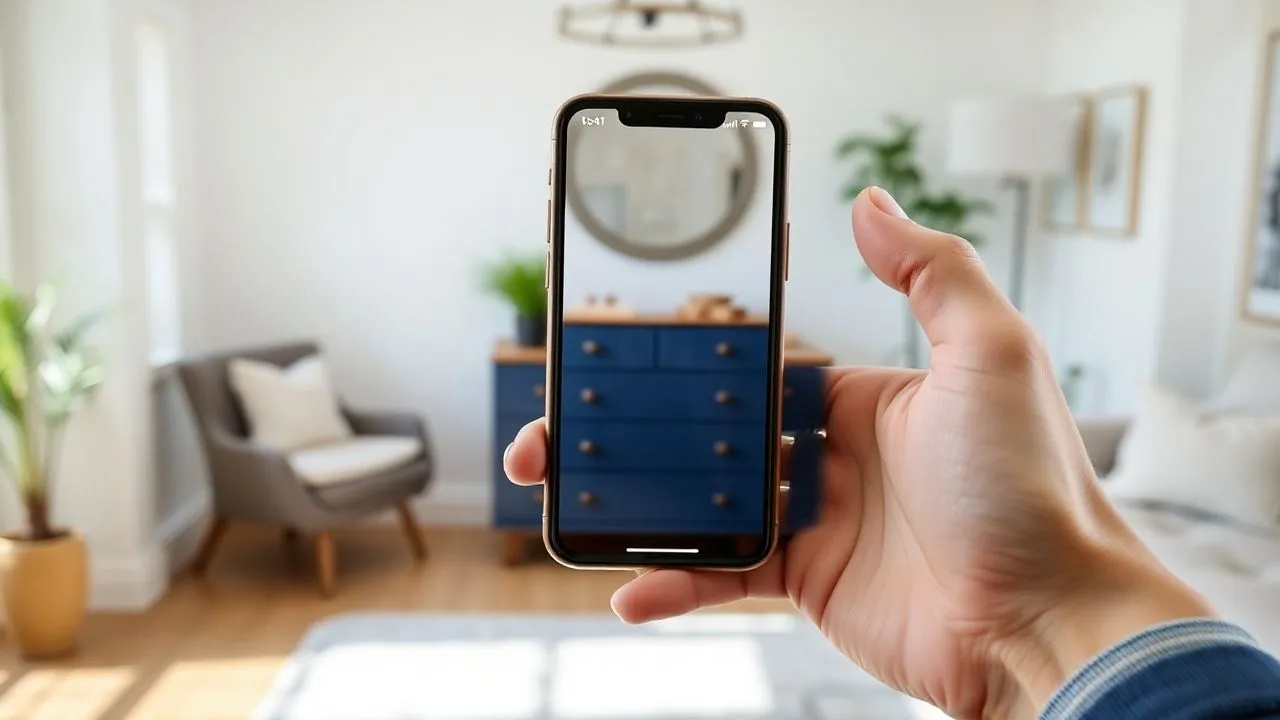
In 2026, the desire to renew domestic environments has become an increasingly felt trend, driven by the need to live in spaces that reflect our personality without necessarily having to invest exorbitant figures in new furniture. Often, the most effective and sustainable solution does not reside in the purchase of new products, but in giving a second life to what we already own. However, fear of making an irreparable mistake during a DIY restyling project is the main obstacle for many interior design enthusiasts. In this context the use of a app to change color to furniture, a fundamental digital tool to display the final result before even opening a paint can. These applications, thanks to the advances of artificial intelligence and augmented reality, allow to simulate with extreme realism how an old wooden cabinet can turn with a green sage opaque finish or how a dated kitchen can shine with a touch of blue whale. In this detailed guide, we will explore the best technological solutions available for free, analyzing how to transform your smartphone into a powerful design lab to avoid aesthetic repentance and optimize your home budget.
The value of digital restyling in virtual decor
Economic and sustainability savings in interior design
Using an application to simulate the chromatic change of its furniture is not only a style exercise, but a strategic choice that directly impacts the portfolio and the environment. In today's panorama of 2026, the concept of circular economy applied to the house took over. Instead of disposed of furniture still structurally valid, the recovery through painting allows to save up to 80% compared to the purchase of a new piece. The simulation phase through virtual furniture is crucial: it allows to test endless combinations without wasting samples of physical paint, which often end up being thrown away by increasing the environmental impact. Thanks to these apps, it is possible to understand whether that particular anthracite grey tone we have seen in a magazine really fits the brightness of our room or if, on the contrary, risks to excessively locating the environment, allowing us to make targeted and aware purchases once you arrive in color factory.
In addition to material savings, the value of time must be considered. A painting project requires preparation, sanding and different colored hands; to realize in half the work that the chosen shade does not match the floor is a nightmare that every DIY lover wants to avoid. Modern applications offer increasingly precise color sampling algorithms, capable of taking into account natural shadows and textures of wood or metal. This means that the digital projection we display on the screen is now extremely faithful to what will be physical reality. Invest a few hours in the digital design phase with a good app to change color to furniture means guaranteeing an aesthetic success that will enhance the entire property, potentially increasing its market value in case of future sale or rent.
View the final result to avoid aesthetic errors
Uncertainty is the main enemy of interior decoration. Many users give up bold colors for fear that the final result is too “heavy” or out of place compared to the existing context. The possibility to preview the furniture inserted in its real environment, surrounded by walls and other objects, is an invaluable advantage that only technology can offer. Through the screen, we can evaluate the contrast between a recolored table and the surrounding chairs, or understand whether the new color of the kitchen doors dialogues correctly with the marble or quartz worktop. This visual preview drastically reduces decision-making stress, transforming a potential risk into a fun and anxieties-free creative path, typical of the modern furniture make you.
In addition, these applications allow you to easily share projects with family members or industry professionals. If you are undecided between two shades of blue, you can generate a quick render and send it via message to get a second opinion. This collaborative approach to domestic design has become the standard, allowing to harmonize the tastes of all the inhabitants of the house before proceeding with definitive interventions. The precision achieved by the software in 2026 allows to distinguish between different finishes, such as gloss, satin or opaque, offering a tactile-visual perception that until a few years ago was unthinkable for free consumer applications. The democratization of these tools has made interior design an activity accessible to anyone who owns a mid-range smartphone.
Change Color: the intuitive solution for Android and iOS
Loading images and selection tools
Change Color is also confirmed in 2026 as one of the most appreciated applications for its immediacy and learning curve almost nothing. Available for both Android and Apple users, the app makes simplicity its main strength. The process begins with the loading of a photo: the user can choose to take a photo at the moment, ideal for capturing the current natural light, or tap from the device gallery or cloud services like Google Photos. This flexibility is essential for those who want to work on their own projects mobile home painting at different times of the day. Once the image is imported, the interface guides the user to the brush tool, which represents the button heart of the editing experience.
The real magic happens in the color selection. Pressing on the icon of the palette opens an infinite chromatic universe where you can create the desired shade, adjusting saturation, brightness and tones. Once the virtual pigment is defined, the user proceeds to “paint” with the finger on the surface of the furniture displayed in the photo. Although it looks like a manual operation, the app integrates edge recognition systems that help keep the color inside the perimeters of the object. This direct interaction method makes the user an active protagonist of the transformation, allowing to test partial changes, such as coloring only the drawers of a dresser leaving the rest of the natural structure, a design technique very popular in recent times to create unique and dynamic pieces of furniture.
Refine details for a professional simulation
To achieve a result that doesn't look like a simple design superimposed to a photo, Change Color offers very effective finishing tools. The zoom “pinch-to-zoom” allows you to enlarge the details more minutes, such as knobs, hinges or wood carvings, ensuring that the digital color is applied with millimeter precision. If the finger slips over the edges during the drafting phase, the rubber tool quickly intervenes to correct the drooping. It is this attention to detail that transforms a simple draft into a real preview color furniture credible. The ability to change the size of the tip of the brush allows you to quickly cover large surfaces or to devote yourself patiently to the most complex profiles.
At the end of the creative process, the application offers different export options. Save the project in common formats such as JPG or PNG ensures maximum compatibility for future display or printing. Many users use these images saved to show them directly to the paint dealer, facilitating the search for the physical color more similar to that created digitally. Despite the presence of advertisements, necessary to maintain free service, the user experience remains smooth and non-interruptive, making Change Color a primary choice for those looking for a quick solution without having to subscribe expensive subscriptions or learn complex photo editing software. It is the perfect tool for those who approach the world of retouching photo furniture for the first time.
- Simplified user interface ideal for beginners.
- Brush tool with intelligent edge recognition.
- Customizable color palette with millions of combinations.
- Advanced zoom function for control of the smallest details.
- Possibility to export high resolution projects for free.
PhotoRoom: artificial intelligence applied to furniture
Removing the background and insulation of the object
If you are looking for a more technological and automated approach, PhotoRoom represents excellence in the field of retouching photo furniture assisted by artificial intelligence. Unlike other apps that require manual intervention, PhotoRoom is able to scan the image and instantly identify the objects present. When you upload the photo of an armchair or a sideboard, the algorithm separates the object from the rest of the room with surgical precision. This functionality is particularly useful when you want to change not only the color of the furniture, but also see how this would go back against a neutral background or a wall of another color, offering an overview of the interior design project.
PhotoRoom's 2026 version has further refined its ability to manage flowing shadows and reflections, making the isolated object extremely natural in its new digital context. Once artificial intelligence has finished segmentation, the user can interact with the various “levels” of the image. You can specifically select the mobile and access the Color section, where you can change the primary and secondary parameters. This distinction is essential for furniture composed of multiple materials, such as a chair with metal structure and seat in fabric, allowing you to experience complex chromatic combinations in a few touches. The power of this interior design app resides in its ability to process complex tasks in a few seconds, leaving the user only the fun part of aesthetic choice.
Advanced editing and original design mode
In addition to the simple color change, PhotoRoom offers a suite of editing tools that allow you to adjust the appearance of the furniture at different points of view. You can change saturation, brilliance and even add blur or artificial shading effects to give depth to the image. However, for those who want to maintain the real context of their home, the “Original Mode” is the most indicated. In this mode, the app does not remove the background but concentrates exclusively on the color modification of the identified elements, allowing you to see the recolored furniture exactly where it is, surrounded by everyday objects. This ensures an incredibly realistic and reliable final result perception.
While many advanced features are enclosed in a paid Pro version, the free version of PhotoRoom remains extremely generous and functional for domestic purposes. Standard export is sufficient for personal evaluations and quick sharing. Using this app radically transforms the way we conceive mobile home painting, bringing a level of professionalism that was once reserved only for experts directly in the hands of the common user. The speed with which it is possible to generate dozens of variants of the same furniture allows an unprecedented creative exploration, encouraging more courageous and modern stylistic choices that can radically transform the atmosphere of an entire room.
Other popular interior design applications
Creative editing with Picsart and Color Pop
In the vast ecosystem of mobile photo editing applications, Picsart occupies a prominent place thanks to its versatility. It is not born as a specific app for furniture, but its color replacement tools are among the most powerful available on the market. Using the “Replace Color” function under the Effects menu, you can select a specific color on the surface of a mobile and turn it into another simply by moving a slider. This approach is extremely useful for furniture with solid and well defined colors, as it allows a global and homogeneous transformation in a few moments. Picsart also offers the possibility to add textures, allowing for example to simulate not only a change of color, but also the effect of a wallpaper applied on the doors of a closet.
Another interesting alternative is Color Pop, which adopts a more artistic and focused approach. This app allows you to convert the entire photo in black and white, leaving in color (or recoloring ex novo) only the element of interest, as a furniture. This “splash” effect is very useful to visually isolate the object of restyling and understand how much chromatic weights inside the room. Although some features are related to viewing ads or small payments, the flexibility offered makes it a very good ally in the process of virtual furniture. The possibility of working on individual details allows to create very suggestive previews that help to focus attention on the quality of the finish that you intend to get.
Apple-specific solutions: Color Changer
For users loyal to the iOS and iPadOS ecosystem, Color Changer is a “light” solution and exclusively dedicated to color change of objects. Its interface is optimized for use with Apple Pencil on iPad, making precision work on furniture contours an almost professional experience. The application is based on a very direct principle: select the color and apply it. There are no complex menus or dozens of useless filters; everything is aimed at achieving a fast and reliable color simulation. This makes it the preferred choice by those who do not want to waste time navigating between a thousand options but needs an immediate visual response to their aesthetic doubt.
The advantage of these smaller applications compared to industry giants is often the speed of execution and the least consumption of device resources. Color Changer, in particular, is known for its stability and ability to manage high resolution photos without slowing down. For a user who is in front of a mobile device in a used market and wants to decide in a few seconds if buying it and then repainting it, having a app to change color to furniture so fast makes the difference between a deal caught on the fly and a missed opportunity. Technology, in this case, becomes a real-time decision-making support that enables new forms of conscious and creative purchasing.
- Download the app chosen from the official store of your device.
- Take a picture of the furniture with uniform lighting.
- Use the selection tool to define the area to recolor.
- Experience with different shades until you find the ideal one.
- Save the image and compare it with real paint samples.
Optimize photos for realistic results
The importance of natural light in simulations
Why a app to change color to furniture return a truly reliable result, the quality of starting photography is fundamental. Light is the element that more than any other influences the perception of color. The advice of professionals in 2026 is to take photos during the central hours of the day, preferably with a diffuse light (such as a lightly cloudy day) to avoid too sharp shadows or violent reflections that could deceive the algorithms of the app. A photo taken under an artificial yellow light will inevitably alter the perception of the new color, making it look different from how it will be applied physically on the surface of the furniture.
You also need to pay attention to the white balance of the camera. If the environment has strong chromatic dominants (e.g. a room with many green plants or red walls), the sensor may distort colors. Before proceeding with simulation through your interior design app, make sure the colors in the original photo correspond as much as possible to what you see with your eyes. Some advanced applications allow you to adjust the color temperature of the image before starting virtual restyling; taking advantage of these preliminary functions will ensure that the green oil you have chosen remains such and does not turn towards unwanted shades once you have saved the project.
Corners and perspective for consistent design
In addition to light, perspective plays a key role in the success of a digital simulation. Taking a photo too close to the furniture or an unusual angle can distort proportions and make it difficult to assess how the new color interacts with the rest of the furniture. The ideal is to be positioned at a man’s height and resume the furniture frontally or with a slight angle of three quarters, including a part of the floor and the surrounding wall. This gives the eye (and application) the necessary references to contextualize chromatic change, making thepreview color furniture much more effective and convincing.
It is also useful to take several photos from various points of the room. A recolored furniture could look beautiful if seen from the entrance, but be too impacting if observed by the sofa. Analyzing the project from multiple points of view helps to confirm the goodness of color choice. Remember that color never lives alone, but is always influenced by the neighboring elements. A painted lemon yellow sideboard will have a totally different effect if placed next to a blue curtain than a white wall. Using apps to test these spatial interactions is the secret to a successful restyling that transforms the house into a harmonious and balanced environment, worthy of a photo shoot of architecture.
From digital to real: choose the correct paint
Correspondence between pixels and physical pigments
Once you find the perfect color on your app to change color to furniture, the next step is to translate that digital code into a physical paint. This is often the most delicate moment. Smartphone monitors use RGB color space (light), while paints are based on physical pigments. Many modern applications include standardized color palette references such as RAL or NCS (Natural Colour System). If the app allows you, try to identify the color code closer to your digital selection. This will greatly facilitate the work of the color factory, which can accurately reproduce the nuance you so loved on the screen of your device.
However, it is always advisable not to blindly trust the only digital preview. Once the color is identified, buy a small test jar (tester) and apply it on a non visible part of the furniture or on a piece of waste wood of the same essence. The porosity of the material and the drafting technique (ring, roller or spray) can affect the final yield. Thepreview color furniture digital acts as a compass, indicating the correct direction, but the physical test remains the test of the nine final. This hybrid approach, which combines the speed of digital with the concreteness of the material, is the safest method to obtain professional results in domestic restyling, minimizing waste and disappointment.
Consider the finishes: matt, satin or glossy
One aspect that basic apps often struggle to simulate perfectly is surface finish, although in 2026 premium versions are very accurate. When you switch from simulation to purchase, you must decide whether your new paint will have to be matt (matte), satin or glossy. This choice will radically change the perception of color itself. A matt finish tends to absorb light, making the color deeper and soft, ideal for shabby chic or contemporary minimalist furniture. On the contrary, a glossy finish reflects the surrounding environment, making the color more vibrant and dynamic, perfect for accent pieces or modern furnishings that must stand out in a dark room.
Applications retouching photo furniture more advanced allow to overlay filters that simulate these different reflections. Trying digitally with the “lucidity” effect can help you understand whether a shiny black furniture is too aggressive or if an ultra-opac finish can give that touch of sophisticated elegance you look for. Never underestimate the impact of the texture: if the original furniture has deep veins of wood, these will remain visible even after painting (unless not using filler products), adding a level of visual complexity that the app may have simplified. Taking into account these factors ensures that the transition from digital dream to physical reality is devoid of unpleasant surprises.
Color is a power that directly affects the soul. Choosing the right shade for home furniture is not only an aesthetic issue, but an act of care towards your everyday well-being.
- Always request the color code RAL or NCS corresponding to the simulation.
- Evaluate the purchase of paints specific to the material of the furniture (wood, laminate, metal).
- Consider the use of a final protective paint (transparent) to preserve the color over time.
- Remember that the ambient light of the room will change the perception of the color during the day.
Frequently asked questions
Are apps to change color to furniture really reliable?
Yes, in 2026 these applications have reached a very high level of precision thanks to the integration of advanced graphics engines and artificial intelligence. However, you should always consider that the color calibration of the smartphone screen may vary. They are excellent tools to define the direction of the project and discard wrong combinations, but it is always advisable to validate the choice with a physical sample before the final application on the mobile.
What is the best free app to start if I'm not experienced?
Change Color remains the best choice for those seeking absolute simplicity. It does not require registration and allows you to obtain immediate results simply “coloring” with your finger above the photo. If you want something more automated that recognizes the object alone, PhotoRoom is the ideal solution, even if the free version could present some restrictions in the export of images in the highest resolution, but for domestic use it is more than enough.
Can I use these apps to change the color of the walls?
Absolutely. Although this guide focuses on furniture, apps mentioned as PhotoRoom and Picsart work on image segments. You can easily select a wall instead of a closet and apply the same coloring techniques. Many users use these tools to create a coordinated project that includes both the restyling of furniture and the new color of the walls, ensuring perfect colour harmony throughout the room.
It is also possible to simulate the change of material, how to move from wood to marble?
Some advanced applications such as Picsart allow you to apply “texture” or “pattern” above the selected areas. Although it is more complex than the simple color change, with a little practice it is possible to overlay the image of a marble grain or a metallic effect to an existing furniture. This allows to evaluate even more radical changes, such as the renewal of a kitchen floor through the application of decorative adhesive films.
What permissions do these apps need to work properly?
Generally, these applications require access to the camera (to take real-time photos) and the multimedia gallery (to upload existing images and save finished projects). Some AI-based apps may require an active internet connection to process images on their servers in the cloud. It is always good to read the privacy policy, especially in free versions, to understand how the uploaded data and images are managed.
In conclusion, use a app to change color to furniture today represents the first fundamental step for anyone wishing to undertake a successful domestic renewal project and awareness. Thanks to the power of mobile technology, the risk of expensive errors has been drastically reduced, leaving room for free creativity and without boundaries. Whether you decide to use the simplicity of Change Color, PhotoRoom IA power or Picsart versatility, you will have a personal design consultant in the palm of your hand. You just have to photograph that old furniture that doesn't suit you anymore and start experimenting with light and color: the house of your dreams is within reach of click. Start your digital restyling project today and turn your home into a unique and regenerated place.


